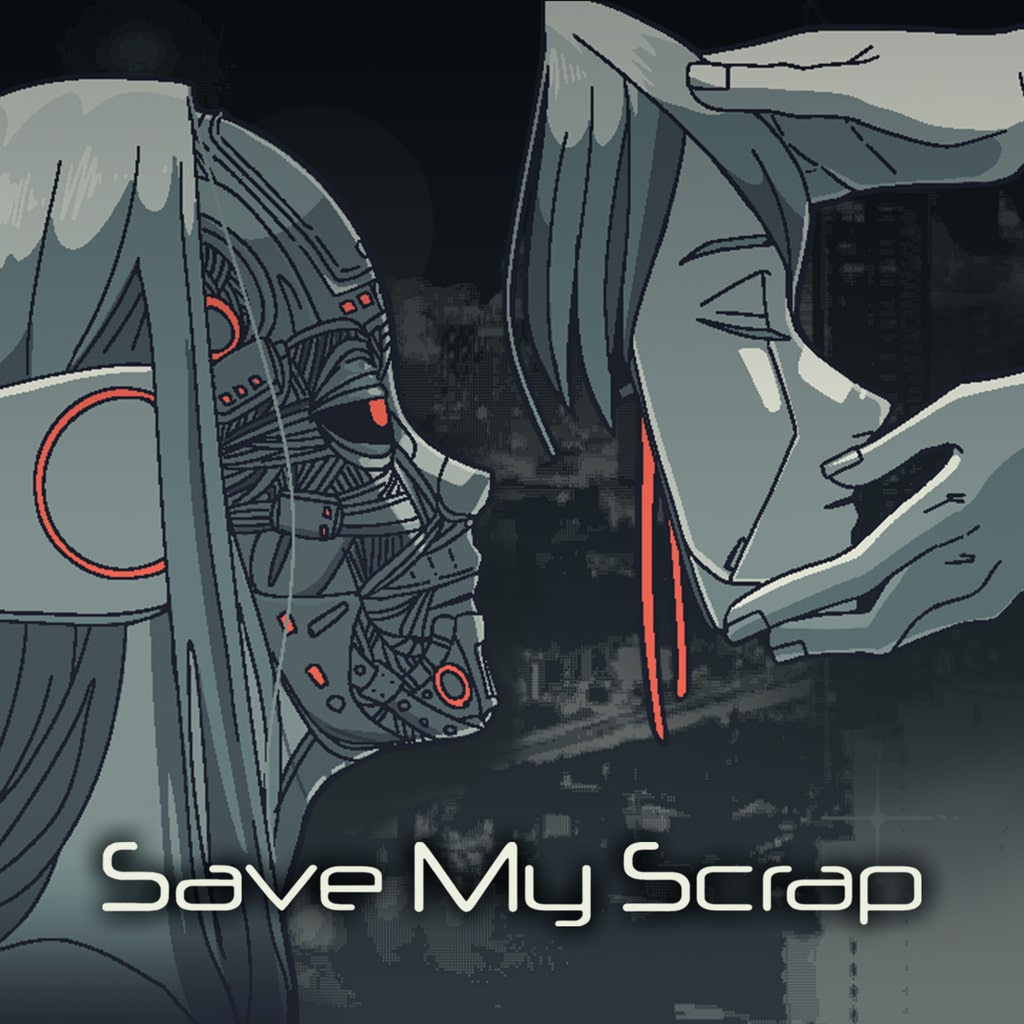
Save My Scrap begins with what feels like a straightforward assignment. You are an android mechanic, brought in to repair a malfunctioning unit named Harima. On paper, it is a routine job. Faulty wiring, outdated systems, a machine in need of careful attention. But very quickly, it becomes clear that nothing here is simple.
The android belongs to a doctor named Miomaru, and the relationship between owner and machine is layered with tension that is not immediately explained. The further you progress, the more the game begins to shift its focus away from mechanical repair and toward emotional reconstruction. What starts as a job slowly turns into something closer to a confession.
The Rhythm of Repair
At the core of Save My Scrap are its repair sequences. These are hands-on puzzle segments where you interact directly with the internal systems of Harima. You are not just selecting dialogue or watching scenes unfold. You are actively dismantling and rebuilding.
Circuits must be rerouted. Components replaced. Systems calibrated. It is deliberate, methodical work that demands attention but not speed. There is no pressure in the traditional sense. Instead, there is focus.
What makes these sections effective is not their complexity, but their repetition. The act of repair becomes familiar. Almost meditative. And as the story deepens, that familiarity begins to take on new meaning.
You are not just fixing a machine. You are repeatedly returning to something broken and trying, piece by piece, to understand why it does not stay fixed.
A Story That Refuses to Stay Mechanical
Between repair sequences, Save My Scrap unfolds through dialogue-heavy visual novel segments. These moments are where the game’s emotional weight begins to surface.
At first, conversations feel grounded in technical detail. Maintenance reports, system diagnostics, routine check-ins. But gradually, the dialogue shifts. Personal histories begin to surface. Fragmented memories bleed into present interactions. The line between machine and memory starts to blur.
The writing is careful with its reveals. It does not rush to explain. Instead, it allows meaning to accumulate slowly, through repetition and implication rather than exposition.
Miomaru and Harima’s relationship becomes the emotional centre of the experience, though it is never presented in a straightforward way. It is layered, complicated, and often uncomfortable in ways that feel intentional.
Machines as Memory Keepers
One of the most compelling ideas in Save My Scrap is how it treats machines as vessels for memory. Harima is not just a malfunctioning android. It is a repository of something larger, something human that refuses to stay buried.
As you progress, repairs begin to feel less like technical fixes and more like acts of excavation. You are not just restoring function. You are uncovering fragments of something that was never meant to be fully understood.
This is where the game’s thematic strength lies. It uses its mechanical systems to mirror emotional ones. Broken circuits reflect broken relationships. Restored functions hint at unresolved histories. And the more you repair, the more uneasy that process becomes.
Minimalism That Carries Weight
Visually, Save My Scrap is understated. It does not rely on elaborate environments or detailed spectacle. Instead, it focuses on clean, functional presentation that keeps attention on the characters and the repair interface.
That restraint works in its favour. It allows the emotional tone to take precedence without distraction. The simplicity of the visual design mirrors the repetitive nature of the gameplay, reinforcing the idea that this is a story about maintenance rather than transformation.
Sound design follows a similar philosophy. Subtle mechanical noises, quiet ambient tones, and restrained musical cues create an atmosphere that feels intimate rather than overwhelming. Nothing here is loud. But everything feels close.
The Weight of Repetition
The structure of Save My Scrap is built around repetition. Repair, conversation, reflection. Then repeat. At first, this rhythm feels steady. Even calming. But over time, repetition takes on a different quality. Each return to the repair interface feels slightly heavier than the last. Each conversation carries echoes of previous ones.
That repetition is not accidental. It is part of how the game builds emotional pressure. By asking you to perform similar actions repeatedly, it forces you to sit with the implications of those actions. There is no mechanical escalation in the traditional sense. Instead, the escalation is emotional.
Where Simplicity Becomes Limitation
While Save My Scrap succeeds in its thematic ambition, its gameplay does remain deliberately simple. The repair puzzles are engaging in their initial stages, but they do not evolve significantly in mechanical complexity over time.
For some players, that simplicity will enhance the experience, keeping focus on narrative rather than challenge. For others, it may feel underdeveloped.
There are moments where the game’s restraint risks becoming limitation rather than design choice. Particularly in longer sessions, the lack of mechanical variation can make the structure feel predictable. Still, it is clear that complexity was never the primary goal here.
Emotional Payoff Through Accumulation
What Save My Scrap does exceptionally well is emotional accumulation. It does not rely on single dramatic moments to carry its impact. Instead, it builds slowly, through repeated interactions, subtle revelations, and the gradual layering of meaning.
By the time the story reaches its later stages, earlier moments begin to recontextualise themselves. Conversations that once seemed routine take on new weight. Repairs that felt mechanical now feel symbolic. The result is a narrative that lands quietly, but firmly.
Final Verdict
Save My Scrap is a thoughtful and emotionally resonant interactive experience that uses simple mechanics to explore complex ideas about memory, repair, and human connection. Its strength lies in how it ties gameplay and narrative together, turning repetition into meaning and routine into reflection.
It is not a mechanically complex game, and it does not attempt to be one. Its focus is narrow, but deliberate, and that focus allows it to deliver a story that lingers long after it ends. For players willing to engage with its slower rhythm and understated presentation, it offers something quietly powerful.