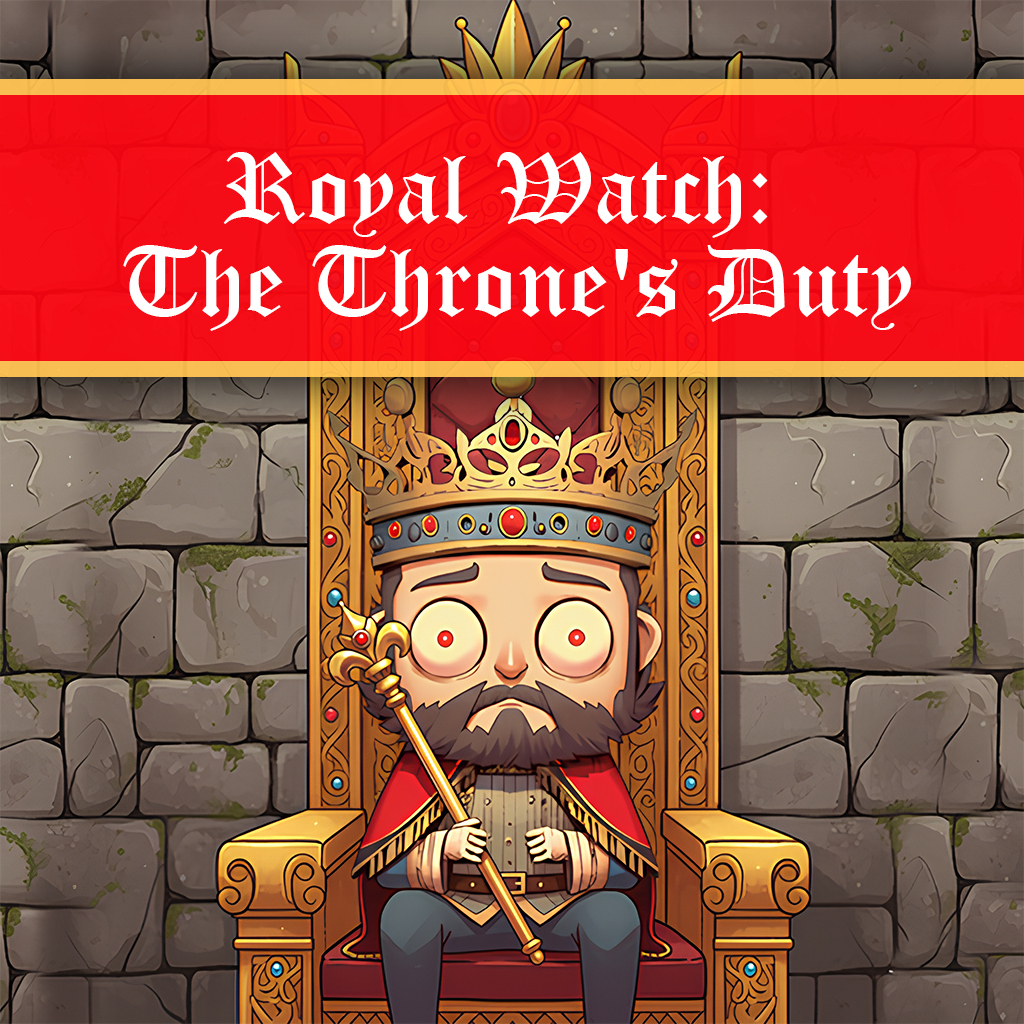
Royal Watch: The Throne’s Duty is a game built around an unusual but compelling premise: the defence of a kingdom not through conquest or grand heroics, but through observation, judgment, and responsibility. Rather than casting the player as a monarch, general, or legendary warrior, the game places them in the role of the Royal Watch — a position defined by duty, discretion, and constant vigilance. It is a concept that immediately sets Royal Watch apart from more traditional strategy and role-playing titles, and one that shapes every aspect of its design.
At its best, Royal Watch delivers a thoughtful, slow-burning experience about power exercised indirectly. At its weakest, it struggles to maintain momentum and mechanical variety. The result is a game that feels deliberate and distinctive, but also uneven in execution.
A Premise Rooted in Responsibility, Not Glory
Royal Watch: The Throne’s Duty frames its narrative around service rather than ambition. You are tasked with safeguarding the stability of the realm by monitoring threats, investigating disturbances, and advising the crown. Decisions are rarely dramatic in isolation, but their cumulative effects define the fate of the kingdom.
Storytelling is largely systemic rather than cinematic. Events unfold through reports, encounters, and subtle changes in the political and social landscape. There are no sweeping cutscenes or constant narrative reminders of your importance. Instead, the game trusts the player to infer meaning from outcomes: a rebellion quelled quietly, a conspiracy uncovered too late, or a crisis averted without public recognition.
This restrained approach gives Royal Watch a sense of maturity. It treats power as something burdensome and thankless, which aligns well with its thematic focus. However, the lack of strong character-driven storytelling may leave some players feeling emotionally detached, particularly those accustomed to more personal narratives.
Core Gameplay: Observation, Decision, Consequence
Gameplay in Royal Watch revolves around information management and decision-making. Players review intelligence reports, assign watch units to locations, investigate anomalies, and respond to emerging threats. Success depends less on quick reactions and more on pattern recognition, prioritisation, and long-term planning.
The game’s systems encourage caution. Resources are limited, and spreading the Royal Watch too thin can leave critical areas vulnerable. Conversely, focusing too narrowly can allow unseen dangers to grow. This tension creates a steady undercurrent of pressure, where every choice carries potential consequences.
Importantly, Royal Watch avoids binary morality. Decisions are rarely framed as “good” or “evil.” Instead, they are pragmatic judgments made under uncertainty. A harsh response may maintain order but fuel resentment. A lenient approach may preserve goodwill while emboldening rivals. These outcomes are not always immediately apparent, reinforcing the game’s emphasis on foresight rather than instant gratification.
Progression and Systems Depth
Progression in Royal Watch is subtle. Rather than dramatically increasing player power, advancement unlocks new tools for information gathering, expanded authority, and additional strategic options. This reinforces the idea that influence grows through trust and experience, not raw strength.
The depth of these systems is respectable, if not exhaustive. There is enough complexity to reward careful play, but the game stops short of true simulation density. Some mechanics feel underexplored, particularly those related to internal politics and interpersonal dynamics within the Watch itself. These elements hint at deeper systems that never fully materialise.
As a result, the mid-game can feel static. Once players understand optimal information flows and threat management strategies, the challenge becomes more about maintenance than adaptation. The game would benefit from greater systemic disruption to force players out of established routines.
Pacing and Structure
Royal Watch: The Throne’s Duty is unapologetically slow-paced. Events unfold gradually, and progress is measured in stability rather than conquest. This pacing supports the game’s themes, but it also demands patience.
Moments of tension — sudden crises, unexpected betrayals, escalating threats — are effective precisely because they interrupt long periods of routine. However, these moments are not frequent enough to sustain momentum throughout the entire experience. Extended stretches of administrative gameplay can feel repetitive, especially for players seeking more dynamic engagement.
That said, the game is at its strongest when viewed as a contemplative experience rather than a traditional strategy title. It rewards players who enjoy reflection, anticipation, and the satisfaction of quiet competence.
Visual Presentation and World Design
Visually, Royal Watch adopts a grounded, muted aesthetic. Environments are functional rather than lavish, reinforcing the idea that the Watch operates behind the scenes rather than in the spotlight. Maps are clear, interfaces are readable, and visual clutter is minimal.
Character design is understated, with uniforms and insignia taking precedence over individual flair. This supports immersion but limits visual variety. Over time, locations and scenes begin to blur together, reducing the sense of place.
The interface is clean and logical, though occasionally dense. Information is well-organised, but new players may find the learning curve steep due to limited tutorialisation. The game assumes a willingness to engage deeply with its systems rather than guiding the player step by step.
Audio Design and Atmosphere
Audio design is subtle and effective. Ambient sounds reinforce the sense of a living kingdom, while music is used sparingly to underscore moments of tension or consequence. The restrained soundtrack complements the game’s tone, avoiding melodrama in favour of quiet unease.
Sound effects are functional rather than immersive, but they provide clear feedback for player actions. Dialogue, where present, is concise and purposeful, reinforcing the game’s serious tone.
Accessibility and Audience Fit
Royal Watch: The Throne’s Duty is clearly aimed at a niche audience. Its slow pace, abstracted mechanics, and lack of overt spectacle make it unsuitable for players seeking immediate excitement or action-driven gameplay.
However, for players who enjoy strategic oversight, political nuance, and systems-driven storytelling, the game offers a distinctive experience. It is a title that values patience, observation, and restraint — qualities rarely prioritised in modern game design.
Final Verdict
Royal Watch: The Throne’s Duty is a thoughtful and unconventional strategy experience that explores power through responsibility rather than domination. Its focus on observation, consequence, and quiet decision-making gives it a unique identity, even if that identity limits its appeal.
While its systems lack the depth and dynamism to fully sustain long-term engagement, its thematic coherence and restrained design make it a compelling experience for the right audience. Royal Watch is not about glory or conquest; it is about standing watch, unseen, and bearing the weight of what might happen if you fail.
A deliberate and thematically rich strategy game that offers a refreshing perspective on authority and duty, but whose limited variety and slow pacing prevent it from fully realising its potential.