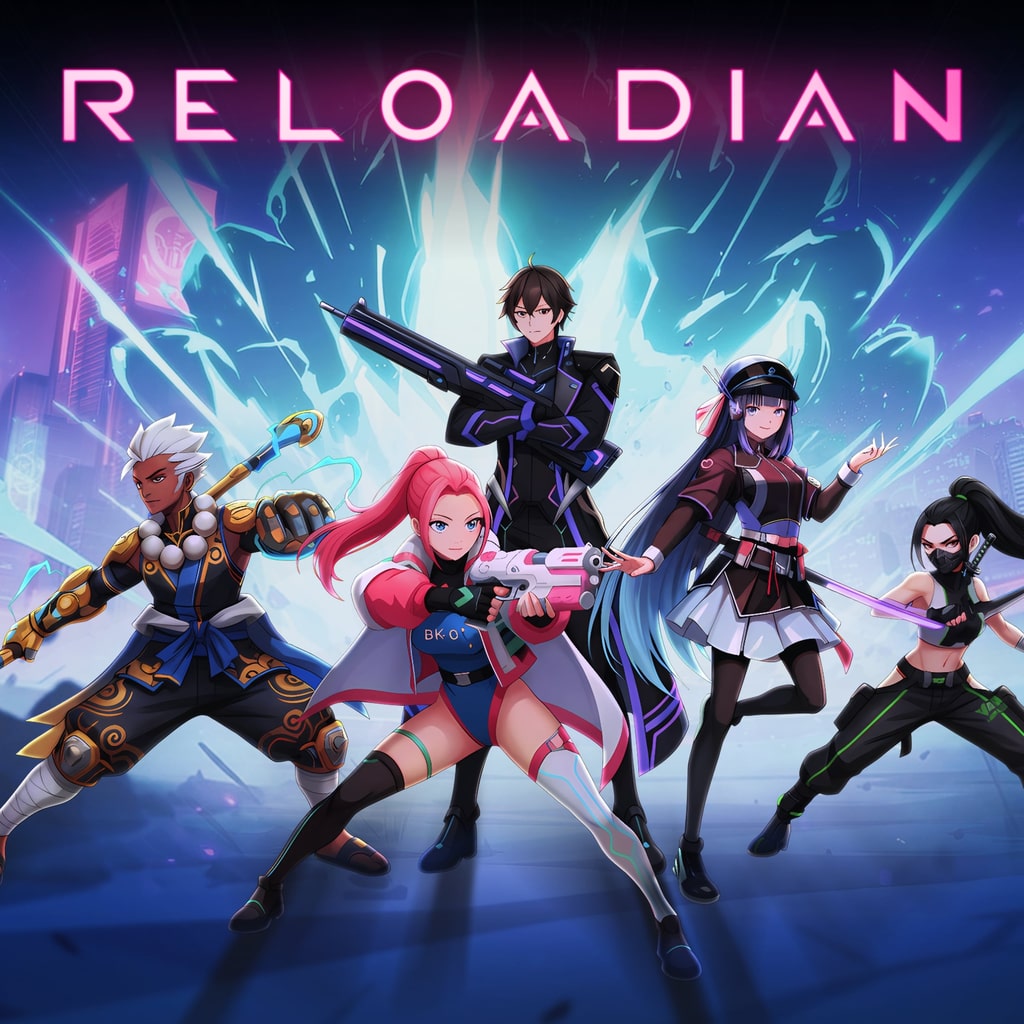
In a gaming landscape saturated with first-person shooters that chase ever-higher fidelity and escalating spectacle, Reloadian arrives as something idiosyncratic and refreshingly self-aware. This is not the next big AAA war epic or a sprawling narrative shooter; instead, it blends classic run-and-gun sensibilities with caricatured action and a stark, arena-focused structure that places emphasis on reflexes, resource management, and the joy of combat itself.
Over the course of several hours with the game, Reloadian reveals itself to be less about story and more about rhythm — the cadence of blasts, reloads, movement, and survival under pressure. It is a game that wears its influences on its sleeve while taking enough creative liberties to preserve its own identity. But while it scores high on pace and style, it sometimes stumbles in balance and depth, making it a title best appreciated in short bursts rather than as a marathon shooter experience.
First Impressions: Bold Presentation, Arcade Energy
From the moment Reloadian boots, its aesthetic signals a departure from realistic grit. The visuals are bold and vibrant, recalling days when texture detail took a back seat to expressive design and clear gameplay readability. Enemies, environments, and effects prioritise silhouette and motion over photorealism, a choice that serves the high-octane combat well. Levels pop with colour and feedback — muzzle flashes bloom, shockwaves ripple the terrain, and enemy deaths are punctuated with satisfyingly exaggerated animation.
Audio design reinforces this arcade leaning. Gunfire is punchy, synthesised beats drive the pace, and explosions land with that cartoonish snap that borders on catharsis. It’s not a symphonic score or a textured soundscape you might find in a story-driven shooter; it’s purposeful and energetic, perfectly tuned to the game’s combat focus.
This stylised approach lays the groundwork for the entire experience: Reloadian is a shooter built for immediacy and spectacle, a playground for rapid engagements rather than methodical pacing.
Core Gameplay: Bullet Ballet With a Twist
At its core, Reloadian is about three things: aim, movement, and reloads. You’ll traverse arenas packed with foes that vary in speed, firepower, and behaviour. Unlike traditional shooters where ammunition and reloading are often logistical considerations, here they are mechanically central. The reload mechanic is designed with a degree of nuance — timing, positioning, and prioritising when to reload under fire becomes a tactical decision rather than an afterthought.
Enemy encounters are fast and, at their best, feel like bullet ballet: waves of foes that approach with distinct rhythms and patterns, encouraging you to learn attack telegraphs and adapt on the fly. The knock-on effect is a combat loop that rewards anticipation and daring execution in equal measure.
Where the game excels is in the feel of combat. There’s a satisfying tactile quality to lining up shots, evading incoming fire, and chaining enemy kills with a well-timed burst. Particle effects, camera shakes, and audio feedback combine to make each minute of action feel weighty and impactful. Even when overwhelmed, the game rarely feels unfair — more like a puzzle of chaos to be mastered rather than a gauntlet designed purely to frustrate.
Weapons and Progression: A Mixed Arsenal
Reloadian presents a roster of weapons that range from traditional rifles and shotguns to more eccentric armaments. Each weapon handles distinctively: some excel in spread damage, others in precision shots, and a few come with quirky effects or cooldown quirks that encourage experimentation.
Early gameplay introduces this assortment gradually, letting players get accustomed to core mechanics before layering additional tools into their kit. This pacing works well in early chapters, but the later game reveals a subtle imbalance: certain weapons — particularly those with splash or area-of-effect damage — begin to overshadow others. When a particular armament becomes the de facto choice for most encounters, the sense of variety diminishes. In an ideal iteration, weapons would encourage more diverse loadouts rather than funneling players toward a handful of “meta” favourites.
Progression between waves or levels leans on unlocks and upgrades. Some of these feel rewarding; others feel perfunctory. While a handful of upgrades genuinely shift your approach (faster reloads, ammo regeneration traits), many serve as incremental boosts that are difficult to distinguish mid-combat. A clearer signal as to how stats affect performance might help players make more informed choices.
Level Design and Pacing: Momentum With Occasional Lulls
Arena layouts are generally compact and well-designed for the game’s combat focus. Enemies spawn from multiple vectors, encouraging movement and awareness rather than static “camp and spray” tactics. The flow from room to room — and encounter to encounter — keeps players on their toes, with difficulty ramps that feel measured rather than abrupt.
That said, pacing is not always consistent. There are moments in mid-game where encounters feel drawn out, with waves that either overstretch the player’s endurance or fall short of challenge. These fluctuations don’t break the experience, but they interrupt the rhythm that Reloadian otherwise strives to maintain.
Boss encounters attempt to punctuate momentum with heightened challenge, though they are a mixed bag. Some feel like masterclasses in pattern recognition, while others almost feel like recycled encounters scaled up in intensity rather than fundamentally redesigned. With tighter tuning and more unique mechanics, bosses could have done more to elevate the late-game experience.
Narrative and Presentation: Minimal Story, Maximum Focus
If there’s a narrative here, it’s subliminal — relegated to brief text blurbs between stages and a bare bones framing device. There’s no sweeping plot, no deep character arcs, and precious little context beyond “shoot, survive, repeat.” For players seeking story as a backbone, Reloadian may feel sparse.
But that’s also part of its identity. This isn’t a title trying to weave emotional sagas; rather, it is the digital equivalent of a stress-ball for trigger fingers. It wants you in the zone, locked into combat loops, not lingering over exposition.
Accessibility and Controls
On PC, controls are responsive and intuitive. Whether using mouse and keyboard or a controller, movement and shooting feel natural. Aiming is tight, and dodge mechanics (if present) are consistent. The options menu includes sensitivity settings, control remapping, and basic graphical toggles — not exhaustive, but sufficient for most playstyles.
Performance is stable even during frenetic encounters. There are no glaring frame drops or noticeable input lag, which is essential in a game where split-second reactions determine survival.
Final Verdict: Arcade Thrills With Some Rough Edges
Reloadian is not a revolution in first-person combat games, nor does it aspire to be. What it is — at its best — is a visceral, high-energy shooter that prioritises feel, pace, and moment-to-moment engagement. Its combat loops are engaging, visuals bold, and audio feedback satisfying. The focus on reload mechanics adds a twist that elevates it above generic “run-and-gun” fare.
However, imbalance in weapon viability, occasional pacing dips, and minimal narrative depth hold it back from true excellence. With more refinement in progression systems and encounter variety, Reloadian could easily stand shoulder-to-shoulder with more established arena shooters.