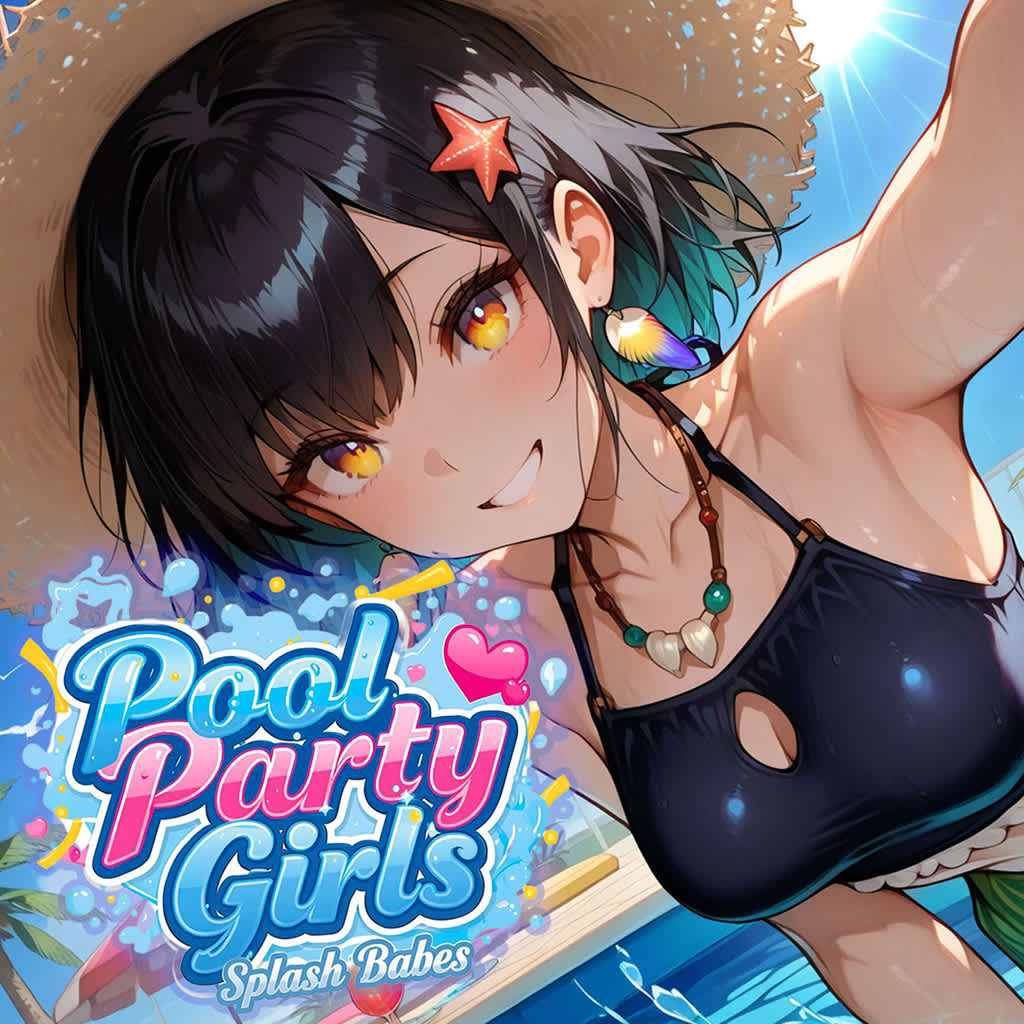
Some games arrive with grand ambitions, demanding your attention for dozens of hours, while others simply want to put a smile on your face for an afternoon. Pool Party Girls: Splash Babes firmly belongs in the second camp. Developed and published by Red Fables, this colourful little puzzle and visual novel hybrid is all about sunshine, swimming pools, anime characters and the sort of uncomplicated entertainment that asks very little of you beyond a willingness to have a bit of fun.
The premise is straightforward enough. You find yourself surrounded by a group of anime girls enjoying a summer pool party, and your job is to impress them by completing a series of quick mini-games. Every successful move earns more attention, and better scores unlock additional artwork. Your performance ultimately determines how your summer adventure concludes. It is hardly Shakespeare, but then again, nobody is pretending it is.
What Pool Party Girls: Splash Babes understands is that sometimes simplicity is exactly what people are looking for. There are no enormous skill trees to navigate, no complicated story arcs requiring pages of notes, and no punishment for wanting to put the game down after twenty minutes. Instead, it offers bite-sized challenges, colourful characters and a steady stream of rewards. Whether that is enough to keep you coming back depends very much on what you want from your games.
Making a Splash
The gameplay centres on a collection of short arcade-style challenges, with pattern-matching, timing exercises and quick-reflex puzzles at its heart. The individual activities are designed to be understood almost immediately, allowing you to focus on getting better rather than learning complicated control schemes. That makes Pool Party Girls: Splash Babes remarkably approachable, even for players who wouldn’t normally consider themselves puzzle game enthusiasts.
There is something quite pleasant about the immediacy of it all. You start a challenge, work out what the game wants you to do, and get straight into it. When you successfully complete a sequence or put together a good run, there is that little burst of satisfaction that comes from knowing you’ve done exactly what was required.
The problem is that the simplicity can work against the game after you’ve spent enough time with it. Once you’ve seen the various mechanics and worked out their basic patterns, there isn’t always much more to discover. The challenges become about repetition and improving your timing rather than mastering increasingly sophisticated systems, which means the appeal can start to fade if you’re looking for something with more substance.
The Girls Are Watching
Of course, the mini-games aren’t the main point. The anime cast is central to the experience, with each character designed to have a distinct personality and reactions. One might be the relentlessly enthusiastic cheerleader, while another is more easily embarrassed or surprised by your achievements. Their responses are intended to make your progress feel more personal than simply watching a score increase.
This works better than you might expect because the game doesn’t completely ignore the character side of the experience. The girls aren’t simply static images placed around a puzzle game. Their reactions create a sense that your performance is actually being noticed, which gives the otherwise straightforward challenges a little extra context.
There is also a nice sense of progression as you get to know the different personalities. The game encourages you to continue playing by dangling new interactions and images in front of you, creating a simple reward loop. It isn’t a sophisticated relationship system by any stretch of the imagination, but it serves its purpose within the game’s lightweight nature.
Unlocking the Gallery
The gallery collection is one of the main reasons to keep playing. Completing challenges and improving your scores unlock additional anime artwork, giving completion-minded players another reason to revisit stages they have already completed. For some players, that will probably be more motivating than the gameplay itself.
There is an old-school simplicity to this approach. Play the game, improve your score, unlock something new, and then have another go. It is a formula that has been used countless times, but it remains effective when the rewards are presented clearly and the process of earning them isn’t buried under unnecessary complexity.
The artwork is undoubtedly one of the game’s strongest attractions. The bright 2D anime presentation fits the poolside setting perfectly, with colourful characters and sunny backgrounds creating the sort of visual style you’d expect from a carefree, summer-themed release. It isn’t pushing artistic boundaries, but it doesn’t need to. Everything is clean, vibrant, and designed to make the experience feel cheerful.
A Summer Holiday in Pixels
Visually, Pool Party Girls: Splash Babes knows exactly what it wants to be. The poolside environments are filled with bright colours, the character artwork is clean and expressive, and the overall presentation has the glossy look associated with casual anime games. There is a pleasant consistency to the presentation that helps the whole thing hang together.
The soundtrack follows the same philosophy. Cheerful, tropical-inspired music accompanies the action, while bright sound effects provide feedback during the mini-games. Nothing here is particularly memorable once the console is switched off, but during play it creates the appropriate holiday atmosphere.
It is the kind of presentation that makes the game easy to pick up after a long day. You aren’t confronted with bleak landscapes, dramatic orchestral scores or an oppressive atmosphere. Instead, Pool Party Girls: Splash Babes feels like the gaming equivalent of putting on a pair of sunglasses, grabbing a cold drink and deciding that absolutely nothing serious is going to happen for the next hour.
How Deep Is the Pool?
Unfortunately, this is where the game begins to reveal its limitations. While the presentation and concept are perfectly pleasant, there simply isn’t much mechanical depth beneath the surface. The mini-games are entertaining in short bursts, but they don’t evolve enough to sustain serious long-term interest.
Difficulty does increase as you progress, with challenges becoming faster and introducing additional obstacles. That helps prevent the early stages from becoming completely trivial, but it doesn’t fundamentally change the experience. Once you’ve understood the underlying mechanics, you’re generally applying the same skills under slightly greater pressure.
For a casual game, that isn’t necessarily a deal-breaker. In fact, some players will appreciate the absence of frustration. There are no punishing consequences for failure, and the game doesn’t demand that you spend hours perfecting a single challenge before allowing you to move forward. The trade-off is longevity, and players looking for a substantial puzzle experience will probably reach the end of the pool rather quickly.
More Than Just a Pretty Picture?
The visual novel elements help break up the gameplay, although they aren’t substantial enough to turn the game into a traditional narrative adventure. The multiple endings do at least give your performance some consequence, encouraging you to pay attention to how well you’re doing rather than simply rushing through everything.
The promise of a hidden final moment also adds a little extra intrigue. Discovering something secret after putting in the effort is always a nice touch, particularly in a game that otherwise wears its simplicity proudly. It gives completionists something else to chase and helps make the final stages feel like they have a purpose beyond simply reaching the end.
Still, it would have been nice to see the character interactions developed further. There is plenty of potential in the concept, and more substantial dialogue, character-specific challenges, or deeper choices could have made the girls feel like genuine personalities rather than colourful rewards surrounding the mini-games. As it stands, the characters are enjoyable company, but the game rarely asks you to become particularly invested in them.
Final Verdict
Pool Party Girls: Splash Babes is unlikely to change anyone’s opinion of puzzle games, but that isn’t really the point. Red Fables has created something lightweight and accessible that knows exactly who it is aiming for. The bright anime artwork, simple mini-games and gallery rewards combine to create an experience that is easy to understand and even easier to dip into.
Its biggest weakness is also its most obvious characteristic. There just isn’t enough depth here to make the game particularly compelling over the long term. The mini-games are fun but basic, while the character interactions could have offered considerably more. Once the novelty of the poolside setting and gallery unlocks wears off, there isn’t much left to uncover beyond chasing better scores and alternate endings.
That said, Pool Party Girls: Splash Babes shouldn’t be judged as though it were trying to compete with a heavyweight puzzle title. It is a small, cheerful game built around quick sessions and colourful rewards, and within those boundaries it does a reasonable job. There is something undeniably likeable about its carefree attitude, especially when so many modern games seem determined to turn everything into a massive commitment.
If you’re after a demanding puzzle game with layers of strategy, this probably isn’t where you should be looking. If you want a bright and breezy anime-themed distraction that you can pick up, play for a while and put down without feeling guilty, however, there is enough here to make it worth a look.