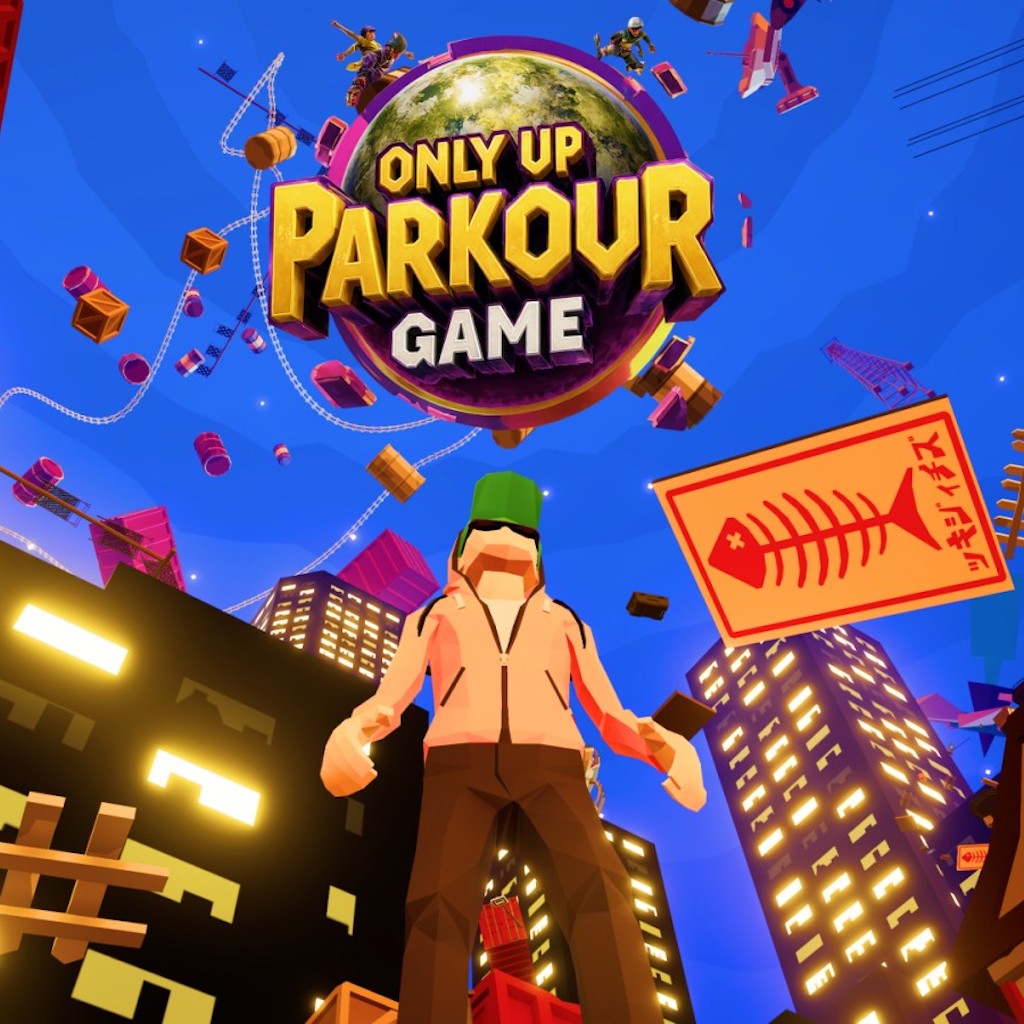
In a world where gaming increasingly blends cinematic storytelling and complex open worlds, Only Up – Parkour Game stands out for its unapologetic commitment to precision-based challenge. It’s a title that strips away narrative, sensory overload, and unnecessary bells and whistles, leaving you with one fundamental experience: ascend. Climb higher. Push further. Don’t fall.
This simplicity is both the game’s greatest strength and its most polarising weakness. Only Up is intensely minimalist in concept — literally built around the idea of progressing only upward — yet it manages to capture a kind of addictive tension rarely found outside competitive or speedrun-minded circles. Whether you see that as exhilarating or exhausting will largely shape your enjoyment of the game.
Core Concept: A Vertical Challenge
At its heart, Only Up – Parkour Game is a physics-driven platformer that tasks players with scaling an endless vertical course filled with obstacles, ledges, moving platforms, and death-defying jumps. There’s no definitive story, no character progression, no cutscenes; there’s only the climb. Each ascent begins at the ground floor and pushes you higher into increasingly hostile terrain.
The slogan could easily be: No shortcuts. No checkpoints. Only up.
That sort of purity in design is rare. Many games offer vertical sections or climbing challenges, but almost none build an entire experience around the single direction of progress. What emerges is an intense focus on skill mastery, spatial awareness, and the kind of muscle memory that turns frustration into satisfaction — one pixel-perfect jump at a time.
Gameplay Mechanics: Precision Meets Momentum
Mechanically, Only Up is deceptively simple. Most actions boil down to:
- Move
- Jump
- Climb
- Balance
- React
And yet — and this is crucial — execution matters. The game’s physics model is weighty in a way that rewards planning and rhythm rather than mindless repetition. Your character feels grounded, not floaty; missteps are punished with gravity’s full force, and every platform, ledge, or obstacle demands attention.
The controls — while basic by modern standards — are tuned around this precision focus. Jump arcs, momentum carry-over, and subtle directional input all contribute to the sense that you are responsible for every inch gained (or lost). Recovery from mistakes is possible but difficult, and there’s an intense satisfaction in mastering a section that once felt impossible.
The challenge curve is steep but deliberate. Early sections appear deceptively easy — a few simple platforms and gentle inclines — but the difficulty compounds quickly. What begins as a confidence-builder rapidly becomes a grueling test of reflexes and patience.
Level Design: Brutal by Design
The environments in Only Up are designed with one priority above all else: create tension. Verticality isn’t just physical — it’s psychological. The higher you climb, the more precarious your position feels. The ground disappears. Platforms shrink. Moving obstacles become faster. Time windows become narrower.
There’s artistry in how the game constructs these challenges. Each section introduces a subtle twist: a shift in rhythm, an unexpected motion pattern, a disappearing ledge. The game trusts its players to learn through doing, and this often results in that addictive tension loop where failure doesn’t feel unfair — just instructive.
However, this approach is not without its detractors. Because checkpoints are rare and the climb relentless, some segments feel punishingly difficult — not because they’re clever, but because any mistake resets you far below. This leads to repetition that many players may find invigorating, but others will experience as tedious.
There’s a fine line between demanding and grinding, and Only Up flirts with it constantly.
Visual and Audio Presentation: Function Over Flash
Visually, Only Up doesn’t compete with AAA spectacle. The art style is utilitarian — clear, readable, and focused on gameplay clarity rather than lush aesthetics. Platforms, hazards, and environmental cues stand out distinctly, which is critical in a game that relies on split-second decisions.
Textures and models are simple but effective — nothing to distract you or obscure your view. Background art ranges from industrial scaffolding to open air vistas, but it’s always secondary to function. You’re climbing, not sightseeing.
Audio is equally minimalist. Sound cues are primarily functional — jump confirmations, landing impacts, subtle environmental ambience. There’s no sweeping score to tug at emotion, no dynamic music to signal pacing. Instead, you hear what matters: the echo of your footsteps, the swish of air, the thud of a misjudged leap. This design choice reinforces the core experience: pure, undiluted focus on upward motion.
For some, this sparse presentation will feel refreshing; for others, it may come off as barebones or underwhelming. But whatever your take, there’s no denying that the audio-visual design supports Only Up’s intention: distraction-free ascension.
Difficulty and Accessibility: A Relentless Ascent
Only Up – Parkour Game is not a casual affair. It’s a title that demands attention, patience, and a willingness to fail repeatedly. That’s exactly why it appeals to a certain type of player — one who enjoys mastery through repetition, pattern recognition, and peak focus sessions.
There are no automatic difficulty settings. No assist modes. No slow motion or rewind buttons. If you miss a jump, you often fall — and fall hard. This is part of the design: to make each success feel earned.
However, that design philosophy inevitably limits accessibility. Players looking for a relaxed climb, a narrative journey, or a stress-free platformer will find this title hostile. This isn’t a world you leisurely explore; it’s a challenge you train on.
There are no lives, but there are consequences. The higher you go, the more distant the ground becomes — and the farther you fall when you err.
Community Dynamics: Shared Challenge
Curiously, Only Up has cultivated a community aesthetic more commonly found in competitive puzzle or speedrun games. Players share strategies, climbing paths, and techniques for tight sections. The ascent becomes a shared cultural experience, with collective frustration and triumph alike.
Leaderboards, if present, tap into that feeling of communal mastery. There’s a competitive edge not in combat, but in who can climb further, smarter, and more consistently.
This shared experience bolsters the game’s appeal for some — a sense of “we’re all climbing the same mountain” — but it underscores again that this isn’t casual fare.
Final Verdict
Only Up – Parkour Game is a bold, focused, and uncompromising challenge that demands patience, precision, and mental resilience. It strips platforming back to its essence and builds from there a game that is as much about mastery as it is about momentum.
It isn’t for everyone: those seeking narrative, variety, or low-pressure play will likely feel fatigued by the relentless climb. But for players who relish the satisfaction of refining technique, learning from repetition, and conquering brutal geometry, Only Up is an exhilarating ascent worth undertaking.