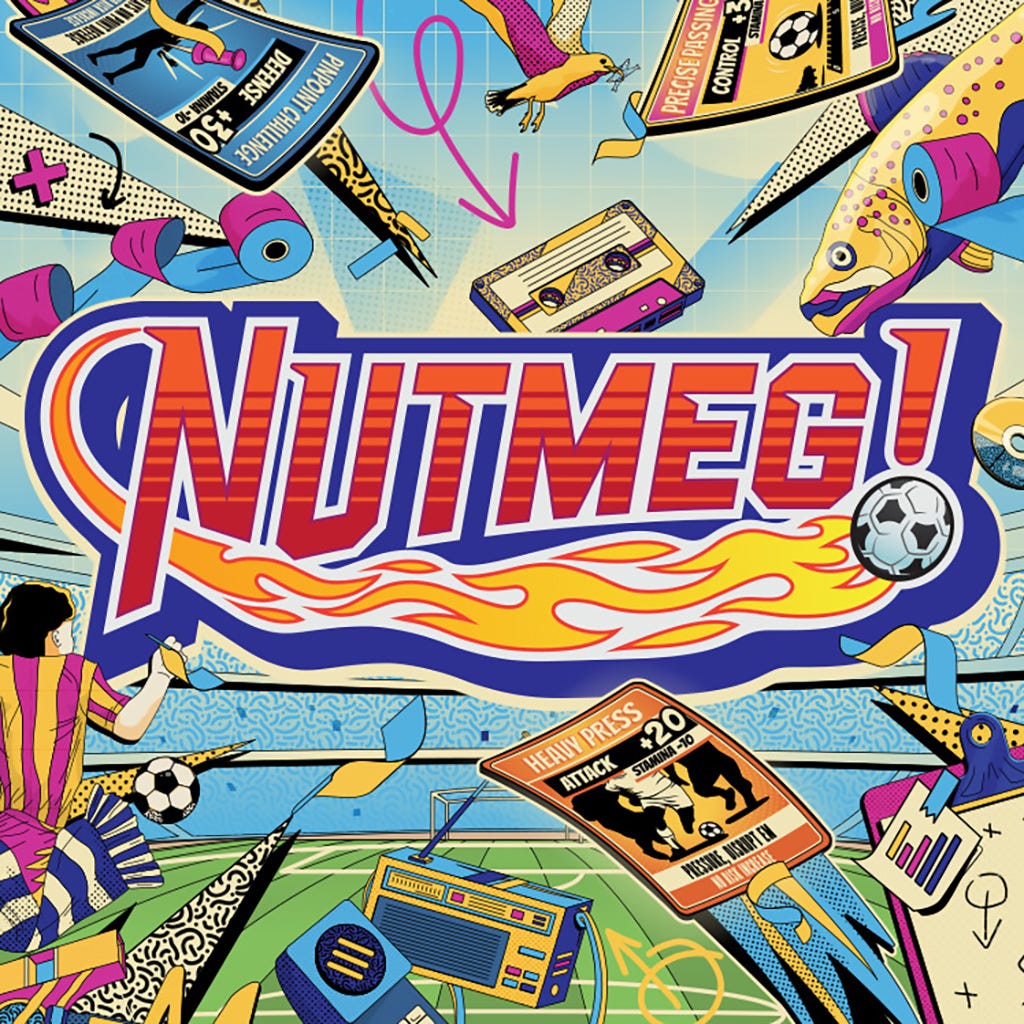
There are few genres as structurally rigid as football management sims—and few as creatively open as deckbuilders. NUTMEG! A Nostalgic Deckbuilding Football Manager combines these two extremes with impressive confidence.
Developed by Sumo Digital and Sumo Digital Academy, the game reimagines the life of a football manager through a distinctly retro lens. Instead of spreadsheets, dropdown menus, and endless statistical screens, you find yourself in a cramped 80s–90s office, managing your club via CRT monitors, Teletext-style updates, and the occasional ringing rotary phone. It’s as much about atmosphere as it is about strategy.
But when match day arrives, everything changes. Football is no longer simulated—it is played through cards.
Every pass, tackle, shot, and tactical adjustment is decided through deckbuilding mechanics, turning each match into a tense, fast-paced card battler where victory relies on both preparation and improvisation.
It’s a daring reinterpretation of both genres—and, for the most part, it succeeds.
Management Without the Spreadsheet Fatigue
Traditional football management games often overwhelm players with data. NUTMEG! deliberately avoids this approach. Instead, club management is simplified into a more tactile, almost narrative-driven experience.
You still handle transfers, scouting, youth development, training regimes, finances, and media interactions — but everything is presented through a retro interface that emphasises clarity over complexity. Decisions feel immediate rather than overly analytical. Hiring a new scout or selling a striker is a quick, easy choice rather than a multi-tab investigation.
This design choice is vital. It ensures that the game maintains its hybrid identity. Management is important, but not the entire focus — it exists to feed your deck, which then influences your success on the pitch.
However, this simplification can sometimes be too limited. Fans of detailed management systems might find the economic and tactical aspects lighter than expected, especially in long-term club development.
Match Days: Football as a Card Battler
The core of the experience is in its match system. Each game is a head-to-head card duel, where your deck reflects your tactical approach.
Formations, player abilities, training upgrades, and strategic choices all turn into cards. A well-crafted deck lets you carry out complex attacking moves, defensive formations, and shifts in momentum during a match. Conversely, a poorly built deck leaves you scrambling as the opposition controls the flow of play.
There’s a compelling tension here. Matches feel like duels of preparation rather than mere probability simulations. You are not just reacting to football—you are creating it.
Importantly, NUTMEG! avoids making matches purely based on luck. While chance affects card draws, strong deck synergy and tactical planning generally outweigh luck. A solid pressing system or counter-attacking deck will typically outperform a chaotic, unfocused one.
However, variance still exists, and in closely fought matches, it can sometimes seem as though the order of your card draws has a significant influence on the outcome.
Deckbuilding Meets Tactical Identity
Where NUTMEG! becomes truly compelling is in how it combines football identity with deck construction. Your tactical philosophy is not merely a menu option—it is essentially your deck.
A counter-attacking side focuses on explosive transition cards, quick breaks, and opportunistic finishing. A possession-heavy team emphasises control, stability, and incremental advantage. Direct “route one” football transforms into a high-risk, high-reward strategy driven by physical dominance and momentum swings.
This creates a fulfilling cycle of identity development. You are not just managing a club—you are honing a football philosophy and showcasing it through card synergy.
Card acquisition directly links to performance. Winning matches, completing training drills, and reaching club objectives earn you packs, upgrades, and combinable enhancements. Over time, your deck mirrors your managerial progression.
The system promotes experimentation but also values consistency. Strong decks are built over seasons, not single matches.
The Nostalgia Layer: Football in the Retro Era
Perhaps the most distinctive aspect of NUTMEG! is its presentation. The game is steeped in nostalgia for 1980s and 1990s English football culture. This isn’t just about aesthetics—it influences the tone, humour, and structure of the entire experience.
From grainy CRT visuals to Teletext-style updates and retro office clutter, the game effectively evokes a specific time and place. Even press interactions and media narratives feel rooted in an era where football was grittier, less polished, and more emotionally intense.
There’s a deliberate charm in how the game celebrates this period. It highlights the chaos of lower-league football, the unpredictability of form, and the cultural significance of Saturday fixtures.
Crucially, this nostalgia isn’t merely visual. It underpins the game’s mechanical identity. Football feels less like a global industry and more like a community-driven obsession shaped by limited resources and raw passion.
Club Management, Identity, and Progression
Over a 20-year career path, players can guide clubs through multiple divisions, shaping long-term narratives. Whether you choose to become a journeyman manager hopping between teams or a one-club legend building a dynasty, progression feels natural.
Youth development and scouting systems contribute to your deck-building strategy, ensuring that long-term planning remains important. A promising youth striker is not just a statistical upgrade—they are a future card archetype that could redefine your tactical approach.
Transfers also serve a dual purpose: they are both roster changes and deck adjustments. Signing the right player can fundamentally alter your tactical identity, while poor recruitment can leave your deck unbalanced and inconsistent.
This integration of management and card systems is where NUTMEG! feels most innovative.
Presentation and Flow
Visually, the game fully embraces its retro identity. The UI is deliberately cluttered in certain areas, echoing old-school desktop management systems. While this boosts immersion, it can sometimes make navigation feel less intuitive than modern genre standards.
Match visuals are practical rather than flashy, focusing on clarity of card effects and tactical states over cinematic presentation. This is a wise choice, though it might disappoint players expecting more lively football animations.
Audio design heavily emphasises atmosphere: crowd murmurs, CRT hums, and subtle match tension cues enhance the sense of old-school football drama.
Charity Collaboration and Tone
It’s also worth noting the game’s real-world connection through its charity partnerships with the Joey Beauchamp Foundation and the Dalian Atkinson Legacy Trust. Although not part of the main gameplay, this initiative adds emotional depth to the project’s football heritage focus, emphasising its link to the human side of the sport.
Final Verdict
NUTMEG! A nostalgic deckbuilding football manager stands out as one of the most inventive hybrid genres recently, skillfully blending football management and deckbuilding into a unified and engaging system. Its greatest strength is how fluidly tactical identity, squad building, and card mechanics are intertwined.
However, its simplification of traditional management systems and occasional dependence on RNG variance in matches may not appeal to purists of either genre.
Nonetheless, its creativity, personality, and mechanical daring make it a notable experience in the crowded strategy landscape.