Some horror games want your pulse racing. Others want you screaming at shadows as monsters leap from the darkness. Necrophosis: Full Consciousness takes an entirely different path. It does not chase adrenaline or cheap terror. Instead, it settles into your mind slowly, wrapping itself around your imagination with an oppressive sense of decay that becomes almost hypnotic.
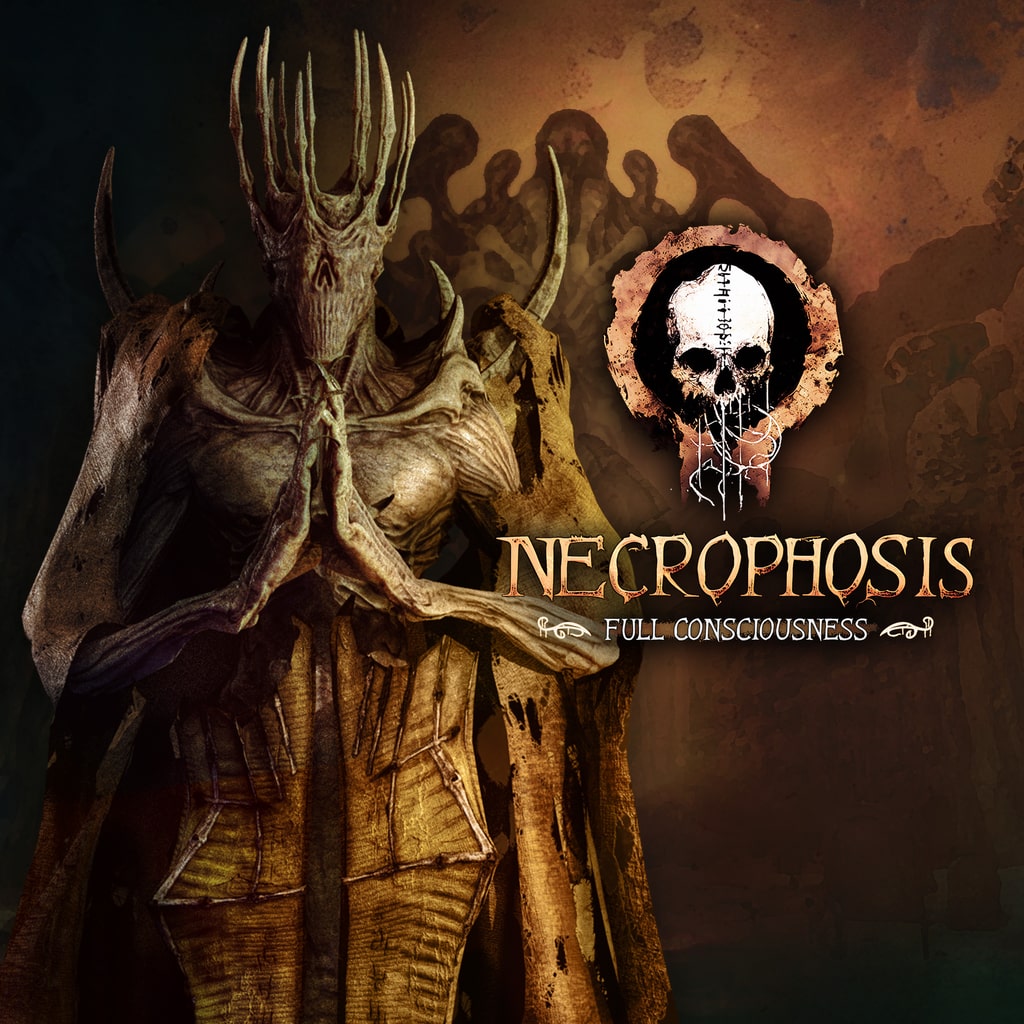
Developed by Dragonis Games and published by PQube, Necrophosis: Full Consciousness arrives on consoles as a complete package, including both the original experience and its Subconsciousness expansion. Heavily inspired by Lovecraftian horror and the deeply unsettling artwork of Zdzisław Beksiński, the game presents a world where death is no longer an ending. It is simply existence itself. Flesh rots endlessly. Gods collapse into themselves. Entire landscapes appear trapped in an eternal process of decomposition.
You awaken as Consciousness, a nameless entity inhabiting a deteriorating body with no understanding of who you are or why you exist. From there, the game sends you spiralling deeper into grotesque dreamscapes filled with skeletal architecture, cryptic poetry, and haunting remnants of forgotten civilisations. There are no weapons to collect and no real combat systems to master. Necrophosis relies almost entirely on mood, exploration, and environmental storytelling to carry its weight. The result is a deeply memorable horror experience, even if certain gameplay systems struggle to match the brilliance of its artistic vision.
Gameplay
Necrophosis is fundamentally an exploration-driven puzzle adventure. You wander through disturbing environments, inspect objects, solve environmental challenges, and gradually uncover fragments of narrative scattered throughout the world. The pacing is intentionally slow, almost meditative at times, encouraging players to absorb every horrifying detail around them.
Exploration becomes the central reward. Every corridor, cavern, and impossible monument feels handcrafted to provoke discomfort and fascination in equal measure. Walls pulse with organic textures. Giant skeletal structures loom over endless wastelands. Massive godlike figures appear frozen in eternal agony. At times, the game genuinely feels less like a traditional horror title and more like walking through an interactive nightmare painting.
The puzzles themselves, however, are far less compelling than the world that houses them. Most challenges rely on simple object placement mechanics. You pick up an item, carry it somewhere nearby, insert it into a mechanism, and continue forward. Early on, the minimalist design works because the atmosphere remains so captivating, but repetition eventually dulls the sense of discovery.
There are flashes of something more inventive beneath the surface. One mechanic allows Consciousness to detach its brain and temporarily possess other entities to manipulate environments from different perspectives. These moments are genuinely intriguing and briefly hint at a deeper puzzle framework that sadly never fully develops. Instead of building upon these ideas in meaningful ways, the game repeatedly falls back on simplistic environmental tasks.
That simplicity may frustrate players expecting layered survival horror mechanics or elaborate puzzle design. Still, there is something admirable about Necrophosis refusing to overwhelm the player with systems. The game wants you focused entirely on its atmosphere and symbolism. Whether that approach works for you depends largely on how much value you place on mood over mechanical complexity.
World Design and Atmosphere
This is where Necrophosis becomes unforgettable. Very few horror games commit so fully to a visual identity. Every inch of this world feels diseased, ancient, and spiritually broken. The environments are not merely creepy. They are oppressive in a way that feels almost physical. Massive bone structures twist into impossible formations while organic matter spills across ruined pathways like exposed nerves.
The influence of Beksiński’s artwork is impossible to ignore, and Dragonis Games deserves enormous praise for translating that surreal style into a navigable 3D space. There are moments when you simply stop moving because the scenery feels too grotesquely beautiful to rush past. The world constantly balances horror and fascination, creating an atmosphere that quietly burrows beneath your skin.
Lighting plays a major role in sustaining that tension. Rather than relying on total darkness, Necrophosis uses muted greys, sickly reds, and pale, dying light to create environments that feel exhausted rather than merely haunted. Even open spaces somehow feel claustrophobic. There is no comfort anywhere in this universe.
The audio design elevates everything further. Silence dominates large stretches of exploration, broken only by distant groans, whispers, and low ambient drones that seem to vibrate through the environment itself. The soundscape rarely screams for attention, but it constantly feeds unease into the background. Wearing headphones transforms the experience completely, making every strange noise feel disturbingly intimate.
Narrative and Themes
Necrophosis tells its story through fragmented poetry, cryptic environmental clues, and brief encounters with decaying entities scattered across the world. The narrative remains deliberately abstract for much of the experience, leaning heavily into existential horror and themes of identity, memory, death, and rebirth.
Some players will likely find the storytelling frustratingly vague. Answers rarely arrive cleanly, and the game often prioritises emotional interpretation over concrete explanation. Yet there is undeniable power in how the world communicates despair. Entire civilisations appear trapped in endless cycles of decay, while ancient gods linger as hollow carcasses, unable to escape oblivion.
The writing occasionally borders on self-indulgent, abstract horror poetry, but it usually avoids becoming completely incoherent. There is enough emotional weight beneath the symbolism to keep the journey engaging, particularly once the Subconsciousness expansion begins to peel back additional layers of the protagonist’s fractured existence.
That said, the ending may divide players sharply. After hours of slow-building dread and mysterious symbolism, the conclusion arrives abruptly and refuses to provide traditional closure. Some will appreciate its bleak ambiguity. Others may simply feel unsatisfied after investing so heavily in the world’s mysteries.
Performance and Technical Presentation
On current-gen hardware, Necrophosis performs solidly overall. The visual presentation remains remarkably stable, given the density of environmental detail packed into many areas. Texture work is especially impressive, with surfaces constantly appearing damp, decayed, and disturbingly organic.
Character animation occasionally feels stiff, particularly during scripted sequences, but that awkwardness almost contributes to the dreamlike tone rather than actively undermining immersion. Load times remain short, and transitions between environments feel smooth throughout most of the experience.
The relatively short runtime may disappoint some players, especially given the premium presentation. Even with the included expansion content, experienced players can comfortably finish the full package in roughly three to four hours. Yet despite its brevity, Necrophosis leaves behind a surprisingly heavy emotional residue.
Final Verdict
Necrophosis: Full Consciousness is not traditional horror. It is horror as atmosphere, horror as art, and horror as existential decay. It prioritises visual storytelling and emotional suffocation over action or mechanical depth, creating an experience that feels uniquely haunting even when its gameplay systems fall short.
The simplistic puzzle design undeniably limits the game’s long-term impact. At times, repetitive interactions begin to undermine the extraordinary imagination behind them. Players seeking deep survival mechanics or elaborate challenge design may leave disappointed.
Still, what Dragonis Games has created here feels genuinely distinctive in a crowded horror landscape. The world of Necrophosis lingers in your memory long after the credits roll. Its grotesque architecture, mournful sound design, and oppressive atmosphere combine to create something deeply unsettling without resorting to excessive jump scares or violence to demand attention. It may not fully realise the brilliance of its ideas mechanically, but artistically, Necrophosis: Full Consciousness is difficult to forget.