Midnight Swamp feels like the kind of story you would overhear whispered around a dying campfire long after midnight, when the trees start creaking and every distant splash sounds like something watching from the water. It carries that old fairytale energy, where wonder and danger sit side by side, where talking animals cannot quite be trusted, and where curiosity often drags people somewhere they should never have gone.
Developed by WildOmul and published by Sometimes You, Midnight Swamp is a compact point-and-click adventure that leans heavily into atmosphere, folklore, and slow-burning mystery. On the surface, it feels familiar. A lost traveller wanders into a cursed place filled with strange inhabitants and cryptic puzzles. Yet the game’s hand-drawn presentation and deeply melancholic tone give it a personality that lingers long after its brief runtime ends.
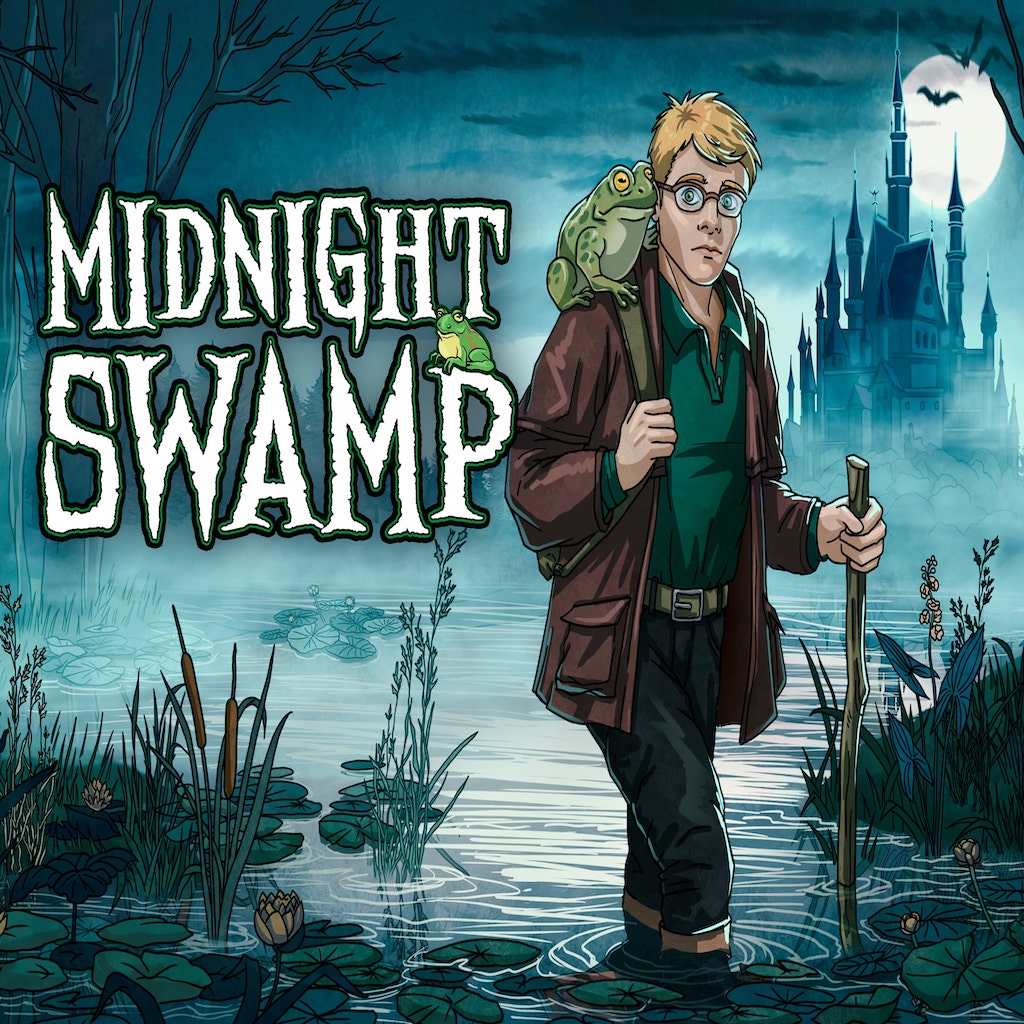
You play as an unnamed tourist whose quiet camping trip spirals into something deeply unsettling after hearing a strange laugh echo across a nearby lake. One step outside the safety of your tent pulls you into a shifting swamp that seems disconnected from reality itself. The deeper you travel, the stranger things become. A talking cat offers guidance with suspicious enthusiasm. A witch living inside a gingerbread house teaches you alchemy. A looming castle watches silently from the fog like some ancient wound carved into the landscape. What follows is less a traditional horror story and more a darkly whimsical descent into folklore and forgotten magic.
Old School Adventure Design With a Storybook Soul
At its heart, Midnight Swamp is proudly old-fashioned. It is a pure point-and-click adventure built around exploration, environmental observation, inventory puzzles, and careful interaction with its bizarre cast of characters. There are no action sequences, combat systems, or survival mechanics to distract from the experience. The game trusts atmosphere and curiosity to pull you forward. Thankfully, that trust mostly pays off.
The swamp itself is wonderfully designed despite the game’s relatively small scale. Every screen feels carefully illustrated rather than procedurally assembled. Broken wooden walkways disappear into thick fog. Crooked houses lean at impossible angles. Murky waters ripple beneath rotting docks while distant lights flicker in places that feel unreachable. The entire world carries a dreamy, uneasy quality, as though reality itself is slightly unstable.
Puzzle design remains largely grounded in logic, though it occasionally drifts into classic adventure-game obscurity. Much of your progression depends on paying close attention to environmental clues and local folklore. Conversations matter. Strange symbols matter. Tiny details tucked into the scenery often become important later. This creates a rewarding sense of involvement because solutions rarely feel handed to you outright.
The potion-crafting system becomes one of the game’s most enjoyable mechanics. Early on, the Witch introduces you to basic alchemy, teaching you how to combine strange ingredients collected throughout the swamp. Mushrooms, glowing roots, swamp herbs, and mysterious liquids slowly become tools for unlocking new areas and solving environmental problems.
Importantly, potion brewing never becomes overly complicated. Midnight Swamp understands that its strength lies in immersion rather than mechanical depth. The system adds flavour and variety without overwhelming the pacing. Mixing strange concoctions in an old, bubbling cauldron while rain taps softly against the windows of the Witch’s house creates some of the game’s most memorable moments.
A World Filled With Strange Company
What truly defines Midnight Swamp is the cast of peculiar creatures inhabiting this decaying world. None of them feel entirely safe. Even the friendliest characters carry an unsettling edge beneath their humour.
The Cat stands out. Smooth-talking, oddly charming, and clearly hiding more than he reveals, he quickly becomes the narrative’s emotional anchor. His dialogue dances between playful sarcasm and quiet menace, keeping his true intentions constantly uncertain. The game wisely avoids giving easy answers too early, allowing tension to build naturally through conversation and implication.
The Witch also deserves praise for avoiding cliché. Rather than portraying her as overtly evil or cartoonishly mysterious, Midnight Swamp presents her as an exhausted caretaker trapped in the same strange reality as everyone else. Her lessons in potion crafting slowly reveal pieces of the swamp’s hidden history, and some of the game’s strongest writing emerges during these quieter interactions.
There is a literary quality to the dialogue throughout the adventure. Conversations often feel more interested in mood and symbolism than in straightforward exposition. At times, it almost resembles interactive folklore more than traditional game storytelling. Fans of Eastern European fantasy and surreal magical realism will likely feel especially at home here.
The game’s inspirations are impossible to miss. Echoes of old Soviet fantasy novels, dark fairy tales, and dreamlike science fiction drift through nearly every scene. Yet Midnight Swamp never feels derivative. Instead, it feels like a small team genuinely in love with those influences and eager to reinterpret them through their own haunting lens.
The Beauty of the Swamp
Visually, Midnight Swamp is gorgeous in a quiet, melancholic way. The hand-drawn artwork carries enormous personality despite the game’s limited scope. Rather than aiming for photorealism or technical spectacle, the visuals focus entirely on mood and texture.
The colour palette deserves special mention. Sickly greens, muddy browns, deep blues, and pale moonlight dominate the world, creating a setting that feels perpetually damp and cold. Small flashes of warm colour stand out because the surrounding world feels so drained and exhausted. Candlelight flickering inside a cabin window suddenly feels comforting. A glowing potion bubbling on a shelf becomes oddly beautiful.
Animation remains fairly simple overall, but the deliberate pacing reinforces the game’s dreamlike atmosphere. Midnight Swamp rarely rushes. It wants players to sit with the discomfort and soak in the eerie stillness of its environments.
The sound design contributes massively to that immersion. Soft wind whistles through dead trees. Water sloshes quietly beneath wooden bridges. Distant laughter occasionally drifts through the fog, just long enough to make you question whether you actually heard it at all. The soundtrack stays restrained for much of the adventure, allowing silence and ambient noise to carry the emotional weight. It is not a loud horror game. It is a lonely one.
A Journey That Ends Too Soon
The biggest issue facing Midnight Swamp is its length. The entire experience can comfortably be completed within two hours, and that brevity ultimately leaves the world feeling underexplored. Just as the lore begins to deepen and the swamp’s mysteries start to become truly compelling, the game suddenly moves towards its conclusion.
That abruptness hurts because the setting is genuinely fascinating. There are hints of deeper mythology, larger conflicts, and stranger forces lurking beneath the surface, yet the game only scratches the surface before the credits arrive.
Some players may also find the puzzle complexity inconsistent. While most challenges remain intuitive, a handful of progression points rely on slightly vague logic that can briefly interrupt the otherwise smooth pacing. Thankfully, the short runtime prevents frustration from lingering too long.
There is also a sense that Midnight Swamp could have benefited from a few more meaningful choices or alternate outcomes. The world feels emotionally reactive, but structurally the adventure remains fairly linear throughout. Still, even with those shortcomings, the experience leaves a strong impression because its atmosphere is so distinct.
Final Verdict
Midnight Swamp is the kind of game that understands the power of mood. It does not need explosive scares, sprawling worlds, or endless mechanics to be memorable. Instead, it builds a small but deeply evocative space filled with fog, folklore, and quiet dread. Its puzzles are engaging without becoming exhausting. Its potion crafting adds just enough variety to keep exploration fresh. Most importantly, its world feels genuinely enchanting in that eerie, old-fairy-tale sort of way, where danger and beauty blur beneath the moonlight.
Yes, it ends far too quickly. Yes, there is room for deeper systems and larger narrative payoffs. But even within its brief runtime, Midnight Swamp manages to create an atmosphere many larger horror games fail to achieve. It feels like wandering through somebody else’s dream and realising halfway through that the dream does not want you to leave.