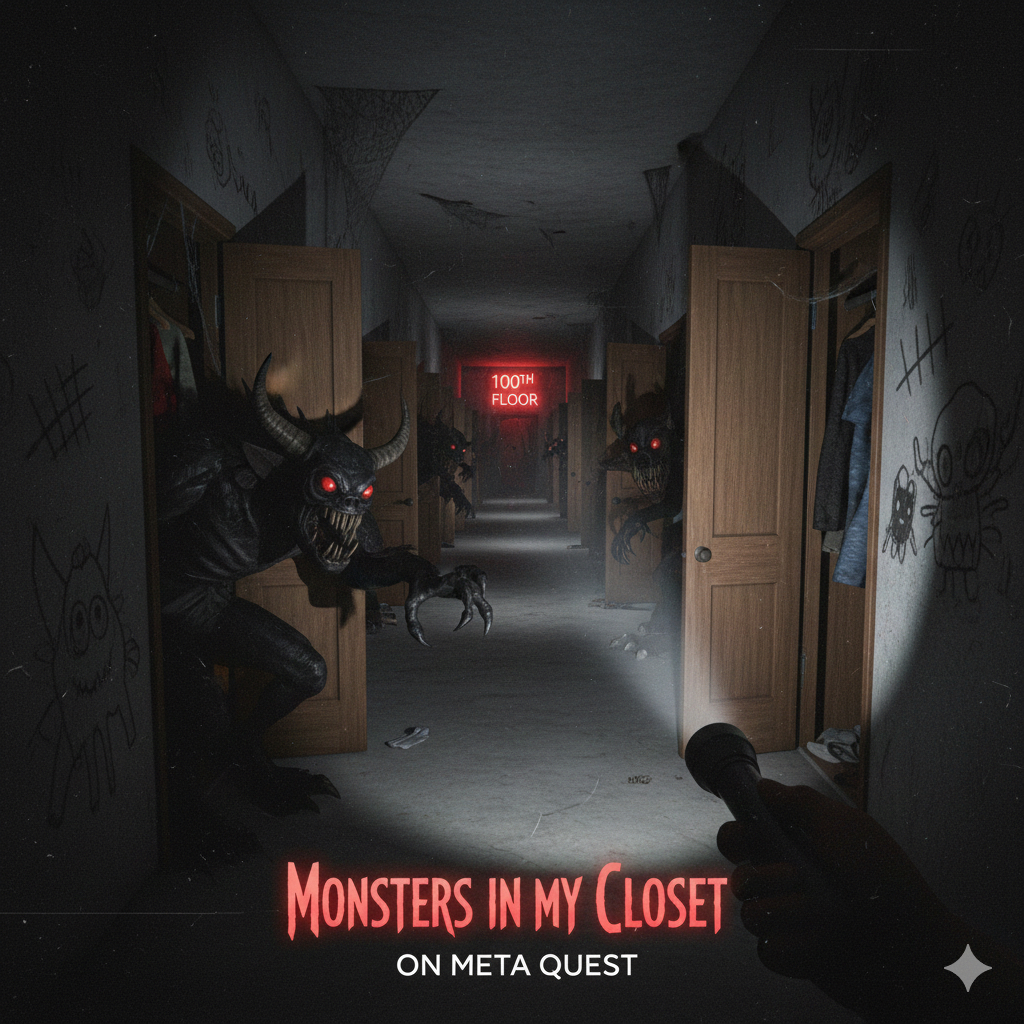
In the crowded Meta Quest store full of shooters, puzzles, and narrative adventures, Monsters In My Closet stands out by embracing a blend of childlike imagination and VR interactivity that leans into whimsy, tension, and physical engagement. It’s not just a game about exterminating monsters — it’s about reliving the fear and fun of childhood nightmares with the agency and presence VR uniquely provides. After extensive playtesting across its core modes and varied encounters, this title reveals itself as a surprisingly robust and engaging experience that balances action, atmospheric storytelling, and emergent gameplay. While it isn’t without flaws — particularly in pacing and variety — Monsters In My Closet ultimately delivers a memorable escapade that is as clever as it is playful.
Core Concept and Identity
Monsters In My Closet places you in the role of someone confronting — and ultimately conquering — the creatures hiding in the dark recesses of your childhood bedroom closet. The premise is simple and evocative: what happens when the monsters you feared as a kid become real? The game builds its identity around this central narrative hook, transforming the familiar (closets, shadows, toys) into something mysterious and alive.
Unlike traditional horror VR experiences that rely on jump scares and relentless dread, Monsters In My Closet opts for playful tension — a blend of eerie atmosphere, surreal creatures, and interactive gadgetry that makes encounters as much fun as they are jarring. The result is a tone that alternates between whimsical and menacing, with a sense of wonder underpinning every spooky encounter.
This approach defines its identity: not terrifying horror, but imaginative confrontation. The game understands that part of what made monster myths compelling as children was not just fear, but curiosity and agency. In VR, that agency becomes literal.
Gameplay Mechanics and Interaction
The game’s mechanics are intuitive and strongly tied to VR’s strengths. Interactions are physical and tactile — reaching into closet darkness, grabbing tools, swinging gadgets, and deploying traps requires deliberate motion. Simple gestures matter; the difference between a successful banishment and a close call often comes down to positioning and timing rather than mere button mashing.
The core gameplay loop revolves around discovering monsters, understanding their patterns, and using the right tool or tactic to deal with them. Some creatures retreat when exposed to light, others react to sound or proximity, and unique boss-type monsters require layered strategies. This emergent diversity prevents fights from feeling identical and keeps the player cognitively engaged rather than mechanically repetitive.
One clever design choice is how the game uses physical space to build tension. You are never in wide, empty halls; instead, most encounters take place in cramped, familiar spaces that feel uncanny when populated with animated threats. Leaning into VR’s spatial strengths, the game asks you to peek, dodge, reach, and recoil in ways that flatter the medium rather than fight it.
However, some limitations emerge in the interaction design. While core mechanics are satisfying, the toolbox doesn’t evolve dramatically over time. Gadgets and weapons introduced early tend to remain the same, meaning that mid-to-late game combat can feel like intensifying waves of the same mechanics rather than introducing fundamentally new interactions.
Environmental Design and Immersion
The environment design in Monsters In My Closet is a standout feature. The titular closet isn’t merely a storage space with shelves and hangers — it is reimagined as a layered ecosystem of hidden spaces, shadowy corners, and atmospheric cues. Lighting plays a critical role: sharp contrasts between deep shadows and patchy illumination intensify both mood and gameplay. Often, finding a threat is less about seeing it with your eyes and more about feeling it with your body as your presence, posture, or movement triggers reactions.
Closet interiors are richly detailed and thematic. Noise-making toys, stacks of old books, forgotten costumes, and abstract shapes all contribute to a sensation that this is a place with history — a perfect locale for the kind of monsters your imagination once whispered about. Sound design here is equally effective: creaks, whispers, thuds, and subtle environmental audio all contribute to an immersive acoustic environment that augments tension without relying on cheap tricks.
The broader environments outside the closet — bedrooms, hallways, backyards — are a bit more conventional visually, but they serve as effective transitions between intense monster encounters and moments of calm. While environmental variety isn’t revolutionary, it’s sufficient to make exploration feel worthwhile and contextually appropriate.
Narrative and Atmosphere
While Monsters In My Closet does not centre on a deep, sprawling narrative, it uses vignette-style storytelling to shape its emotional arc. You uncover notes, toy fragments, and environmental clues that hint at a larger world behind the monsters, and this subtle layering works well in VR, where traditional cutscenes or text-heavy storytelling would feel intrusive.
The atmosphere is where the game most consistently succeeds. It understands how to make space feel like character. The closet, hallway, bedroom, and yard all radiate a unique mood that is enhanced by sound design, lighting, and scale. Small touches — a flickering bulb, a shifting shadow at the edge of view, a distant rattle — elicit real physiological responses without resorting to cheap horror mechanics.
Because the game trusts the player’s presence in space and time, it doesn’t need to be loud to be effective; frequently, the tension arises from what you choose to ignore until it becomes unavoidable.
Progression and Replayability
Progression in Monsters In My Closet is tied to unlocking new areas and monster types, and while this system is effective, it remains modest in depth. There is a clear sense of advancement — new threats, new tactics, and subtle escalation in challenge — but no overarching meta-progression system (such as skill trees or weapon specialisations) to deepen long-term engagement.
That said, replayability is bolstered by variable monster spawns, emergent behaviours, and performance metrics that encourage players to refine strategies. For players who enjoy mastering VR movement and mastering combat encounters, Monsters In My Closet offers enough variability to justify repeat runs.
The absence of competitive leaderboards, time challenges, or community challenges is noticeable — these additions could have provided structured incentives for continued engagement beyond personal mastery.
Accessibility and Comfort
The game offers a solid suite of comfort options, including smooth locomotion, teleportation, vignette adjustments, and adjustable interaction sensitivities. These options ensure that players with varying tolerances for VR movement can enjoy the experience without discomfort.
Controls are intuitive and playtested responsive, and the game avoids overly complicated input schemes that can often plague VR action titles. This accessibility is a smart design choice: it lets players focus on presence, spatial awareness, and emergent discovery rather than complex control memorisation.
Final Verdict
Monsters In My Closet is a delightful and engaging VR experience that excels in atmosphere, physical interaction, and spatial presence. While it isn’t a large-scale narrative epic or a mechanically exhaustive simulator, it nails what it sets out to do: bring imaginative encounters to life in a way that is playful, tactile, and genuinely memorable.
Its blend of reflex-driven combat, exploration, and environmental immersion makes it one of the more compelling action-oriented VR titles on Meta Quest — especially for players who enjoy tactile interaction and emergent gameplay.