There is a particular rhythm many of us remember from childhood playgrounds, the strange confidence that came from timing your steps perfectly across moving surfaces, hopping between cracks in the pavement, or trying not to touch the floor during an imaginary game where lava waited below. Those moments weren’t really about speed. They were about trust. Trusting momentum, trusting timing, and learning to move with something rather than against it.
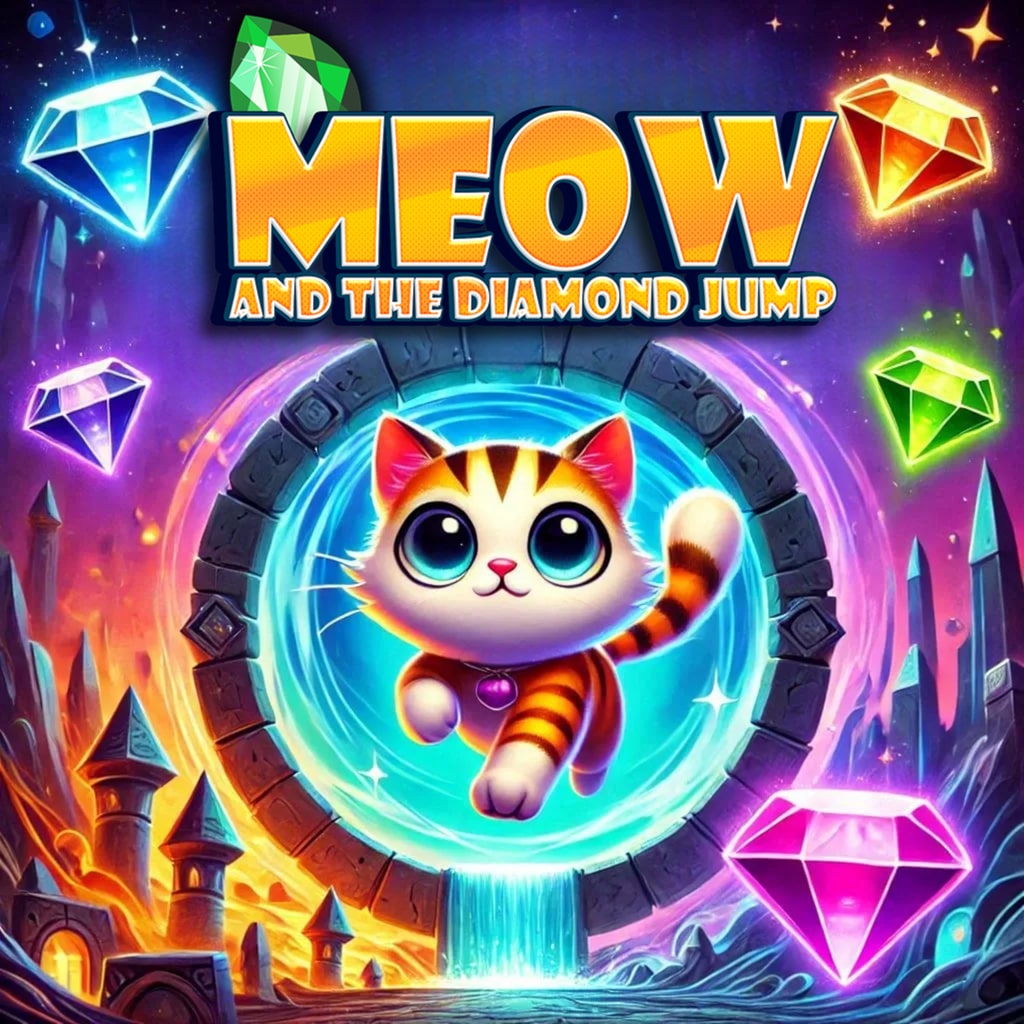
Meow and the Diamond Jump, developed by Yume Game Studio, captures a digital version of that same focused rhythm. By stripping away the jump button entirely and making movement an automatic constant, the game forces you to master the space between landings rather than the leap itself. Released this week on PlayStation platforms, it’s a colourful little platformer that understands something many larger games forget: simplicity only works when the core idea is genuinely clever.
At first glance, Meow and the Diamond Jump looks almost aggressively straightforward. You control a cheerful cat bouncing endlessly through bright, obstacle-filled stages, collecting diamonds and searching for a portal to the next level. There are only forty levels. Infinite lives remove most punishment. The art style is playful and inviting. Everything about it screams “casual.” Then you start playing. Suddenly, the absence of a jump button becomes fascinating.
The Art of Letting Go
Traditional platformers are built around control. You decide when to jump, how long to hold the button, and how aggressively to move through a level. Meow and the Diamond Jump removes one of those core pillars entirely. Your cat jumps automatically at a constant rhythm, leaving horizontal movement and positioning as your primary tools.
That tiny mechanical change completely transforms how you think. Instead of reacting moment by moment, you begin anticipating movement several seconds ahead. Every platform becomes a timing puzzle. Every spike trap becomes an exercise in rhythm. The game quietly shifts from a platformer to something closer to a movement-based puzzle game. It’s surprisingly effective.
The early stages act as gentle tutorials, teaching players how to read the cat’s jump arc and understand momentum. Before long, levels introduce tighter corridors, moving hazards, disappearing platforms, and awkwardly positioned diamonds that force careful route planning. You stop thinking about “jumping” entirely. Instead, you think about flow. Where should you land? How long should you wait before moving forward? Should you commit to the next platform immediately or reposition first? These tiny decisions create a satisfying rhythm that feels unique compared with more traditional platformers.
Small Game, Big Charm
One thing Meow and the Diamond Jump absolutely nails is its tone. The game radiates positivity. Bright colours, chunky environments, and cheerful animations make every stage feel inviting, even as the difficulty begins to creep upward. The cat itself has a wonderful sense of personality despite the minimalist presentation, bouncing enthusiastically through danger with the kind of carefree energy that makes failure feel lighthearted rather than frustrating. That atmosphere matters because the game is clearly designed as an accessible experience first and foremost.
Infinite lives remove the fear of experimentation entirely. If you fail, you restart instantly. No dramatic punishment. No lengthy loading screens. No unnecessary friction. You simply try again.
That design philosophy makes the game approachable for younger players while still offering enough challenge to keep experienced platforming fans engaged for a few hours. It reminds me of the era of smaller downloadable games, when developers focused on refining a single mechanic rather than overwhelming players with endless systems and collectables.
Accessibility Done Right
One of the most admirable aspects of Meow and the Diamond Jump is its accessibility options. The game offers thoughtful settings that let players further simplify controls, remove unnecessary input complexity, and tailor the experience to comfort rather than difficulty. That may not sound revolutionary, but too many games still treat accessibility as an afterthought. Here, it feels intentional.
The automatic jumping mechanic already significantly lowers the skill barrier for players who struggle with traditional platformers. Combined with forgiving checkpoints and infinite retries, the game creates a welcoming space where failure never feels punishing. There’s a genuine warmth to that approach.
Not every game needs to demand perfection or lightning-fast reactions. Sometimes there’s value in creating something people of different skill levels can simply enjoy together.
This feels especially true given the game’s family-friendly nature. I can easily imagine parents playing through these levels with younger children, guiding timing and positioning while celebrating successful runs together.
Simplicity Has Limits
That said, the game’s stripped-back design occasionally works against it. Forty levels sound substantial at first, but experienced players will likely finish the entire game in a single sitting. While the difficulty steadily increases, the game never fully evolves beyond its initial premise. New obstacles appear, but the core interaction remains largely unchanged throughout. That simplicity creates consistency, though it also limits variety.
Some stages begin to blend visually after extended play sessions, and while the soundtrack is upbeat and charming at first, its repetitive loops become more noticeable the longer you spend replaying difficult sections.
There’s also a slight missed opportunity with progression. Unlockables, alternate gameplay modifiers, or optional challenge modes could have added replay value without compromising the approachable structure. Still, it’s important to judge Meow and the Diamond Jump for what it actually wants to be rather than what it isn’t trying to become.
This is not an expansive indie epic or a mechanically dense precision platformer. It’s a focused arcade-style experience built around one clever idea, executed with sincerity.
The Rhythm of Failure
One of the game’s quietest strengths is how it handles mistakes. Because jumping is automatic, failure rarely feels like clumsy controls. Instead, mistakes become timing errors or positioning miscalculations. That distinction matters enormously. Every death teaches you something about rhythm.
You begin to read levels musically. Hazards become beats. Platforms become pauses. Safe landings feel almost like hitting notes in sequence. There’s a strange, hypnotic quality to repeated attempts as your brain slowly syncs with the game’s tempo.
Some later stages become surprisingly tense because of this. Tiny windows for movement create moments when you’re essentially guiding the cat through danger by instinct alone. When everything clicks together, the sensation is immensely satisfying.
The game never reaches the brutal intensity of hardcore platformers like Celeste or Super Meat Boy, but it doesn’t need to. Its challenge exists in a softer, more inviting space. That balance feels intentional.
Final Verdict
What ultimately makes Meow and the Diamond Jump memorable is its honesty. There’s no bloated ambition here. No attempt to artificially inflate the experience beyond what it needs to be. It introduces a mechanic, explores it thoughtfully across forty stages, and leaves before overstaying its welcome. That restraint gives the game charm.
In a gaming landscape crowded with endless progression systems and oversized open worlds, there’s something refreshing about a small platformer focused entirely on movement, rhythm, and accessibility. It feels handcrafted in the best possible way.
Yes, some players may finish it quickly. Yes, veteran platforming fans may wish for more complexity or tougher endgame challenges. But not every experience needs to become an obsession. Sometimes a game simply needs to brighten your evening for a few hours and leave you smiling when the credits roll. Meow and the Diamond Jump achieves exactly that.