There is a specific, focused frustration many of us remember from childhood, the moment you realise that while your LEGO castle was getting bigger and more impressive, it no longer fit through the bedroom door. It’s that fundamental lesson in spatial awareness: growth always comes at the cost of manoeuvrability. GluMe, published by Eastasiasoft Limited, bottles that exact tension and turns it into a brain-teasing puzzle mechanic. Released this spring across consoles and PC, it’s a game that asks you to gather your friends and grow in power, only to realise that every new ally makes the path ahead just a little tighter. It’s a minimalist, retro-soaked reminder that sometimes the biggest obstacle to your success is the very thing you thought you needed to survive.
At first glance, GluMe looks disarmingly simple. The bright pixel art, tiny smiling slimes, and cheerful chiptune soundtrack make it feel like the kind of game you casually boot up for fifteen minutes before bed. Then, somewhere around the tenth or fifteenth puzzle, the game quietly tightens the screws. Corridors narrow. Pitfalls multiply. Gem placement becomes increasingly cruel. Before long, you stop thinking of GluMe as a relaxing puzzle game and start treating every level like a carefully choreographed dance of positioning and restraint. That escalation is where GluMe truly shines.
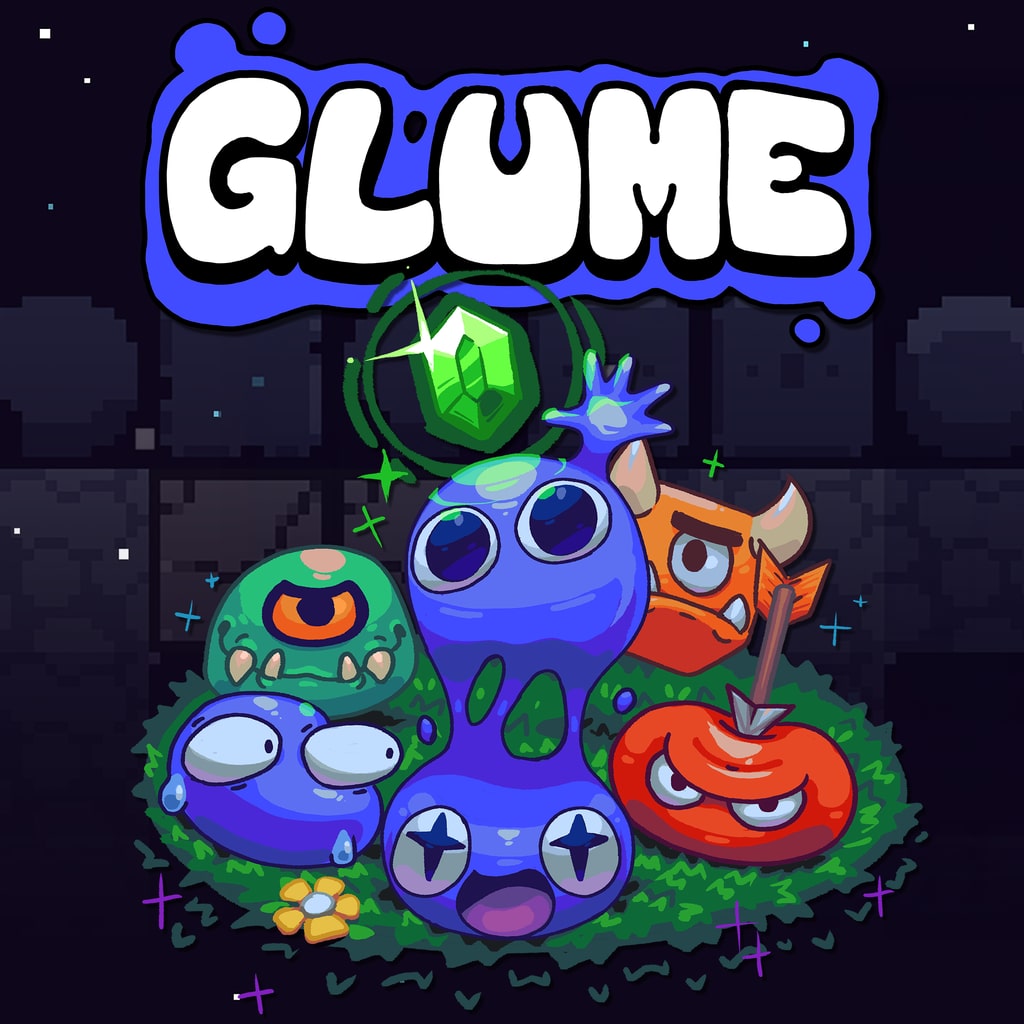
Developed by Solluco and brought to consoles by Eastasiasoft, this is a Sokoban-style sliding puzzle game built around one deceptively clever mechanic: every slime you touch joins your body. These slimes become extensions of yourself, reshaping your form into awkward chains, blocks, or winding trails that alter how you move through the world. Larger shapes allow you to cross gaps and activate certain pathways, but they also make navigating tight spaces significantly harder. It is an idea that sounds simple on paper yet becomes remarkably intricate in execution.
A Puzzle Game About Shape
Most puzzle games revolve around logic. GluMe revolves around space. Every level feels like an exercise in understanding your physical footprint. Early puzzles introduce the fundamentals gently. You learn how extra slimes attach to your body, how to cross pits by stretching your form, and how certain routes become inaccessible depending on your size.
Then the game begins to combine these concepts in increasingly devious ways. A narrow corridor may require you to remain small until the very last moment. Another puzzle might ask you to deliberately absorb slimes in a precise order so your body bends correctly around corners. Some stages turn your slime into a strange moving key, forcing you to shape yourself precisely enough to unlock pathways while avoiding dead ends.
There’s a fascinating push-and-pull at the centre of every puzzle. Growth gives you options, but it also creates limitations. Every new slime attached to your body is both a solution and a problem. That constant balancing act gives GluMe an identity that feels genuinely fresh.
Difficulty That Quietly Bites
One of the biggest surprises is how demanding GluMe becomes. The first handful of levels ease players into the mechanics with approachable layouts and forgiving objectives. You might initially assume the game is targeting younger players or casual audiences because of its colourful presentation. That illusion does not last long. Later puzzles become wonderfully brutal. Not unfair, but absolutely uncompromising.
There were several moments when I stared at a puzzle for minutes at a time, convinced I had soft-locked myself beyond recovery, only to discover a tiny positioning trick or movement sequence I had completely overlooked. The best puzzle games create that exact sensation. They make you feel stuck until suddenly the solution clicks into place and your entire perspective shifts. GluMe understands this rhythm perfectly.
Thankfully, the instant reset button keeps frustration from spiralling out of control. Restarting a puzzle is effortless, encouraging experimentation rather than punishment. The game actively wants you to test ideas, fail quickly, and rethink your approach.
That accessibility is essential because many later stages demand genuine trial and error. You often need to visualise how your body shape will evolve several moves ahead, almost like mentally folding origami in reverse. It becomes surprisingly absorbing.
The Beauty of Constraint
What impressed me most about GluMe is how much mileage it gets from such limited ingredients. There are no flashy cinematic sequences or complicated progression systems here. The entire experience is built from grids, slimes, gems, and environmental obstacles. Yet the developers constantly remix those elements in inventive ways.
Sleeping grey slimes become especially important later in the game. Since they only awaken when touched, deciding when and how to activate them becomes part of the puzzle itself. Some levels even feel almost maze-like, requiring you to preserve a specific body shape while weaving through narrow routes without accidentally blocking yourself off.
The game also hides secrets in previously completed levels, giving completionists a reason to revisit older puzzles with fresh understanding. Returning to an earlier stage armed with deeper mechanical knowledge creates a satisfying sense of growth, not for your slime, but for yourself as a player. That subtle educational curve is one of GluMe’s greatest strengths. It teaches through experience rather than tutorials.
Retro Comfort
Visually, GluMe embraces a clean retro aesthetic that suits the gameplay beautifully. The pixel art is simple yet expressive, giving each slime a playful personality despite its minimal design. Bright colours greatly improve puzzle readability, ensuring the screen never feels visually cluttered even when your slime body expands into strange, tangled formations. The environments remain fairly minimalist throughout, which works in the game’s favour. Puzzle clarity always takes priority over decoration.
Meanwhile, the chiptune soundtrack delivers exactly the kind of upbeat energy you would expect from a retro-inspired puzzler. The music starts out charming and catchy, though I will admit some tracks loop a little too aggressively during extended puzzle sessions. Spending twenty minutes wrestling with a particularly nasty level can make the repetition more noticeable than intended.
Still, the audio overall complements the experience well. There’s a pleasant rhythm to everything. Movement feels snappy, resets are instant, and the cheerful presentation softens the edges of the game’s tougher moments.
Hard Mode and Perfectionism
For players seeking an even greater challenge, GluMe includes a surprisingly demanding Hard Mode. Here, optimal solutions are mandatory. Every puzzle tracks the minimum number of moves required to complete it, transforming levels from simple problem-solving exercises into efficiency tests. Suddenly, solutions that merely work are no longer good enough. You need precision, planning, and absolute control over your movements.
This extra layer adds impressive longevity for puzzle enthusiasts. It also highlights how meticulously these stages are designed. The presence of elegant, perfect solutions beneath the apparent chaos gives the game satisfying structural integrity. Even when I became frustrated, I never doubted that the puzzles were thoughtfully crafted.
Final Verdict
GluMe does not entirely reinvent puzzle games, nor does it overwhelm players with complexity for its own sake. Instead, it focuses relentlessly on a single core mechanic, exploring every angle with confidence and creativity. That restraint is admirable. In an era when many puzzle games bury good ideas beneath endless gimmicks, GluMe succeeds because it understands the value of refinement. Every level builds naturally on what came before. Every mechanic serves a purpose. Every challenge feels handcrafted.
Yes, the difficulty curve may scare away some casual players. Yes, the soundtrack occasionally overstays its welcome. But beneath its modest price tag and cheerful presentation lies one of the smartest spatial puzzlers I’ve played this year. Sometimes the most memorable games arrive quietly. GluMe fits that category effortlessly.