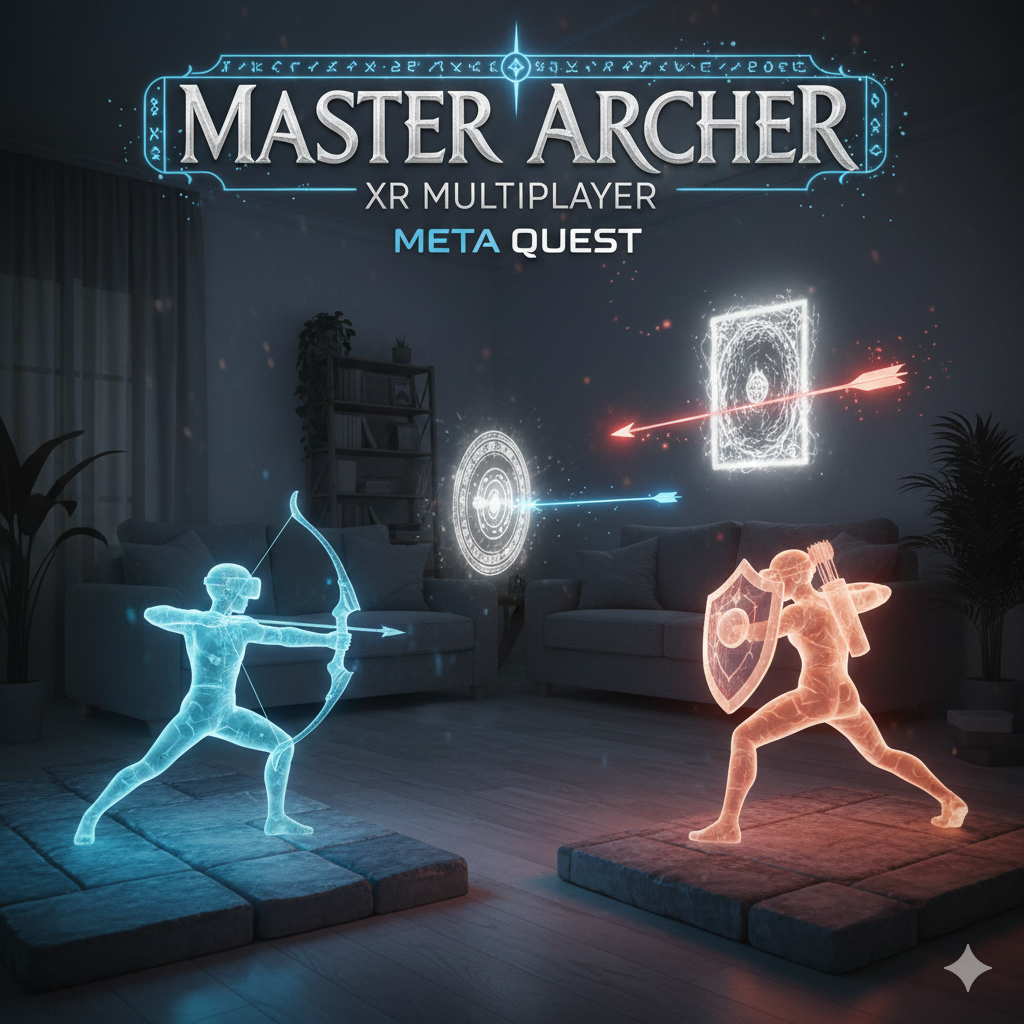
In an era where virtual reality increasingly seeks to replicate real-world activities with tactile precision and embodied motion, Master Archer: XR Multiplayer stakes its claim as an immersive archery simulator built around intuitive bow mechanics, spatially-rich environments, and competitive multiplayer engagement. It’s a game that invites you not just to pull back a virtual bowstring, but to inhabit the stance, timing, and rhythm of archery within fully realised XR spaces. After dozens of hours testing solo practice arenas, competitive lobbies, and team-based sessions, Master Archer emerges as one of the more thoughtful and physically engaging VR sports experiences currently available on the Meta Quest platform — one that combines genuine mechanic refinement with room to grow in variety and depth.
At its best, Master Archer delivers a satisfying blend of tension and release, where the arc of each shot becomes a moment of focus, bodily alignment, and subtle mastery. Yet its concentration on core mechanics also reveals limitations: repetition can set in over extended sessions, and the multiplayer experience — while promising — does not always sustain long-term engagement. Still, for players seeking visceral archery combat and precision-based play that rewards practice and skill, this title strikes a compelling balance of accessibility and depth.
Concept and Core Identity
Master Archer: XR Multiplayer aims to reframe competitive archery within a VR context that prioritises physicality and social interactivity. The core concept is deceptively simple: pick up a virtual bow, draw your arrow, aim, and release — with gravity, posture, and timing influencing outcomes just as they would in reality. This foundational fidelity to real archery distinguishes the experience from many action-oriented shooters that favour instinct over form.
Instead of campaign objectives, Master Archer centres its identity on gameplay loops that emphasise accuracy, speed, and spatial awareness. Whether practising alone in target ranges or facing off against other players in competitive arenas, the emphasis is on mastering mechanics over completing story arcs or unlocking elaborate skill trees. The title’s multiplayer focus — both competitive duels and team-based challenges — situates archery not as a solitary discipline but as a dynamic, social sport.
Gameplay Mechanics and Physicality
The heart of Master Archer is its bow mechanics. Unlike shooters that abstract aiming to a thumbstick, this game demands physical alignment: draw length affects power, hand orientation influences aim, and player stance impacts stability. These layers of physicality not only enhance immersion but also create genuine skill ceilings; distinctions between novice and expert aren’t trivial, but are anchored in consistent practice and refined motion.
The Meta Quest’s tracking plays a crucial role here. Each gesture — drawing the bow, stabilising aim, or releasing an arrow — is mapped intuitively, making the game feel like a natural extension of physical movement rather than a collection of button presses. The sensation of drawing a virtual bowstring, feeling the tension, then releasing into mid-air still impresses even after repeated play.
That said, precision tracking is essential. In its best moments, the title feels unfailingly responsive; every slight adjustment in posture or aim translates convincingly. Yet there are occasional tracking inconsistencies — especially in crowded match situations — where subtle controller drift can register as unintentional movement. These moments are infrequent but noticeable, and are reminders of the inherent limitations of current wireless VR systems.
Multiplayer Modes and Competitive Engagement
Multiplayer is where Master Archer truly attempts to distinguish itself. A suite of modes — from one-on-one duels to larger team skirmishes and free-for-all arenas — offers pathways for social play and competitive expression. In one-on-one matches, the tension of duelling another human archer adds palpable stakes: every arrow looses not just against a target but against another player’s strategy and nerve.
Team modes expand the dynamic, encouraging communication and strategic positioning. In larger arenas, players may assume roles — covering fire, precision marksmen, or rapid-fire skirmishers — shaping emergent playstyles that feel less like scripted matches and more like organic competition. The social element is undeniably the title’s strongest suit; light banter over headset, coordinated tactics, and the shared satisfaction of a well-landed shot elevate immersion beyond mere mechanics.
Yet competitive systems are not without limitations. Matchmaking can feel uneven at times, especially for newcomers pitted against seasoned veterans with refined aim and optimized postures. Skill-based sorting, ranked ladders, or seeding systems would have further enriched competitive integrity and encouraged sustained play. Without more sophisticated matchmaking, the experience sometimes feels like a series of sporadic scrimmages rather than a structured competitive ecosystem.
Solo Play and Practice Arenas
For players who prefer a more solitary focus, Master Archer offers practice arenas designed to hone precision, timing, and control. These range from static target ranges with varying distances to dynamic simulations where targets move unpredictably or appear in timed sequences.
These solo spaces are valuable training grounds — especially for VR newcomers acclimating to bow mechanics — and can be genuinely enjoyable in their own right. However, they are not particularly deep or varied compared to the robust standalone sports simulators in other media. A broader suite of solo challenges, perhaps with narrative framing or layered objectives, could have helped bridge the gap between practice and competitive engagement, offering more ways to build muscle memory and hone skill outside multiplayer.
Visual and Audio Presentation
Visually, Master Archer leans into clarity and readability over spectacle. Arenas are designed with clean lines, clear sightlines, and visually distinct target elements that prioritise gameplay functionality. Backgrounds — whether tranquil fields, misty forest clearings, or stylised arenas — provide atmospheric context without distracting from core action. The simplicity of visual design supports focus, but also means aesthetic variety is somewhat limited.
Audio design is strong in its supportive role. Bow twangs, arrow whizzes, and environmental ambience provide encouraging feedback without ever becoming overwhelming. Spatial audio cues help players anticipate movement or competitive shifts, and the subtle murmur of VR presence — distant chatter, environmental rustle, wind — enhances immersion while keeping attention anchored to gameplay.
UI elements are unobtrusive and intuitive. Scoreboards, timers, and match indicators are clearly visible without dominating the visual field, and menu navigation translates smoothly to VR motion controls.
Progression and Replay Value
Progression in Master Archer is tied primarily to skill improvement, unlockable gear, and cosmetic enhancements. As players accumulate experience, they unlock bows of varied design, quivers with greater capacity, and cosmetic flair that personalises their avatar. These rewards function well as motivational tools, but they do not confer significant mechanical advantage; this design choice prevents imbalance in competitive play but also limits a sense of evolving power.
Replay value stems less from narrative progression and more from competitive and social engagement. Earning bragging rights, refining aim, and climbing informal community leaderboards become the main drivers of long-term involvement. For players who thrive on mastery and community competition, this approach is compelling; for casual players seeking structured campaign content, the experience may feel comparatively sparse.
Accessibility and Learning Curve
Master Archer strikes a reasonably approachable balance for new and experienced VR players alike. Basic mechanics are learnable within minutes, and early practice challenges help acclimate players to tracking nuances and physical demands. Unlike fully simulated sports titles that can overwhelm with complexity, this title scales its challenge with clarity and immediate feedback.
That said, mastery does require time and physical commitment. Precision control demands refined posture, breath rhythm, and reorientation of real-world motion into virtual targeting — aspects that can be physically taxing over extended sessions. Comfort options, configurable playspaces, and seated modes help broaden accessibility, but sustained play benefits from a standing stance.
Final Verdict
Master Archer: XR Multiplayer is one of the more compelling VR sports shooters on the Meta Quest. It blends satisfying physical mechanics with social and competitive energy, offering engaging archery combat that rewards practice, precision, and strategic play. While its progression systems and single-player depth could be expanded, its core combat and multiplayer modes deliver compelling experiences that are greater than the sum of their parts.