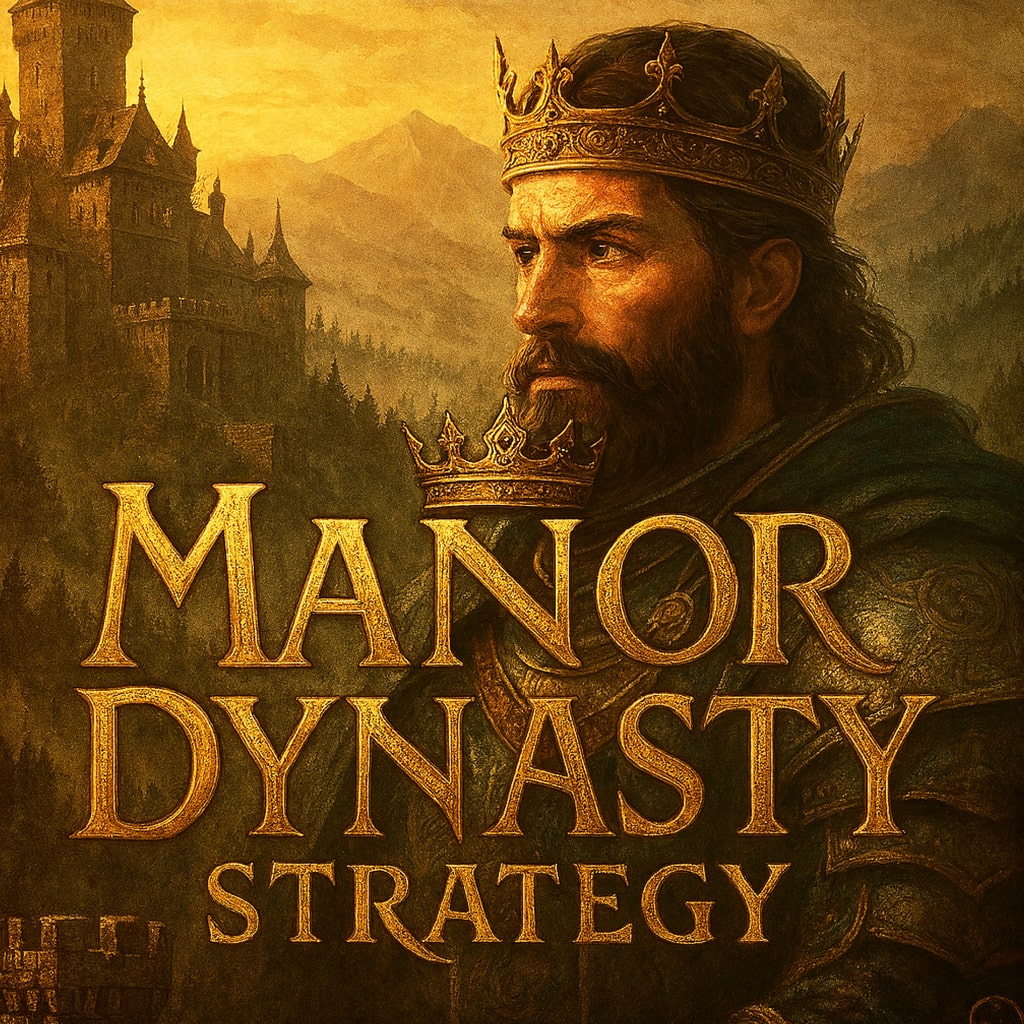
There’s something inherently appealing about the promise of building a medieval settlement from scratch—watching muddy paths develop into busy trade routes, wooden huts transform into stone fortifications, and a few peasants grow into a thriving society. Manor Dynasty Strategy, created by Testagamercreations Ltd, ventures into that familiar territory with ambition, positioning itself between hardcore simulation and accessible console strategy.
Launched on 18 March 2026 for PlayStation 4 (and playable on PS5 through backward compatibility), it’s a game that clearly takes inspiration from PC titans like Manor Lords and Medieval Dynasty. However, instead of aiming for a direct copy, it adapts the formula for console gameplay—sometimes successfully, sometimes not.
What you end up with is a game full of good ideas, uneven execution, and a surprisingly engaging sense of progression that keeps you invested even after its rough edges become apparent.
From Mud to Majesty: The Core Loop
At its core, Manor Dynasty Strategy focuses on growth—slow, deliberate, and often delicate expansion.
You start with little more than a patch of land and a handful of workers. From there, you gather resources, build structures, and gradually establish the systems that enable your settlement to operate. Food production, housing, trade, and defence all interconnect, forming a web of dependencies that feels fittingly complex for a medieval simulator.
One of the game’s standout features is its gridless building system. Instead of snapping structures to a rigid grid, you’re encouraged to shape your settlement naturally around the terrain. Farms follow the contours of hills, roads meander through forests, and your town develops an organic, almost lived-in appearance.
This approach is both freeing and occasionally vexing. While it fosters creativity, it can also cause problems with precise placement—especially on a controller. Trying to position buildings or optimise layouts can seem cumbersome, particularly when compared to mouse-and-keyboard strategy titles.
Nevertheless, when it works, it works beautifully. There’s genuine satisfaction in watching your village evolve into something that feels completely your own.
Economy and Survival: Balancing a Living System
Where Manor Dynasty Strategy truly excels is in its economic simulation.
This isn’t a “set it and forget it” city builder. Every system connects to another, and neglecting even one aspect can cause a chain of consequences. Food shortages spark unrest. Overexpansion depletes resources. Poor trade choices can halt growth altogether.
Seasons are key here. Winters are severe and relentless, requiring you to plan carefully and stockpile supplies. A good autumn harvest isn’t just a bonus—it’s essential.
The game also adds environmental factors, which introduce a subtle but important layer. Over-harvesting forests or mismanaging land can decrease productivity over time, encouraging more cautious expansion.
However, the interface sometimes struggles to clearly communicate all of this. The information is there, but not always displayed in the most user-friendly way. New players might feel confused about why something isn’t working, even when the underlying systems are well-designed.
Warfare: Tactical, Weighty, but Limited
Combat in Manor Dynasty Strategy takes place through real-time tactical battles, and it’s here that the game tries to expand its scope beyond simple city-building.
Battles focus on positioning, terrain, and unit fatigue. Charging recklessly into combat is rarely effective—you must consider elevation, weather, and your troops’ stamina.
There is a rewarding sense of weight to each encounter. Units don’t seem disposable; losses have significance, and rebuilding your forces consumes time and resources. This creates tension in every engagement.
However, the combat system lacks depth in its execution. Unit variety is limited, and battles can feel repetitive over time. Additionally, there’s a noticeable lack of polish in animations and responsiveness, which can make engagements feel less satisfying than they could be.
It offers a solid foundation but one that feels underdeveloped compared to the game’s economic systems.
Presentation: Functional, Not Flourished
Visually, Manor Dynasty Strategy prioritises historical accuracy over spectacle.
Buildings and environments are realistic and convincing, with a subdued colour palette that emphasises the medieval setting. There’s a certain charm in its simplicity—this isn’t a game trying to dazzle you with visual effects but rather to immerse you in a believable world.
That said, it’s clearly limited by its budget and platform. Character models are basic, animations are stiff, and the overall presentation lacks the polish seen in more premium strategy titles.
Performance on PS4 is generally steady, with occasional dips during larger settlements or battles. On PS5 (via backward compatibility), load times are shorter, but the core experience remains largely the same.
The audio design is similarly understated. Ambient sounds and music perform their role, but rarely stand out. There’s nothing particularly memorable here, but nothing actively detracts from the experience either.
Console Strategy: A Noble Attempt
Perhaps the most intriguing aspect of Manor Dynasty Strategy is its attempt to adapt a traditionally PC-focused genre to consoles in a meaningful way.
The control system is practical, with radial menus and shortcuts designed to streamline complex systems. For the most part, it works—but there’s no escaping the inherent limitations of a controller for this type of game.
Navigation can feel slow, and managing multiple systems at once is less smooth than it would be with a mouse. Experienced strategy players will probably notice the difficulty immediately.
That said, for console-first players, this might be one of the more accessible entries in the genre. It doesn’t overwhelm with complexity, and its systems—while deep—are not impossible to understand.
Pros & Cons
Pros
- Engaging and interconnected economic systems
- Organic, gridless building allows for creative settlements
- Meaningful seasonal mechanics that impact gameplay
- Strong sense of progression from village to city
- Accessible entry point for console strategy fans
Cons
- Clunky controls and interface limitations on console
- Combat system lacks depth and polish
- Visuals and animations feel dated
- Occasional lack of clarity in system feedback
- Performance dips in larger scenarios
Final Thoughts
Manor Dynasty Strategy is a game of ambition and compromise.
It doesn’t quite reach the heights of its PC counterparts, nor does it fully overcome the challenges of adapting a complex genre to console. However, what it does succeed in is still notable: a genuinely engaging medieval simulation that captures the slow, deliberate satisfaction of building something from nothing.
Its flaws are easy to notice—clumsy controls, uneven combat, and a lack of polish—but they don’t entirely ruin the experience. There’s a solid core here, one that rewards patience and careful play.
For players willing to look beyond its rough edges, Manor Dynasty Strategy offers a rewarding journey from humble beginnings to feudal dominance. It may not be the definitive console strategy game—but it’s a step in the right direction.