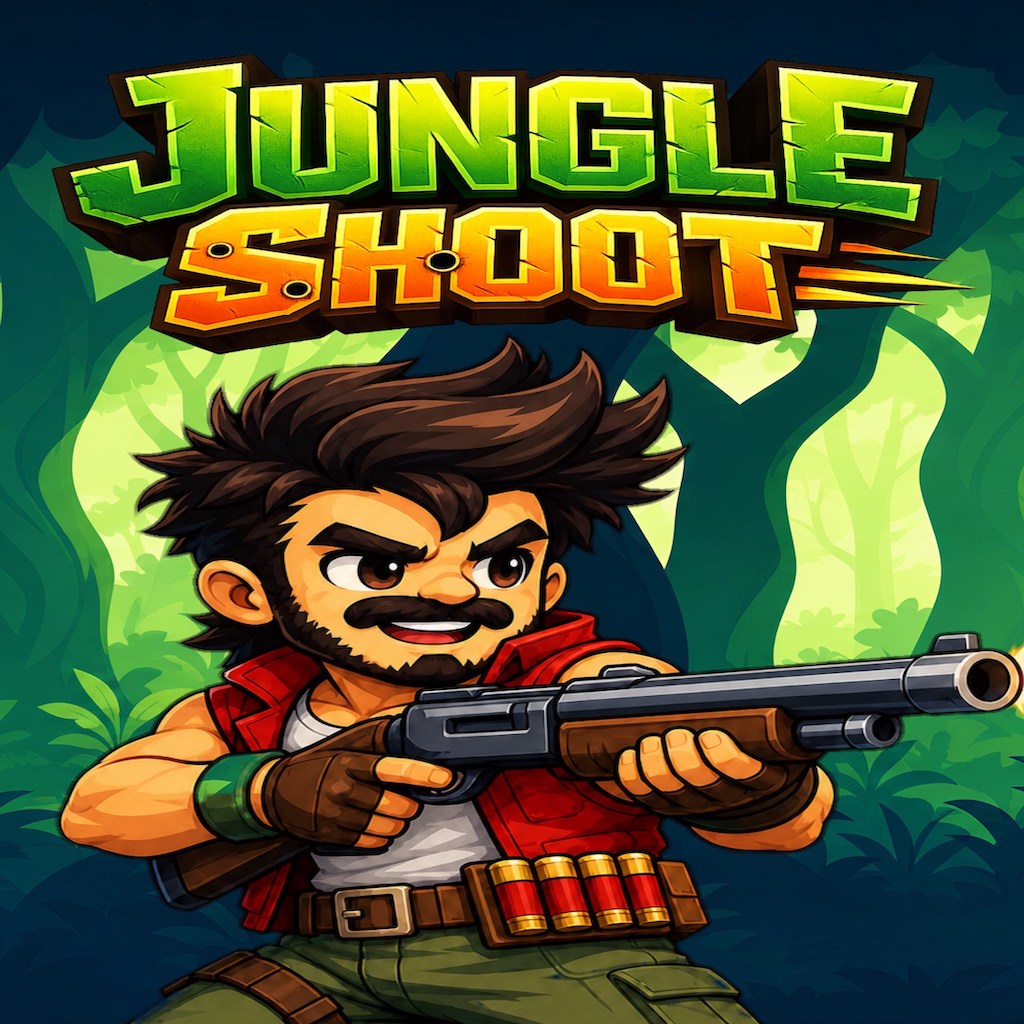
The budget-action genre has become one of the busiest corners of modern digital storefronts. Every week brings another wave-based shooter or platformer promising endless action, escalating challenges, and addictive progression systems. Most fade into obscurity almost immediately, lacking the mechanical depth or personality to stand out. Jungle Shoot, developed and published by Well Game Studio, avoids that fate through sheer momentum.
At first glance, the premise could not be simpler. You are dropped into a dangerous jungle environment where survival is the only objective. Enemies pour onto the screen from every direction, platforms become both lifelines and death traps, and every second survived pushes the challenge to a new level. It is a straightforward setup, but simplicity can be a strength when paired with responsive controls and satisfying progression.
Jungle Shoot does not attempt to tell an elaborate story or immerse players in a richly detailed world. Instead, it focuses entirely on creating an engaging gameplay loop built around movement, precision, and adaptation. The result is a game that knows exactly what it wants to be, even if it occasionally struggles to evolve beyond that foundation.
Movement is Everything
The moment Jungle Shoot begins, one thing is immediately clear: standing still is not an option. Unlike many wave-survival games that let players establish defensive positions or rely on static strategies, Jungle Shoot constantly encourages movement. Platforms become your primary means of survival, forcing you to leap, dodge, and reposition as enemies close in from every angle. Staying in one place for too long almost guarantees disaster.
This focus on mobility creates a frantic energy that drives the entire experience. Every jump feels important, every landing carries risk, and every misstep can quickly lead to a failed run. There is a satisfying rhythm to navigating the jungle canopy while managing incoming threats.
The controls deserve considerable praise. Movement feels responsive and precise, which is essential for a game built around quick reactions. Tight controls ensure that failures rarely feel unfair. More often than not, when you die, you know exactly what mistake led to your downfall. That sense of accountability helps make each defeat feel like an opportunity to improve rather than a reason to quit.
Escalating Chaos
A strong survival game lives or dies by its ability to sustain tension over time. Fortunately, Jungle Shoot recognises that simply throwing more enemies at the player is not enough.
Enemy patterns evolve as runs progress. Early encounters introduce straightforward threats that teach the fundamentals of movement and positioning. Later waves grow increasingly aggressive, forcing players to react to multiple dangers at once. Projectile attacks, faster movement speeds, and more complex enemy behaviours combine to create situations that demand constant attention.
This escalating difficulty keeps the action engaging throughout the early and middle stages of a run. There is a genuine sense of pressure as the battlefield becomes more crowded and opportunities for safe movement become increasingly scarce.
What makes the challenge effective is how it encourages adaptation rather than simple endurance. Players who cling to a single strategy quickly discover its limitations. Success comes from learning enemy patterns, understanding movement routes, and adjusting priorities on the fly.
The best runs often feel like carefully orchestrated chaos. Somehow, despite dozens of enemies, projectiles, and hazards filling the screen, everything falls into place for a few glorious moments before the next crisis emerges.
Progression That Keeps You Playing
The progression system is the glue that holds everything together. As enemies fall, players collect coins to invest in upgrades and enhancements. These improvements deliver tangible benefits, from increased firepower to enhanced survivability. While the upgrade paths are not especially deep, they offer enough meaningful progression to keep players invested across multiple sessions.
There is a satisfying sense of growth with each run. Even failed attempts contribute to future success, ensuring that time spent playing rarely feels wasted. Unlocking stronger equipment or improving existing abilities creates a steady stream of small victories that complement the larger goal of surviving longer.
This progression loop fuels the game’s strongest quality: its ability to encourage one more attempt. A difficult defeat often leads directly into another run because players know they are just one upgrade away from pushing further than before.
Many arcade-inspired games rely on this formula, but Jungle Shoot executes it effectively enough to remain compelling for far longer than its modest scope might suggest.
A Jungle That Rarely Changes
For all its strengths, Jungle Shoot struggles with one significant issue: environmental variety. The jungle setting provides an attractive backdrop at first. Dense foliage, elevated platforms, and vibrant colours create a fitting arena for the game’s fast-paced action. Unfortunately, the visual experience remains largely unchanged throughout the adventure.
Players encounter the vast majority of environmental assets very early in the experience. New challenges arrive through enemy behaviour and escalating difficulty rather than meaningful changes to the world itself. While this approach keeps development focused on gameplay, it also fosters a growing sense of familiarity.
After several hours, the environments begin to blur together. The excitement generated by the gameplay remains intact, but the sense of discovery fades considerably. More visual variety could have helped extend the game’s longevity and reinforced the feeling of progressing deeper into a dangerous wilderness. It never becomes actively unpleasant to look at, but it does become predictable.
Presentation and Performance
Visually, Jungle Shoot adopts a clean, functional art style that prioritises readability over spectacle. This proves wise given the intensity of the action. Even in particularly chaotic encounters, enemies, hazards, and key pickups remain easy to identify.
Animations are smooth enough to support the fast-paced gameplay, and visual effects communicate danger effectively without overwhelming the screen. The art direction may not be groundbreaking, but it serves the game well.
The audio presentation follows a similar philosophy. Sound effects provide satisfying feedback in combat, while the soundtrack delivers energetic background music that complements the frantic pace of the action. The music may not produce memorable individual tracks, but it maintains the necessary sense of urgency.
Performance remains consistently stable throughout. Frame rate issues would have been disastrous in a game built around precision platforming and quick reactions, but Jungle Shoot avoids those pitfalls. The experience remains smooth even as enemy numbers climb.
Final Verdict
Jungle Shoot is not a game that seeks to revolutionise the platform shooter genre. It knows exactly what it is: a fast, challenging, arcade-inspired survival experience built around movement, reflexes, and progression. Within those boundaries, it delivers a surprisingly enjoyable package.
The responsive controls, escalating enemy encounters, and rewarding upgrade systems create a gameplay loop that remains engaging for far longer than expected. Its survival mechanics have an addictive quality that encourages repeated attempts, and the constant demand for movement keeps every run energetic and tense.
Its shortcomings are difficult to ignore. Environmental variety is limited, long-term progression lacks significant depth, and the game reveals most of its ideas relatively early. Yet despite those issues, Jungle Shoot succeeds because its core mechanics are genuinely fun.
Sometimes, a game doesn’t require grand ambitions to be valuable. Often, it only needs a solid foundation and the confidence to expand on it. Jungle Shoot may never become a genre-defining classic, but for players seeking a quick-fire arcade challenge filled with frantic action and satisfying progression, it proves there is still plenty of life left in the jungle.