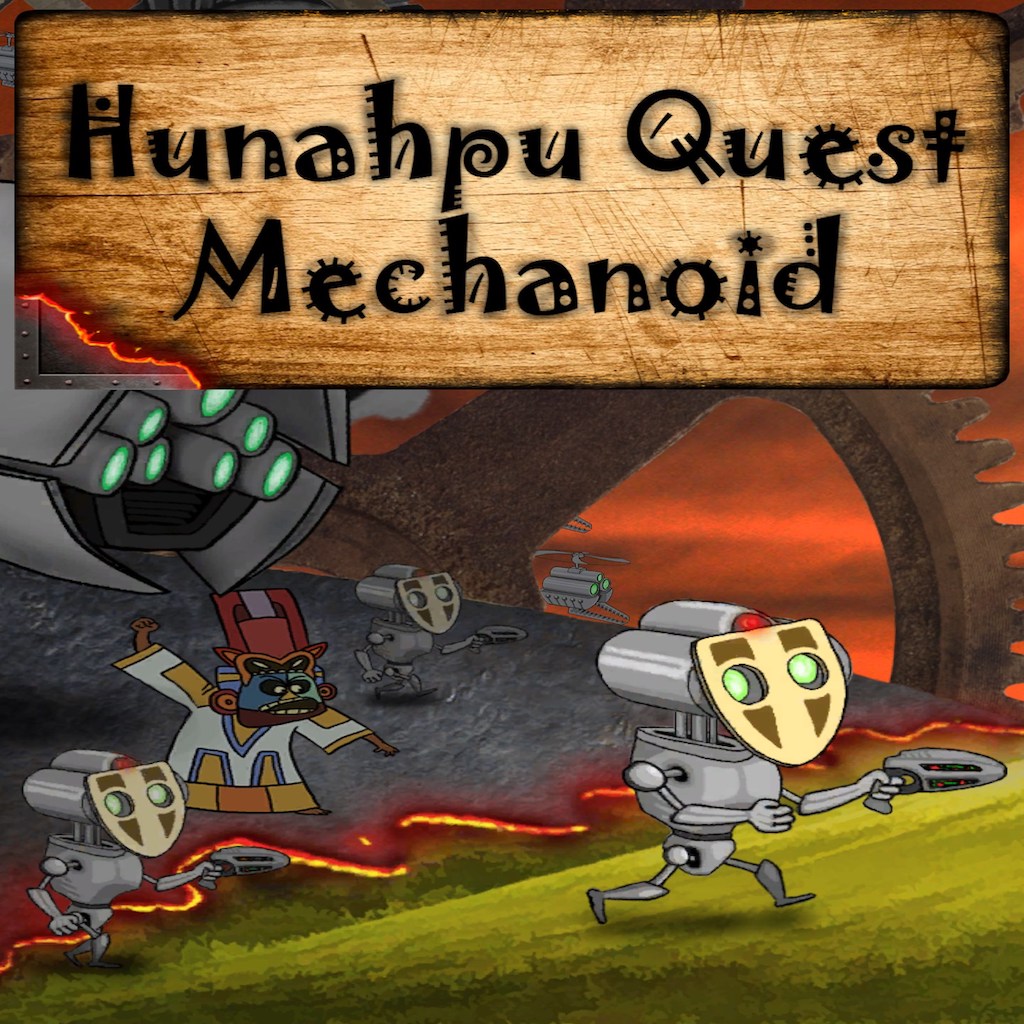
There is a certain charm in a game that takes two things that have absolutely no business sharing the same screen and decides they belong together perfectly. Hunahpu Quest: Mechanoid takes the ancient mythology of the Mayan hero Hunahpu and throws him into a world of mechanical monsters, laser barriers and futuristic machinery, creating a curious little adventure that feels like somebody raided an old 16-bit platformer and then plugged it into a science-fiction laboratory. It is colourful, compact and wonderfully old-school in its approach to exploration and challenge. More importantly, beneath the unusual premise lies a platformer that understands the importance of responsive controls, satisfying puzzles and giving players a reason to look beyond the obvious path.
A Hero Out of Time
The story begins with a simple objective. During his adventures, Hunahpu must fight enemies, make new friends and solve increasingly complex puzzles as he attempts to rescue his brother from the clutches of a mechanical monster. It isn’t the sort of narrative that needs lengthy exposition to establish its purpose. The motivation is clear from the start, allowing the game to get on with what it does best.
There is something appealing about placing Hunahpu so far outside his traditional setting. Mayan mythology and futuristic machinery shouldn’t naturally fit together, yet the contrast gives Mechanoid much of its identity. Ancient relics sit alongside technology, traditional imagery collides with mechanical threats, and Hunahpu finds himself relying on intelligence and agility against enemies that look as though they have escaped from an entirely different genre.
The simplicity of the story also suits the game’s retro character. This isn’t a platformer that wants to bury its adventure beneath endless dialogue trees or complicated character relationships. The rescue mission provides enough motivation to keep moving, while the strange world surrounding Hunahpu provides plenty of visual personality along the way.
Jump, Think, Survive
At its heart, Hunahpu Quest: Mechanoid is a puzzle platformer, and its fundamentals are refreshingly straightforward. Hunahpu needs to jump across hazards, avoid enemies, activate switches and work out how different mechanisms fit together. The challenge comes from combining these elements rather than simply throwing increasingly powerful enemies at the player.
Movement is particularly important, because the environments are filled with traps that demand good timing. Spikes, mechanical saws, laser systems and other hazards can turn a seemingly harmless section into a sudden test of reflexes. The controls need to be reliable when you’re dealing with this sort of design, and thankfully they feel appropriately responsive. When you miss a jump, it generally feels like something to learn rather than something the game has randomly taken away from you.
The puzzle elements add a welcome change of pace. Flipping switches and finding the correct route through dangerous areas give the player something to think about between bouts of platforming. There is satisfaction in spotting the solution to a room, particularly when several hazards have to be dealt with in the correct order. It isn’t revolutionary puzzle design, but it understands that sometimes the simplest solution is also the most enjoyable.
Ancient Power, Mechanical Enemies
The enemies add another layer of variety, with Hunahpu facing a collection of mechanical threats throughout his journey. The futuristic creatures and machines fit well within the game’s strange mythology-meets-science-fiction aesthetic. They don’t simply stand in Hunahpu’s way, either, as dealing with them often requires awareness of their movement patterns and attack behaviour.
The inclusion of energy weapons gives Hunahpu another option when things get dangerous. This helps prevent the game from relying entirely on platforming, while it never loses sight of its puzzle-focused foundations. There is still strong emphasis on positioning and timing, so simply having a weapon doesn’t turn every encounter into a shooting gallery.
Boss encounters provide the biggest tests. These mechanical monstrosities require players to recognise patterns, react to attacks and manage their resources carefully. They are also where the game’s arcade roots become most apparent, as learning the rhythm of a boss battle is often more important than simply throwing attacks at it. Later encounters can be considerably more demanding, but overcoming a boss after several failed attempts delivers the sort of satisfaction that classic platformers have been providing for decades.
Secrets Reward Curiosity
One of the nicest aspects of Mechanoid is that it encourages exploration rather than simply pointing players towards the next objective. Hidden areas contain relics and upgrades, giving you a reason to investigate corners that could easily be ignored. In a game built around compact levels, these secrets help make the environments feel more substantial.
The collectable element also works because it complements the game’s mythology. Finding ancient Mayan artefacts in a world dominated by mechanical technology reinforces the strange identity that makes the game stand out. These discoveries aren’t arbitrary objects scattered around the levels. They contribute to the feeling that there is more history behind the world than the main route initially suggests.
Of course, completionists are likely to get more out of this than players who simply want to reach the end. Searching every corner can occasionally interrupt the forward momentum, particularly when you’ve already worked through a difficult section. Still, the temptation to check one more suspicious-looking platform is difficult to resist.
A Lovely Retro Throwback
Visually, Hunahpu Quest: Mechanoid knows exactly what it wants to be. Its 16-bit-inspired pixel art immediately recalls the era of classic console platformers, while the mechanical enemies and futuristic environments lend the familiar aesthetic a slightly different flavour. Character sprites are expressive enough to give Hunahpu personality, and the environments are rich in colourful details to keep the journey visually interesting.
The soundtrack follows a similar philosophy. Energetic chiptune music gives the adventure a distinctly retro personality without becoming overly distracting. It is the sort of soundtrack that feels naturally suited to jumping through traps, fighting mechanical monsters and figuring out another room full of switches.
There is no attempt to disguise the game’s indie scale. Some areas are simpler than others, and the presentation lacks the polish or spectacle of a major modern platforming production. Yet that isn’t necessarily a weakness. Mechanoid works because its visual identity is cohesive, and the pixel art helps establish a warm, nostalgic atmosphere that suits the mechanics.
When the Challenge Bites
The difficulty curve is generally well handled, though there are moments when the game asks considerably more of the player. Boss encounters, in particular, can cause a sharp spike in difficulty, especially when their attack patterns grow more complex. Fortunately, checkpoints help ease the frustration, allowing players to retry challenging sections without repeating large portions of the adventure.
That checkpoint system is important because Hunahpu Quest: Mechanoid is clearly designed around learning through failure. You are expected to make mistakes. You are expected to fall into traps and be caught by enemies. The key is that the game makes it easy enough to try again and apply what you have learned.
There are occasions when the challenge can feel a little abrupt, and players accustomed to modern platformers with generous movement systems may need some time to adjust. Those willing to meet the game on its own terms, however, will find a rewarding little adventure that values patience and observation.
A Strange Combination That Works
Perhaps the greatest achievement of Hunahpu Quest: Mechanoid is that its bizarre concept never feels like a gimmick. Mayan mythology and mechanical science fiction sound like ingredients that should clash, yet the game makes the combination feel surprisingly natural. The retro presentation helps bridge the two ideas, giving everything a cohesive, colourful, slightly fantastical visual language.
It also helps that the underlying gameplay is dependable. The game doesn’t need its unusual setting to carry it, because the platforming and puzzles are enjoyable in their own right. The mythology and mechanical elements simply provide the flavour that makes the experience easier to remember.
That is ultimately what I took away from Hunahpu Quest: Mechanoid. It isn’t trying to redefine the platformer. Instead, it feels like a lovingly assembled little adventure that understands why these games were so enjoyable in the first place. Jumping across a dangerous room, finding a hidden relic, solving a switch puzzle, and eventually defeating a giant mechanical boss remain a wonderfully satisfying formula.
Verdict
Hunahpu Quest: Mechanoid is a charming retro platformer that successfully blends Mayan mythology with mechanical science fiction without losing sight of what makes a good side-scrolling adventure work. Responsive controls, enjoyable puzzle-solving, colourful pixel art, and increasingly dangerous mechanical enemies create a consistently entertaining journey. The boss battles provide welcome difficulty spikes, while hidden relics and upgrades encourage curious players to explore beyond the obvious route.
It isn’t without its limitations. The underlying mechanics are familiar, and anyone looking for a major evolution of the genre won’t find it here. Some later challenges can also feel noticeably tougher than those that precede them, while the game’s modest production values occasionally show through. Yet these are relatively minor complaints in an experience that understands its audience and delivers exactly the sort of focused, nostalgic platforming adventure it promises.
There is a real warmth to Hunahpu Quest: Mechanoid. It feels like a game made by people who genuinely enjoy the classic platformers that inspired it, while still having enough imagination to throw something unusual into the formula. Hunahpu’s journey through this wonderfully strange world may not be the longest adventure you’ll undertake this year, but it is an enjoyable one, and sometimes that’s all a good platformer needs to be.
It is a fun, colourful and pleasantly old fashioned platformer with a wonderfully eccentric premise. If you have a soft spot for 16 bit adventures, precision platforming and games that aren’t afraid to embrace a genuinely strange idea, this mechanical Mayan adventure is well worth taking for a spin.