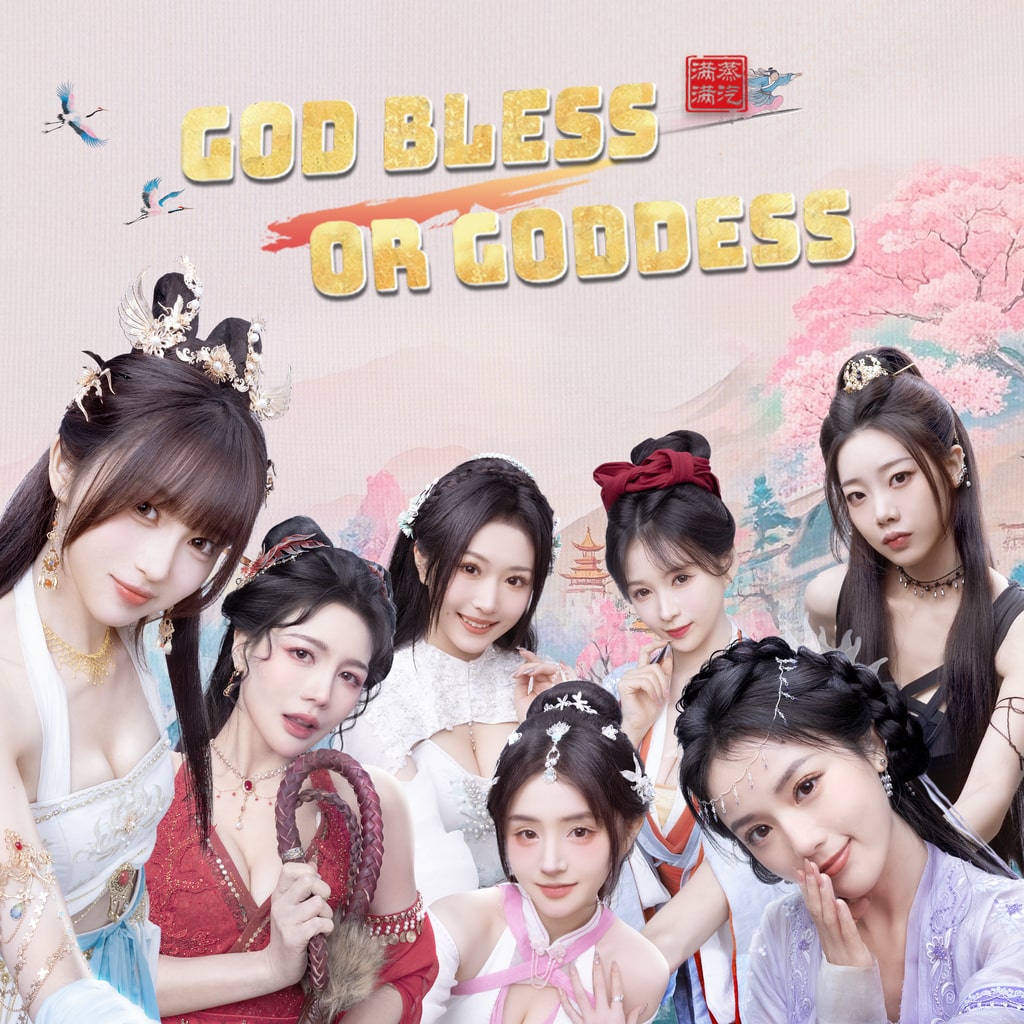
Few games in recent years take such a bold swing at blending live-action cinematic storytelling with interactive choice mechanics as God bless, or Goddess. Set against a backdrop inspired by xianxia mythology — where ascension, spiritual discipline, and human desire intertwine — the game places players in the role of Lin Fan, a disciple striving toward immortality within a rigid cultivation sect.
Rather than relying on traditional animation or real-time 3D environments, God bless, or Goddess commits fully to a full-motion video (FMV) presentation. Narrative moments unfold through filmed performances, with player choices shaping how scenes progress and how relationships evolve. The result is an experience that feels closer to an interactive drama than a conventional RPG — one that prioritises story, character, and atmosphere over mechanical complexity.
Story & Setting: Cultivation, Conflict, and Choice
The narrative follows Lin Fan as he navigates life within the Crane Illusion Sect, a world governed by strict hierarchies, spiritual discipline, and ever-present temptation. His Pure Yang lineage positions him as someone destined for greatness, but also places him under intense scrutiny from mentors, rivals, and peers.
While the overarching goal is ascension, the journey is defined by interpersonal dynamics. Fellow disciples, senior sisters, and authority figures each bring their own motivations and pressures, forcing Lin Fan to balance ambition with emotional restraint. The game plays with familiar cultivation tropes — spiritual trials, inner demons, and destiny — but grounds them in character-driven moments that give the world a human edge.
Humour is woven throughout, preventing the story from becoming overly self-serious. Light-hearted exchanges and situational comedy help balance the higher-stakes moments, making the narrative feel accessible even to players unfamiliar with xianxia themes.
Gameplay Structure: Interactive Narrative First
From a gameplay perspective, God bless, or Goddess is firmly rooted in the interactive narrative genre. There is no traditional combat system, open exploration, or complex stat management. Instead, the experience is built around decision-making, dialogue selection, and timed interactions.
Branching Narrative Design
Player choice is the heart of the game. Dialogue options and situational decisions shape relationships, alter narrative paths, and ultimately determine which ending players reach. Some choices have immediate consequences, while others quietly influence future events, rewarding attentive players who consider the long-term implications of their actions.
This branching design gives the game strong replay value. Seeing alternative outcomes, uncovering new character arcs, and steering Lin Fan toward different destinies encourages multiple playthroughs.
Quick-Time Events and Trials
Quick-time events appear during moments of tension, such as spiritual trials or critical confrontations. These segments add bursts of interaction that help break up longer stretches of dialogue, though they remain relatively simple and forgiving. The focus remains on narrative flow rather than mechanical challenge.
Presentation: Live-Action Fantasy
The most distinctive aspect of God bless, or Goddess is its live-action presentation. Characters are portrayed by real actors, with cinematography and staging that lean into theatrical fantasy rather than realism. Digital effects are layered on top to convey supernatural powers, spiritual energy, and mythic environments.
While the integration of visual effects with filmed footage is not always seamless, the ambition is clear. The performances carry much of the experience, and the cast brings enough personality and expression to make the characters memorable.
Audio & Performances
Voice acting is central to an FMV-driven game, and God bless, or Goddess delivers confident performances across its cast. Characters feel distinct, and emotional beats — whether dramatic or comedic — generally land as intended.
The soundtrack supports the mythic tone with atmospheric compositions that underscore moments of tension, reflection, and escalation. While not especially memorable on its own, the music does its job in reinforcing mood and pacing.
Narrative Depth and Pacing
Narratively, the game offers plenty to engage with, but pacing can occasionally feel uneven. Some story paths move briskly, while others linger longer than necessary, particularly if players are replaying sections to explore alternate choices.
The writing embraces heightened emotion and fantasy stylisation, which may not resonate with everyone, but it suits the genre and presentation. Those who enjoy character-focused storytelling will find plenty to appreciate, even if the overall structure lacks the complexity of deeper RPG narratives.
Accessibility and Player Appeal
God bless, or Goddess is highly accessible. The lack of complex systems or reflex-heavy gameplay makes it welcoming to players who prefer story-driven experiences. Menus and choices are clearly presented, and the game places minimal mechanical barriers between the player and the narrative.
Players seeking traditional gameplay depth may find the experience too lightweight, but those drawn to interactive films, visual novels, or branching stories will feel right at home.
Replayability & Longevity
Multiple endings and character paths give the game solid replay value. While a single playthrough may be relatively short, discovering alternative outcomes and relationship dynamics adds meaningful longevity.
Final Verdict
Pros:
- Ambitious use of live-action FMV storytelling
- Strong emphasis on player choice and branching narratives
- Memorable characters and expressive performances
- Accessible, story-focused design
- Good replay value through multiple endings
Cons:
- Limited mechanical depth
- Occasional pacing issues
- Visual effects integration can feel uneven
Summary:
God bless, or Goddess succeeds as a cinematic, choice-driven experience that prioritises narrative and character over traditional gameplay systems. Its ambition, presentation, and replayability make it a compelling option for fans of interactive storytelling, even if its mechanics remain intentionally light.