Horse racing has always held an unusual place in video games. While football, basketball and motorsport have enjoyed countless blockbuster adaptations over the decades, horse racing has remained something of a niche pursuit. The few games that truly captured the tension of sitting in the saddle, reading a race and making split-second decisions have become cult classics, fondly remembered by players who still long for a proper successor. Full Stride arrives carrying those expectations on its shoulders, and from the moment the starting gates clang open, it becomes clear that this is a game made by someone who genuinely understands the sport.
Developed by Blue Bullet Inc., Full Stride strips away flashy distractions and places players directly in the boots of a professional jockey. Rather than focusing on breeding bloodlines, stable management or endless menus, the emphasis is firmly on the race itself. Every decision matters, from choosing where to settle in the pack to judging precisely when to ask your horse for one final effort. It captures the tactical side of horse racing with remarkable precision, delivering moments of genuine excitement that feel earned rather than scripted.
That said, Full Stride is also a game that demands a great deal of its players before it reveals its strengths. It offers very little guidance, arrives with a handful of rough edges, and occasionally feels like a project that could have benefited from a few more months in the stable. Beneath those frustrations, however, lies one of the most authentic jockey simulations released in years.
Every Race is a Tactical Battle
What immediately separates Full Stride from most sports games is that raw speed counts for very little. Success depends on reading the race as it unfolds. Charging into the lead from the opening seconds might look impressive, but it usually leaves your horse exhausted long before the finishing post comes into view.
Instead, every race becomes an exercise in patience. You study the horses around you, look for gaps opening between rivals, and constantly monitor your mount’s stamina reserves. Holding your position through the early stages, while resisting the temptation to push forward, creates a quiet tension that builds with every passing furlong.
Different horses require different riding styles, adding welcome variety throughout Career Mode. Some horses naturally enjoy leading from the front and maintaining a relentless pace. Others prefer to sit comfortably in midfield before unleashing a devastating burst of acceleration in the closing stages. Learning those personalities becomes as important as mastering the controls.
The result is a surprisingly cerebral experience. Winning rarely comes from frantic button-mashing. Instead, victory belongs to riders who stay calm under pressure and trust their judgement.
Seeing the Race Through a Jockey’s Eyes
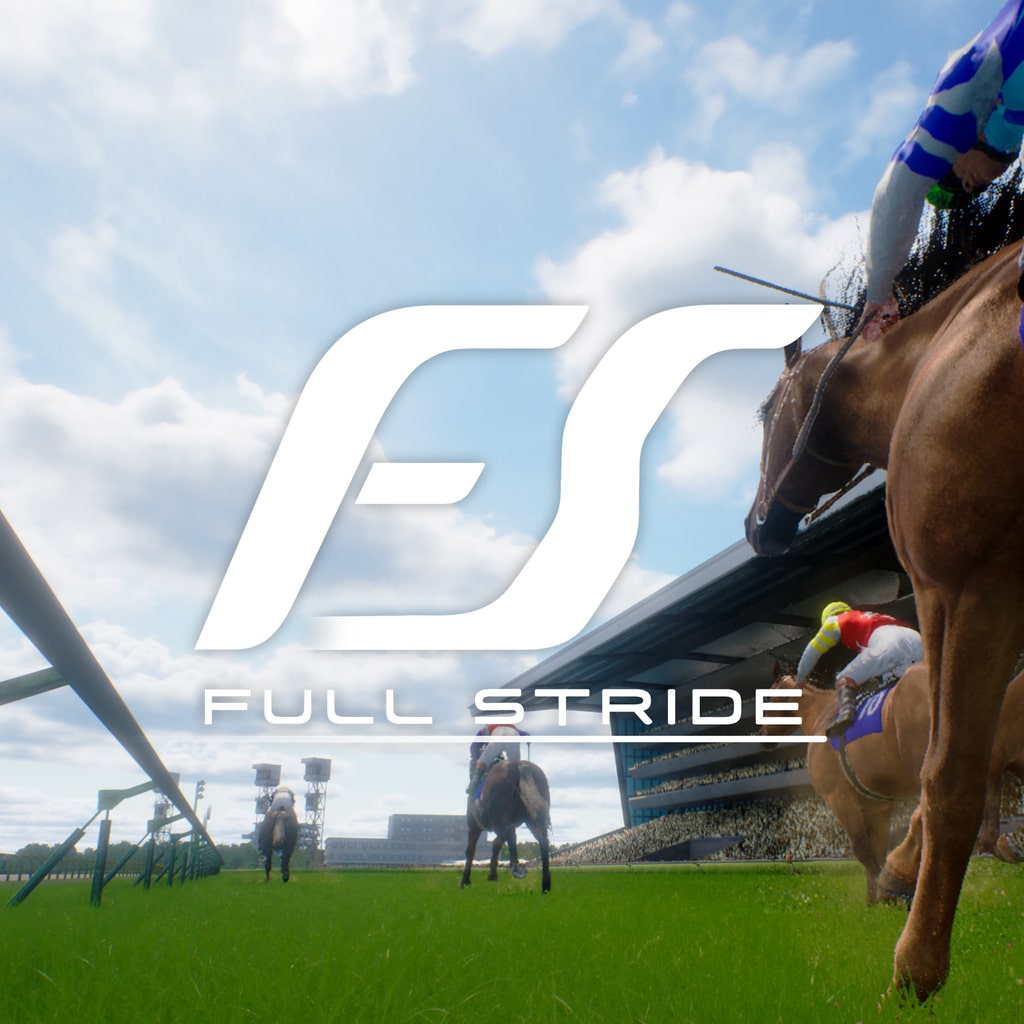
One of Full Stride’s biggest achievements is its presentation during races. The optional Jockey Cam transforms the experience, placing players directly in the action from the rider’s perspective. Suddenly, the track feels much narrower, rival horses appear intimidatingly close, and approaching corners demand immediate decisions.
It offers an incredibly immersive viewpoint that conveys the chaos of horse racing far better than a distant television-style camera ever could. Watching dirt fly into your face while hearing the pounding rhythm of dozens of hooves creates a genuine sense of speed and urgency.
Certain courses become especially memorable from this perspective. Long, sweeping bends demand careful positioning, while famous uphill finishes test whether you’ve managed your horse’s energy wisely. Those final few hundred metres often become thrilling battles where every tiny movement matters.
The camera options are varied enough to satisfy different preferences, but the first-person viewpoint is undoubtedly where Full Stride truly comes alive.
A Career Built One Ride at a Time
Career progression follows a fairly traditional path. Players begin by riding in smaller races, gradually earning opportunities aboard stronger horses and competing in increasingly prestigious events. The ultimate goal is to reach the elite G1 races, where the competition becomes noticeably fiercer.
There is satisfaction in climbing through the ranks, especially when owners begin to trust you with more capable horses. Winning an important race feels significant because it represents progress earned through consistent performances rather than arbitrary experience points.
Unfortunately, the surrounding career lacks much personality. Outside the races themselves, there is very little to become emotionally invested in. Owners remain largely anonymous, horses rarely develop meaningful identities beyond their statistics, and there are no relationships or rivalries to help shape your journey.
Compared with management-focused racing games, Full Stride feels sparse. It succeeds as a racing simulator but misses opportunities to create memorable stories between events. Over time, the loop of entering races, earning points and moving on to the next competition begins to feel repetitive.
Multiplayer Adds an Unpredictable Edge
Online multiplayer supports up to four riders, and this is where Full Stride often delivers its most dramatic moments. Computer-controlled opponents behave intelligently enough, but human players introduce a level of unpredictability that no artificial intelligence can fully replicate.
Battling for position through crowded fields becomes considerably more intense when you know another player is waiting to seize any opening you leave. Every corner feels more dangerous, every tactical decision carries greater consequences, and every perfectly timed sprint becomes immensely satisfying.
Winning against real opponents creates stories you’ll remember long after the race has finished. Nose victories, perfectly judged overtakes and desperate battles down the final straight capture the competitive spirit that makes horse racing so captivating.
The multiplayer offering remains fairly straightforward, complementing the game’s strongest mechanics rather than detracting from them.
Rough Around the Edges
Despite its mechanical strengths, Full Stride struggles to welcome newcomers. The complete absence of a proper tutorial is astonishing. Players are expected to understand stamina management, pacing, controls and riding techniques with almost no explanation.
This creates a frustrating opening few hours, during which races can feel confusing rather than rewarding. Rather than learning naturally through careful instruction, many players will likely search for online guides or external manuals simply to understand basic systems. That is an unnecessary barrier for a game with such satisfying mechanics beneath.
Technical issues also occasionally interrupt the experience. While performance is generally solid, visual glitches and occasional odd behaviour from computer-controlled horses remind you that this is an independent production with limited resources. None of these issues completely derail the experience, but they do prevent the game from feeling as polished as its core design deserves.
Controller support is another area that feels underdeveloped. Although controllers work well once configured, keyboard support remains limited, and interface prompts favour PlayStation button layouts regardless of platform. These are relatively small frustrations individually, but together they contribute to a feeling that the presentation lacks refinement.
A Passion Project with Real Potential
Perhaps the most impressive thing about Full Stride is how clearly its passion shines through. This is not a cynical attempt to capitalise on a forgotten genre. It feels like a genuine love letter to horse racing and the tactical brilliance that often escapes casual viewers.
When everything clicks, the experience becomes genuinely exhilarating. Timing your final sprint perfectly, squeezing through a narrow gap before the home straight and crossing the finish line by the smallest possible margin deliver an adrenaline rush unlike almost anything else in sports gaming. Those moments remind you exactly why fans have waited so long for another dedicated jockey simulator.
It is impossible not to imagine how much stronger a sequel could be with expanded career systems, improved tutorials and a more polished presentation. The foundations are already remarkably solid. They simply need more support.
Final Verdict
Full Stride is one of those rare games that earns admiration for its authenticity rather than spectacle. Blue Bullet Inc. understands the psychology of horse racing, delivering a simulation in which patience, judgement and intelligent decision-making consistently triumph over reckless aggression. Every race demands concentration, and every victory feels genuinely deserved.
Its shortcomings are equally hard to ignore. The lack of onboarding, limited career progression and persistent technical issues make it harder to recommend without reservation, especially for newcomers unfamiliar with jockey simulators. Players willing to persevere will find an absorbing, deeply satisfying experience, but they will also need to accept that much of the learning happens through trial and error.
For dedicated racing fans who have spent years hoping for a spiritual successor to the classics, Full Stride offers enough tactical depth to make the journey worthwhile. It may not yet cross the finish line as a complete package, but it proves there is still plenty of life left in this overlooked genre. With a little more polish and a stronger supporting structure, this could easily become the benchmark against which future jockey simulations are measured.