Puzzle-platformers thrive on their core mechanic. You might have charming visuals, precise controls, and clever level design—but if the main idea doesn’t hold up, the whole experience falls apart. FlipCat, made by Fa Games, understands this better than most. Its entire identity depends on one simple, playful concept: flip the world and rethink everything.
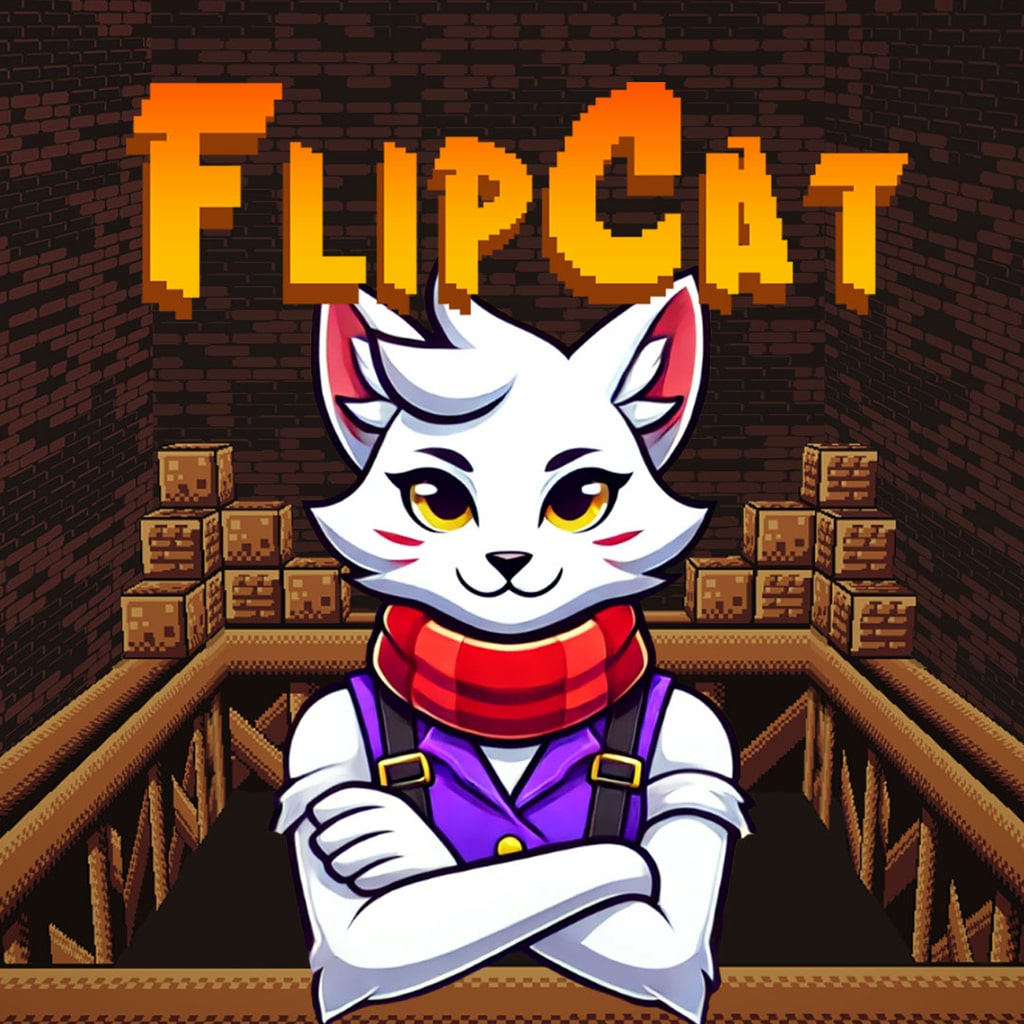
Originally launched in 2025 for Xbox and PC before coming to PlayStation 5 on April 2, 2026, FlipCat is a 2D pixel-art platformer featuring a delightfully quirky protagonist—a white cat in a purple shirt navigating a series of increasingly tricky puzzle stages. It’s quirky, colourful, and instantly understandable. But the real question is whether its gravity-defying gimmick can sustain an entire game.
For the most part, the answer is yes—though not without a few missteps along the way.
Turning the World on Its Head
The defining feature of FlipCat is its rotation mechanic. When you collide with specific yellow blocks, you rotate the entire game world by 90 degrees. Floors turn into walls, walls become ceilings, and hazards shift positions, forcing you to rethink your approach.
This mechanic feels intuitive almost immediately. There’s no complicated control scheme to master—just movement, jumping, and flipping. Yet, the simplicity hides surprisingly deep possibilities.
A simple jump can turn into a multi-step puzzle. A wall blocking your way might become a floor after a rotation. A deadly spike pit might transform into a harmless surface—if you flip at the right moment.
This constant recontextualisation of space is where FlipCat truly shines. It encourages experimentation, rewards spatial awareness, and fosters a satisfying cycle of trial, discovery, and achievement.
30 Levels of Escalating Challenge
Across its 30 meticulously crafted levels, FlipCat consistently develops its core concept.
The early stages serve as tutorials, introducing the rotation mechanic within safe, controlled environments. You’ll understand how flipping influences movement, how to overcome basic obstacles, and how to time your actions effectively.
As the game progresses, new elements are layered in:
- Moving platforms that change orientation with each flip
- Cannons that become more dangerous depending on your angle
- Trampolines that alter your trajectory mid-rotation
- Portals and switches that add additional layers of complexity
This gradual escalation is handled well. Each new mechanic feels like a natural extension of the core concept, rather than an arbitrary addition.
However, the game’s relatively short length means it never fully explores the potential of these systems. Just as things start to become truly inventive, the experience begins to wind down. It leaves you with the sense that there was room for more—more levels, more mechanics, more ambitious puzzles.
Precision Meets Playfulness
In terms of controls, FlipCat is refreshingly responsive.
Movement is precise, jumps feel consistent, and rotations occur instantly without input lag. This is crucial in a game where accuracy often makes the difference between success and failure.
The challenge lies not in clunky mechanics, but in the design of the levels themselves. Timing your flips, positioning your character correctly, and anticipating how the environment will change requires focus and planning.
That said, the difficulty curve can be uneven.
Some levels strike the perfect balance between challenge and clarity, offering satisfying “aha” moments when everything clicks into place. Others lean more heavily on trial-and-error, requiring multiple attempts to understand the intended solution.
It never feels unfair, but it can occasionally seem a bit rough around the edges—particularly when hazards like cannons or spikes demand near-perfect timing after a rotation.
A Retro Aesthetic with Personality
Visually, FlipCat features a traditional pixel-art style and does so confidently.
The environments are vibrant and tidy, with a strong focus on readability. This is especially crucial considering the rotation mechanic—players must quickly grasp their surroundings, even as the world shifts orientation.
The protagonist is simple yet memorable. A white cat in a purple shirt might not be expected to stand out so much, but there’s a charm to the design that leaves an impression. Small animations—such as idle movements or jump arcs—add just enough personality without overcomplicating things.
Although the visual variety between levels isn’t particularly extensive, the consistent art style helps sustain a cohesive identity across the game.
Sound Design That Keeps It Light
Audio in FlipCat complements its light-hearted tone.
The soundtrack features upbeat, unobtrusive melodies that maintain a relaxed feeling—even as the puzzles become more challenging. It’s not particularly memorable, but it performs its role effectively.
Sound effects are sharp and purposeful. The “click” of a world rotation, the bounce of a trampoline, the impact of hazards—all deliver clear feedback without overwhelming the player.
It’s a subtle yet effective audio design that enhances the game’s accessibility.
Short but Sweet
One of FlipCat’s most notable features is its brevity.
With 30 levels, the game can be finished in a relatively short time—especially for seasoned puzzle-platformer players. While there’s some replay value in perfecting levels or enhancing performance, it’s unlikely to keep you engaged for dozens of hours.
This isn’t necessarily a flaw. FlipCat feels crafted as a concise, targeted experience—one that introduces a clever idea, explores it, and then concludes before overstaying its welcome.
However, for players looking for a more substantial or enduring experience, it might feel somewhat slight.
Where It Stands
FlipCat comfortably occupies the space usually filled by smaller, idea-driven indie games. It doesn’t aim to be a genre-defining masterpiece, but it executes its core concept with enough skill and charm to make it stand out.
Its greatest strength is its clarity of vision. Everything—from level design to controls to presentation—supports the central mechanic. There’s very little wasted space or unnecessary complexity.
At the same time, that focus also reveals its limitations. The game doesn’t change much beyond its initial premise, and its relatively short length means it never fully explores its ideas to their fullest.
Final Thoughts
FlipCat is an inventive, charming puzzle-platformer that makes excellent use of a simple yet effective mechanic.
By enabling players to rotate the world and reconsider spatial relationships, it crafts a series of engaging challenges that reward creativity and careful planning. Its precise controls, clear visuals, and accessible design make it easy to pick up and enjoy.
Although it is slightly limited by its short length and occasional reliance on trial-and-error, it remains a thoroughly enjoyable experience from start to finish.
It may not revolutionise the genre entirely — but it certainly spins it in an interesting new direction.