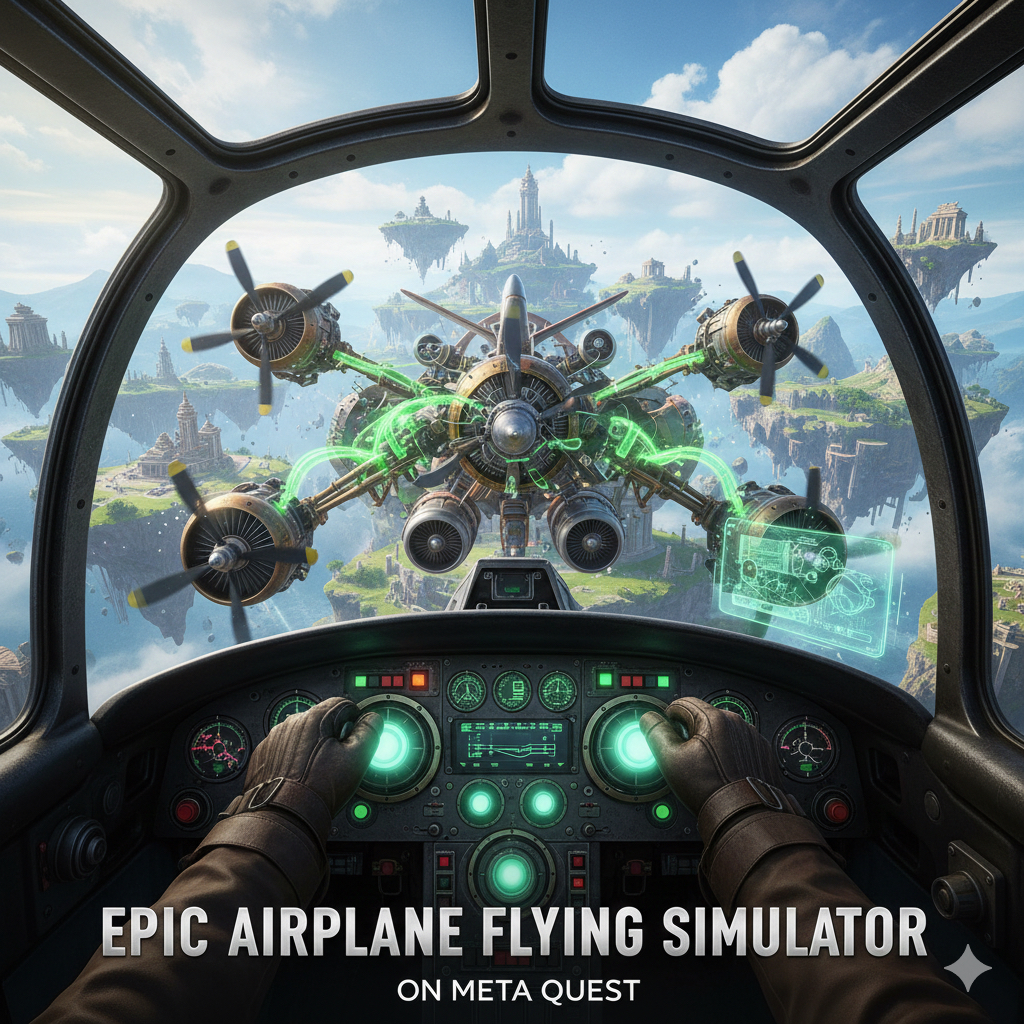
In the realm of VR simulators, where immersion and mechanical fidelity are paramount, Epic Airplane Flying Simulator sets out with a clear ambition: to bring the awe and precision of flight to the Meta Quest platform. It aims to satisfy flight enthusiasts, simulation purists, and curious newcomers alike by delivering a cockpit-centric experience that mimics real-world aviation behaviors, atmospheric environments, and a tactile sense of altitude, speed, and control. After extensive time in the virtual cockpit — logging hours across takeoffs, landings, navigation challenges, and scenic exploratory flights — Epic Airplane Flying Simulator emerges as a competent and ambitious title with strong high-points in immersion and flight realism, even if it occasionally falters in polish, pacing, and depth of content.
Concept and Scope
At its core, Epic Airplane Flying Simulator is unapologetically a flight simulator: no quests, no narrative campaigns, and no haphazard minigames. Instead, it delivers an experience rooted in authentic cockpit interaction, navigational discipline, and the meticulous feel of piloting an aircraft through varied skies and terrains. The premise is straightforward: players learn to fly, master flight systems, and explore airspace with a degree of freedom and mechanical accuracy that gives VR a distinct advantage over flat-screen simulators.
This design philosophy aligns well with the expectations of simulation fans. By prioritising realistic aircraft behavior, control responsiveness, and environmental feedback, the game creates a sense of presence few non-VR simulators can replicate. The sensation of being up in the air — whether gliding above snow-capped peaks or navigating stormy weather — is vivid, engaging, and genuinely evocative.
Flight Mechanics and Controls
Where Epic Airplane Flying Simulator shines most is in its core flight mechanics. From the moment you grip the yoke and throttle up, controls are intuitive, physically grounded, and responsive. The developers wisely map key cockpit elements — throttle, flaps, landing gear, radios, and trim — to recognizable VR interactions that feel natural whether you are standing or seated.
The simulation model does not skimp on realism. Aerodynamic effects such as pitch, roll, yaw, lift, drag, and turbulence all influence how your aircraft responds. Suddenly, simple turns can become complex negotiations of weight and momentum. Takeoffs impart the thrill of physics in motion, and landings strike a fine balance between rewarding precision and punishing sloppiness.
Wheels touch tarmac with satisfying feedback, wings bank with believable resistance, and even simple adjustments to trim produce noticeable effects that novices learn to appreciate over time. This is not an arcade flyer where a flick of the joystick equals perfect maneuvers; it is a system that encourages learning and rewards gradual proficiency.
Beginners will not be left totally adrift. The game includes basic tutorials that introduce cockpit layout, instrument reading, and takeoff/landing procedures. However, these tutorials sometimes feel overly simplified and not always well integrated with the complexity of the full simulation. A deeper, modular training program that scales difficulty and introduces systems in progressive layers would have helped ease the transition from novice to intermediate control.
Cockpit Immersion and Visual Fidelity
Visual immersion is arguably Epic Airplane Flying Simulator’s greatest strength. Once you strap into the cockpit — with instruments realistically arrayed, switches at your fingertips, and world space humming around you — the illusion of actual flight is compelling.
The aircraft interiors are detailed and consistent, with legible gauges, clear labels, and switchgear that echoes real-world design. Lighting effects inside the cockpit adapt convincingly to external conditions — harsh sun, twilight glow, or stormy overcast — reinforcing presence without overwhelming clarity.
Out in the world, the environmental design is solid where it needs to be. Terrain transitions feel coherent, mountain ranges have convincing scale, and cityscapes nestled in valleys or along coasts create compelling low-altitude flying opportunities. Atmospheric effects — varying cloud layers, sunlight scattering, rain textures — are well realised for Quest hardware. Draw distance is respectable, and even at higher altitudes, horizon detail holds without stuttering.
That said, the game’s environments occasionally feel repetitive beyond the most scenic regions. While mountainous and coastal areas receive attention to nuance, flatter regions can feel texture-lite or aesthetically similar across vast distances. The visual fidelity remains impressive for standalone VR, but variability in biomes and landmarks could be improved to make long cross-country flights more visually dynamic.
Navigation, Systems, and Challenge
Real flight is as much about navigation and systems management as it is about physical control — and Epic Airplane Flying Simulator broadly respects this balance. Instrument panels include functional altimeters, compasses, artificial horizons, radios, and engine readouts. Navigational beacons, waypoints, runway headings, and flight planning add layers that reward thoughtful piloting.
Yet for a flight title that aspires to simulation depth, the systems layer sometimes feels shallow. Radios, for example, are present but under-utilised by the game’s guidance systems. Autopilot exists but functions in a basic manner; more advanced auto-nav features — IFR controls, multi-segment flight plan editing, or dynamic weather routing — would deepen the simulation experience substantially for seasoned virtual aviators.
Challenge levels are primarily self-imposed. There are no structured missions with escalating objectives, nor a built-in campaign that commands progression through varied flight conditions. Instead, players may choose to fly “free” or engage in optional landing challenges and time-based navigational goals. While this open-ended structure fits the simulation ethos, it risks reducing long-term engagement for players who enjoy structured objectives and narrative momentum.
Replayability, Progression, and Longevity
Replayability in Epic Airplane Flying Simulator hinges on two main pillars: intrinsic motivation and skill mastery. Piloting proficiency — smoother landings, more efficient climb/descent profiles, better autopilot integration — becomes its own reward. However, outside of personal achievement and cumulative skill improvement, the game lacks a robust meta-structure that constantly introduces new mechanics, aircraft types, or evolving environments.
Aircraft variety is modest. While different models are available and each handles distinctly, the catalogue could be broader. More aircraft classes — gliders, seaplanes, multi-engine transports — would extend engagement and encourage exploration of varied flight mechanics.
A more developed system of progressive challenges, unlockables, and perhaps even contextual storytelling (in the form of flight contracts, discovery missions, or narrative setpieces) would provide players with tangible goals beyond free flight and solo challenges.
Sound Design and Immersive Feedback
Sound design in Epic Airplane Flying Simulator reinforces immersion effectively. Cockpit ambience — whirring instruments, subtle mechanical hums, wind noise — blends with external audio cues such as engine pitch shifts, flap deployment, and runway impacts. These elements provide both aesthetic satisfaction and practical feedback, aiding spatial awareness and reinforcing presence.
Environmental audio is integrated smoothly. Weather cues, distant thunder, airport traffic noise, and even terrain-based sound cues help ground the player in space. Music — when present — is unobtrusive and supports focus rather than dramatic punctuation.
Accessibility and Comfort
Accessibility options are thoughtfully implemented. Whether opting for seated or standing play, adjustable sensitivity settings, or comfort options for yaw and locomotion, the game accommodates diverse VR tolerance levels. Critics of VR motion sickness will appreciate the stability and absence of unnecessary head movement induced by non-player-controlled motion.
Instrument interaction is natural, and guided tutorials — while imperfect — provide an accessible gateway into flight systems that might otherwise feel overwhelming to novices.
Final Verdict
Epic Airplane Flying Simulator on Meta Quest is a commendable addition to the VR flight simulation genre. Its core mechanics — responsive controls, immersive cockpit experience, and strong environmental immersion — are precisely what players seek in a flight simulator. While its content depth, mission structure, and systems complexity could be broader and more refined, the experience it does deliver is compelling, engaging, and remarkably tactile for standalone VR hardware.