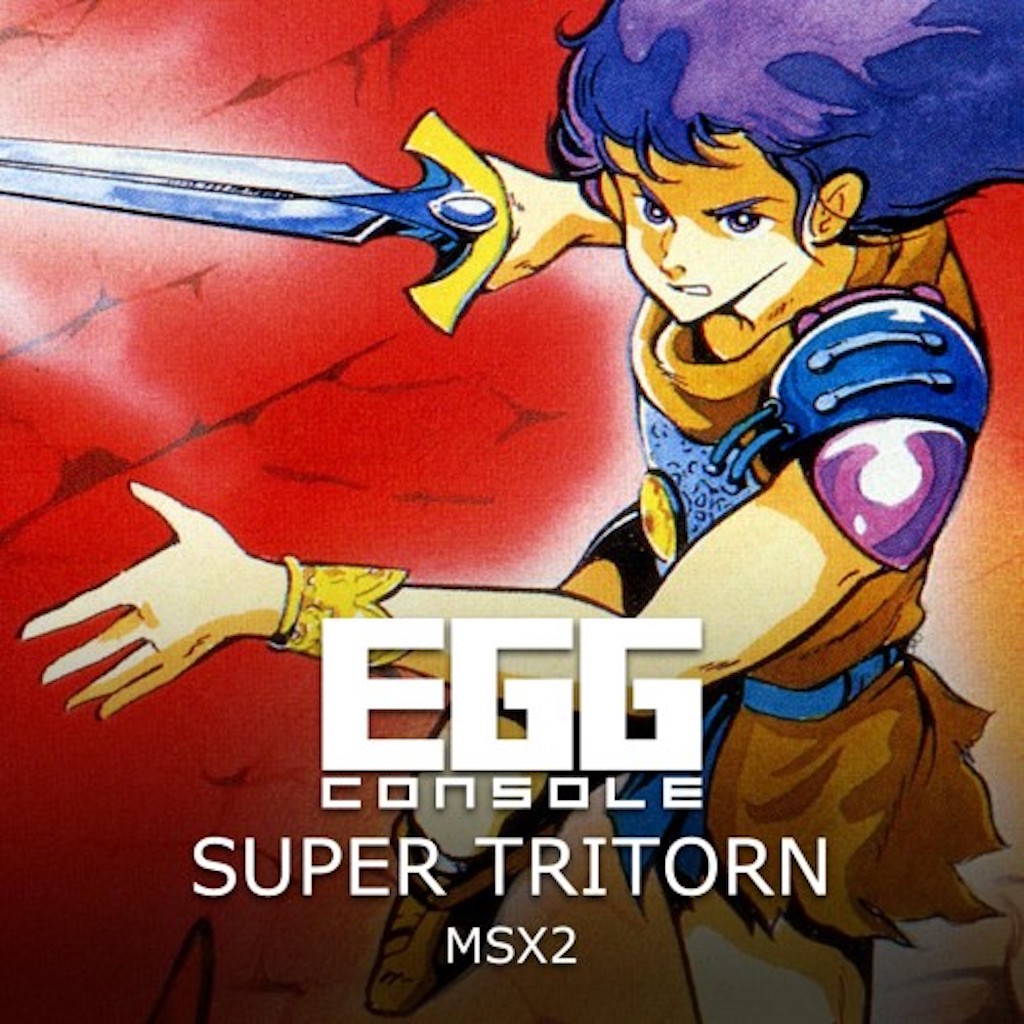
Retro revivals often feel like museum pieces — preserved carefully, admired politely, and then quietly returned to the shelf. EGGCONSOLE SUPER TRITORN MSX2 is different. This 1986 Action RPG from SEIN SOFT arrives on modern platforms through D4 Enterprise’s EGGCONSOLE initiative, and instead of gathering dust it still kicks, bites, and occasionally bites back hard enough to remind you why early Japanese PC games earned such fearsome reputations.
On paper it’s a straightforward quest: the hero Tritorn must save Luwanda Island from the tyrannical Pay Balusa. In practice it’s a fascinating blend of swordplay, platforming precision, and surprisingly devious puzzle design that refuses to hold your hand. Nearly forty years later, the game remains rough, cryptic, and often brilliant.
A Hero With a Mean Jump Cut
Combat in Super Tritorn looks simple until you realize how much technique hides beneath its pixelated surface. Tritorn attacks with a sword and a jump, but the key mechanic is a delicious risk-reward system: striking an enemy while airborne deals double damage. This turns every encounter into a tiny tactical decision. Do you play it safe with grounded slashes, or leap in for the high-risk killing blow?
Enemy behavior is just unpredictable enough to make those choices tense. Monsters dart, hesitate, or swarm in patterns that demand observation rather than button mashing. The controls are responsive by MSX2 standards, and mastering the rhythm of jump-strikes provides a genuine sense of growth long before any numerical leveling occurs.
As Tritorn develops, he learns three types of magic — abilities that can freeze foes or wipe them from the screen entirely. These spells feel powerful without becoming a crutch, especially because resources are limited and bosses punish reckless casting. The combat loop, while basic, has an old-school purity that modern Action RPGs often bury beneath systems bloat.
More Than Just Monster Slaying
What elevates Super Tritorn above many contemporaries is its puzzle-driven progression. Defeating enemies isn’t always enough; certain items only appear after specific conditions are met, such as eliminating foes in a particular sequence. Doors, NPC hints, and environmental riddles intertwine with combat to create a surprisingly cerebral adventure.
This structure prevents the dreaded grind of early RPGs. Instead of farming endlessly, you experiment, observe, and occasionally curse the designers before experiencing that delightful “aha!” moment. The island of Luwanda feels less like a linear gauntlet and more like a hostile escape room with swords.
Boss battles punctuate the journey with imposing sprite work and patterns that demand everything you’ve learned. These encounters remain highlights, showcasing how imaginative design can overcome the technical limits of the MSX2 hardware.
Preservation With Personality
D4 Enterprise’s EGGCONSOLE release focuses on authenticity rather than modernization. The main game and gallery remain in Japanese, while menus and “How to play” screens are offered in English. There’s no scene select or rewind — a decision that will delight purists and terrify newcomers.
Visually, the game is a time capsule: chunky sprites, bold colors, and that unmistakable MSX2 aesthetic. What might look crude today carries a strange warmth, especially when paired with the energetic chiptune soundtrack. The music, repetitive as it can be, lodges itself in your brain like an 8-bit sea shanty.
Quality-of-life features are minimal, but the emulator wrapper is stable and input lag is low. The lack of save states or assist options means you experience the game almost exactly as a 1986 player would — for better and worse.
The Brutal Charm of Old Design
Let’s be honest: Super Tritorn can be unforgiving. Clues are sometimes opaque, and a few progression requirements border on the obscure. Without community guides many modern players will hit walls that feel unfair rather than challenging.
Hit detection, while generally solid, occasionally produces head-scratching moments. Enemy placement can be downright cruel, and the absence of contemporary conveniences like maps or quest logs forces you to take notes like a digital archaeologist.
Yet these frustrations are part of the game’s identity. It trusts the player to think, to fail, and to learn — philosophies largely abandoned in today’s tutorial-heavy landscape. When you finally crack a puzzle or topple a giant boss, the victory feels intensely personal.
Historical Value vs. Modern Taste
Evaluated purely as a 2020s product, EGGCONSOLE SUPER TRITORN MSX2 is a tough sell. Its pacing is archaic, its storytelling minimal, and its difficulty occasionally mean-spirited. But as a piece of interactive history it’s invaluable.
You can see design ideas here that later defined the genre: action-based leveling, environmental puzzles woven into RPG structure, and skill-dependent combat multipliers. It’s a missing evolutionary link between early Japanese computer games and the console Action RPG boom that followed.
For enthusiasts of retro design, the game offers a raw, unfiltered look at how ambitious developers were even within severe hardware limits. For casual players, it may feel like deciphering a relic written in another language — which, in some respects, it is.
Should You Return to Luwanda Island?
If your idea of fun includes mapping dungeons on scrap paper, experimenting with enemy sequences, and mastering jump-strike timing, Super Tritorn will treat you like royalty. If you expect modern onboarding or narrative handrails, Pay Balusa will eat you alive.
D4 Enterprise deserves credit for making such niche classics accessible without sanding off their sharp edges. This isn’t nostalgia wrapped in comfort; it’s nostalgia served straight, bones and all.
Final Score
A challenging, inventive Action RPG that still sparkles beneath its ancient crust, EGGCONSOLE SUPER TRITORN MSX2 is best suited for retro adventurers willing to meet it on its own uncompromising terms.