There is something wonderfully appealing about discovering an old game that has somehow slipped through the cracks of gaming history. We live in an era when practically every major release is dissected, replayed and remembered, yet countless smaller games from the early days of home computing remain almost completely unknown outside their original audience. EGGCONSOLE Nyan Pi MSX2 is one such curiosity, bringing a charming action puzzle game from 1990 back into the spotlight. Originally developed by Compile for the MSX2 and released as part of Disc Station DX #3, it is a reminder that clever game design has never depended on cutting-edge technology.
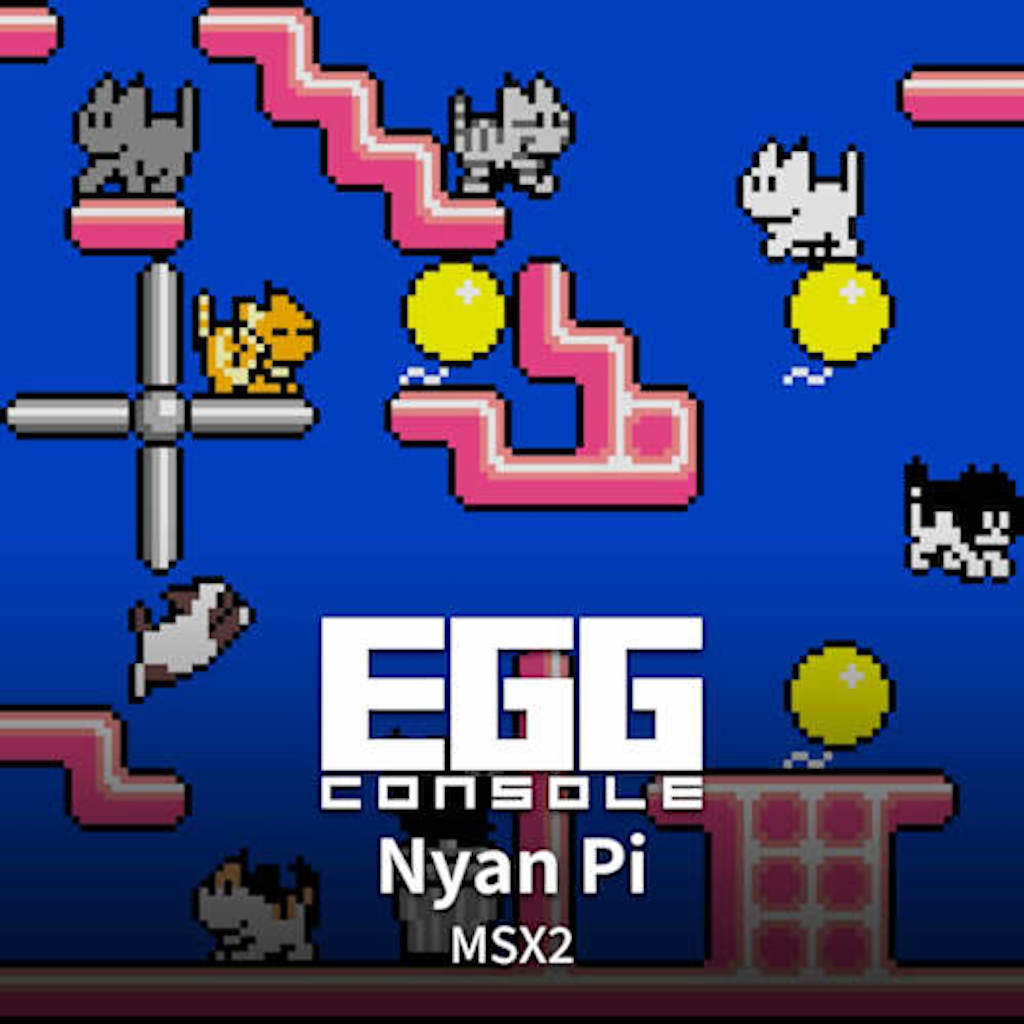
At first glance, Nyan Pi looks almost impossibly cute. You choose one of eight adorable kittens and set off across a series of single-screen challenges, with the ultimate objective of popping every balloon and reaching the goal, which rather amusingly resembles a humble rubbish bin. It sounds simple enough, and visually there is very little here to suggest that you are about to be presented with a serious test of your problem-solving skills. Yet that innocent appearance hides a surprisingly thoughtful puzzle experience in which every jump, every balloon and every step can have consequences.
That is what makes Nyan Pi such a lovely little discovery. It does not need to shout for attention, throw explosions at the screen or bombard you with complicated systems. Instead, it gives you a small playground, a clear objective and enough tools to make you think carefully about how you are going to achieve it. Sometimes the simplest ideas really are the ones that stick.
Cute, But Cunning
The central idea behind Nyan Pi is beautifully straightforward. Each stage presents you with a layout to navigate, with balloons scattered around the environment and a goal somewhere within the level. Your kitten can move and jump around the screen, but simply charging towards the objective is rarely the answer. The real puzzle lies in understanding how the environment can be manipulated and, more importantly, recognising that something you initially want to destroy may be essential to reaching your destination.
This is where Nyan Pi starts to show its clever side. Balloons are not merely things to be popped because the game tells you to clear them. They can also become vital platforms, so destroying one too early can leave your kitten stranded and force you to rethink the entire route. That simple idea creates a wonderful little mental tug-of-war, as the player is constantly encouraged to complete the obvious objective while being warned not to remove something that might be needed later.
It is a classic puzzle design trick, but it works remarkably well here. The game gradually teaches you to stop thinking about individual objects and start considering the entire level as one interconnected problem. A jump that looks perfectly sensible in isolation might completely ruin your chances a few seconds later. Conversely, leaving something untouched can open up a route that was not immediately obvious, rewarding patience rather than speed.
There is something particularly satisfying about that approach. When you finally understand the solution to a level that initially appeared impossible, the feeling comes from your own brain rather than from a flashy reward system. Nyan Pi makes you feel clever, and that is one of the most valuable qualities a puzzle game can possess.
Forty Little Brain Teasers
With 40 rounds to conquer, there is a decent amount of puzzle-solving packed into this modest release. The individual stages are compact, making them ideal for short sessions, but the increasing complexity gives the game a sense of progression. You are not simply repeating the same puzzle forty times with different scenery. The layouts encourage you to develop an understanding of the game’s rules and gradually become more confident in manipulating them.
Perhaps the best decision is the absence of a punishing time limit. Nyan Pi is not interested in forcing you to panic while trying to work out what the designer wants you to do. There is no need to race around the screen simply because a clock is ticking down, and there is no sudden Game Over waiting to punish you for taking a moment to think. Instead, the game gives you the breathing room to experiment, make mistakes and try again.
That makes a huge difference to the overall character of the experience. There is an almost relaxing quality to sitting in front of a puzzle, looking at the arrangement of platforms and obstacles, and gradually working out a route in your head. You can try something, discover that it does not work, and simply start again without feeling that you have wasted anything. For players who enjoy thoughtful puzzle games rather than twitch-based challenges, that approach is genuinely refreshing.
Of course, some players may find the lack of urgency a little too gentle. Those looking for constant pressure or a more action-focused experience will probably find Nyan Pi rather sedate. But that is not really what Compile was trying to create. The challenge here comes from understanding the puzzle, not from beating a stopwatch.
A Window Into 1990
The real fascination with EGGCONSOLE Nyan Pi MSX2 goes beyond the gameplay itself. This is a small piece of Japanese computer gaming history, and playing it today offers an opportunity to experience the creativity that existed outside the more familiar console landscape of the period. Compile would go on to become an important name in Japanese game development, and seeing a lesser-known work from the company’s earlier years gives the release an added sense of historical interest.
The MSX2 hardware naturally imposes considerable limitations by modern standards. The presentation is basic, the characters are small, and the environments lack the visual sophistication contemporary players take for granted. Yet there is a certain warmth to those limitations. The colourful sprites, simple animations and old-school sound effects have a personality of their own, while the authentic MSX2 presentation gives the whole experience the feeling of opening a dusty box of forgotten computer games.
The music and sound are similarly rooted in their era. Those familiar with Japanese home computer games from the period will likely find the soundscape particularly appealing, while newcomers may need a little time to adjust to its distinctly vintage character. It is not going to compete with modern orchestral soundtracks or elaborate audio design, but that is missing the point. The appeal lies in authenticity, and Nyan Pi wears its age proudly.
The EGGCONSOLE Treatment
D4 Enterprise’s EGGCONSOLE range has become increasingly valuable to players seeking to preserve older Japanese computer games, and Nyan Pi is another example of why this work matters. Such games are not always the titles that receive lavish remakes or modern reinterpretations, despite being fascinating pieces of gaming history. Bringing them to modern hardware gives curious players the chance to experience them without needing access to original MSX2 hardware.
The added convenience of modern save and load functionality and other accessible system options also makes revisiting an old game considerably less intimidating. The ability to preserve progress is particularly welcome in a puzzle game, where players may want to experiment without worrying about losing everything. Display options and other emulator conveniences further help bridge the gap between an old computer game and a modern player’s expectations.
However, preservation does not magically make every aspect of an old game feel modern. Nyan Pi retains its original presentation and Japanese language elements, which can leave players unfamiliar with the era feeling like outsiders looking through a window into another gaming culture. Fortunately, the basic gameplay is straightforward enough that language is unlikely to prevent players from understanding the fundamental objective.
That authenticity will be a major part of the attraction for retro enthusiasts, although it also limits the game’s mainstream appeal. This is not a modern remake attempting to reinvent a classic for today’s audience. It is much closer to a preserved time capsule, and players need to approach it with that expectation.
A Little Game With A Big Personality
What I particularly like about Nyan Pi is that it never seems embarrassed by its simplicity. Modern games often feel compelled to throw progression systems, unlockables, upgrade trees and endless rewards at the player, as though simply providing an enjoyable set of levels is no longer enough. Compile’s little kitten adventure has none of that baggage. It presents a puzzle, gives you the tools to solve it, and trusts you to enjoy the satisfaction of figuring things out.
That confidence is refreshing. There is no need for an elaborate story about why the kitten needs to reach the bin, and frankly, trying to explain it would probably make the whole thing less charming. The adorable characters and straightforward objective are enough. Beneath that cheerful exterior lies a surprisingly intelligent collection of puzzles that can leave you staring at the screen, wondering how on earth you are supposed to get from one side to the other.
The result is a game that can be both relaxing and frustrating in equal measure. Some stages will probably have you scratching your head, particularly when you realise that the obvious solution is actually the wrong one. But because there is no pressure to hurry, those moments tend to feel like an invitation to think rather than a punishment for getting things wrong.
Final Verdict
EGGCONSOLE Nyan Pi MSX2 is exactly the sort of release that makes retro preservation worthwhile. It may not have the fame of Compile’s better-known games, nor does it possess the technical sophistication of anything released today, but beneath its humble MSX2 presentation lies a genuinely enjoyable puzzle experience. The clever use of balloons as both objectives and potential platforms gives the game more depth than its cute appearance suggests, while the absence of time limits allows players to approach its 40 stages at their own pace.
There are obvious limitations. The graphics and sound are firmly rooted in 1990, the Japanese presentation will not appeal to everyone, and the game’s niche nature means it is unlikely to attract players looking for a modern, feature-packed puzzle adventure. Some may also find the deliberately simple structure too restrictive. For the audience this release is targeting, however, those are largely part of the package rather than serious flaws.
What remains most impressive is how well the central puzzle design holds up. Strip away the age of the hardware, the tiny sprites and the wonderfully retro presentation, and you are left with a game built around a timeless idea: give the player a problem and let them feel brilliant when they solve it. Nyan Pi does exactly that, and there is something rather lovely about discovering such an unassuming little gem more than three decades after it first appeared.