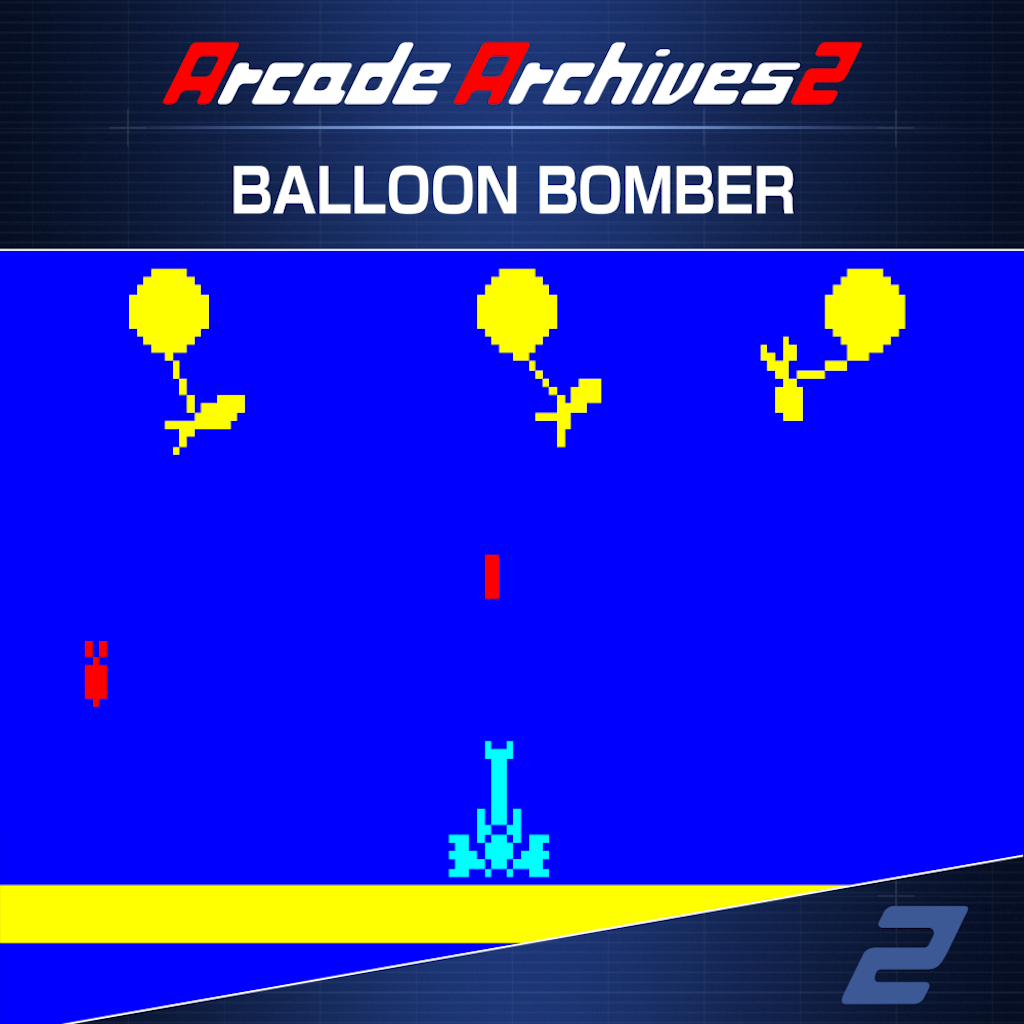
There is something wonderfully nostalgic about returning to the arcade games of the early 1980s. Before sprawling open worlds, cinematic storytelling and complex control schemes became the norm, arcade gaming was often built around a single, brilliantly simple idea. The challenge was to make that idea so compelling that players would happily feed another coin into the machine, determined to beat their previous score. BALLOON BOMBER, originally released by TAITO in 1980, is a fine example of that philosophy, taking the familiar foundations of the fixed-screen shooter and introducing a surprisingly clever twist that turns every shot into a potentially costly decision.
Now brought back to life through HAMSTER Corporation’s Arcade Archives 2 series, BALLOON BOMBER offers a faithful recreation of a game that feels distinctly different from many of its contemporaries. At first glance, it appears to be a fairly straightforward arcade shooter, with players controlling an anti-aircraft gun positioned at the bottom of the screen and firing upwards at balloon bombs drifting gently across the sky. Yet there is a catch, and it is one that gives the game its identity. Destroying the balloon is not enough. You must hit the bomb itself, because striking the balloon causes the unexploded device to fall to the ground, leaving a crater that can permanently restrict your movement.
It is a simple concept, but one that gives BALLOON BOMBER a personality all of its own. Beneath its modest presentation lies an arcade experience that demands patience, precision and a little forward thinking. It may not have the scale or variety of modern shooters, but it understands something that many larger games occasionally forget: a clever mechanic, properly executed, can be more memorable than a mountain of content.
Aiming for the Right Target
The central gameplay loop is refreshingly easy to understand. You move your anti-aircraft gun horizontally along the bottom of the screen, lining up shots against the balloon bombs floating above. The balloons sway gently as they travel, so simply holding down the fire button and hoping for the best is unlikely to get you very far. Instead, you need to pay attention to their movement, judge the trajectory of your shots, and carefully time each attack to strike the bomb rather than the balloon carrying it.
That distinction is what makes the game so engaging. In many classic arcade shooters, firing is an almost instinctive response to anything moving on screen. Here, that instinct can quickly become your undoing. A poorly judged shot can cause a bomb to drop harmlessly from the sky, with little immediate effect on enemy forces, but its impact with the ground leaves a hole that creates a much more troublesome problem. The game effectively turns your own mistakes into obstacles, forcing you to deal with the consequences of inaccurate shooting rather than simply allowing you to move on to the next target.
There is a real sense of satisfaction in landing a clean shot, particularly when several balloons are moving across the screen and you have to carefully pick your moment. The game encourages you to slow down and observe rather than simply react, which feels unusual for an arcade shooter of this vintage. It is not necessarily a complicated system, but it gives each shot a degree of importance. You are not just trying to eliminate targets. You are trying to preserve the battlefield beneath you.
The Ground Beneath Your Wheels
The crater mechanic is undoubtedly the most distinctive feature of BALLOON BOMBER, elevating the experience beyond a basic exercise in aiming. Whenever a shot hits a balloon rather than its attached bomb, the device falls and explodes on the ground, leaving a hole your anti-aircraft gun cannot cross. As more craters appear, the available movement space becomes increasingly restricted, gradually turning the bottom of the screen into a hazardous patchwork of open ground and impassable gaps.
It is an ingenious way to introduce environmental consequences into a game that otherwise unfolds on a relatively static screen. The battlefield is not simply a backdrop for the action. It is something you actively shape through your successes and failures. A careless shot early in a run might seem relatively harmless, but as the craters accumulate, the space available to manoeuvre can become uncomfortably narrow. Suddenly, the player is not only worrying about the balloons overhead but also about where they can safely move next.
This adds a pleasing layer of strategy that is particularly effective given the game’s age. There is no elaborate upgrade system or extensive collection of weapons to master. Instead, the challenge comes from making the most of the limited tools available to you. Every crater represents a small failure with lasting consequences, and the need to avoid creating too many of them encourages a more considered approach. It is a mechanic that remains easy to appreciate decades after its original release, largely because it is so neatly integrated into the basic act of shooting.
Of course, this system can also be frustrating. A sequence of inaccurate shots can quickly leave you boxed in, and the limited movement options may make it difficult to recover from a particularly poor run. For players accustomed to modern games that constantly provide ways to undo mistakes, this unforgiving design may take some adjustment. However, that is also part of the game’s appeal. BALLOON BOMBER expects players to learn from their errors, and the satisfaction of improving through practice is central to its old-school character.
Simple Presentation, Timeless Appeal
Visually, BALLOON BOMBER is very much a product of its time. Its graphics are uncomplicated, with a restrained arcade presentation that places the emphasis firmly on gameplay rather than visual spectacle. The balloons, bombs and anti-aircraft gun are clearly represented, making it easy to understand what is happening on screen even when the action becomes more demanding. There is little in the way of elaborate animation or decorative detail, but the simplicity has its own charm, particularly for anyone who remembers the era when arcade cabinets competed for attention with bright screens and instantly recognisable sprites.
The sound design is similarly straightforward. The audio serves its practical purpose, reinforcing shots and explosions without attempting to create an elaborate atmosphere. Compared with modern games, the soundscape is undeniably limited, and players looking for a memorable soundtrack or a rich collection of effects may find it rather sparse. Yet there is an authenticity to this stripped-back presentation. It feels like a game built for the arcade floor, where clarity, immediate feedback and the urge to have another go mattered far more than cinematic immersion.
The downside is that the lack of visual and audio variety can become noticeable over longer sessions. Enemy designs and environments are limited, and the basic presentation does not evolve dramatically as you continue playing. For newcomers who have grown accustomed to the constant stimulation of contemporary games, the experience may initially seem a little bare. But judged within its historical context, the presentation is entirely understandable, and its uncluttered design keeps the central mechanic the focus throughout.
An Arcade Challenge for a Modern Audience
One of the most welcome aspects of Arcade Archives 2 BALLOON BOMBER is the collection of modern features included alongside the original experience. HAMSTER has built its reputation on preserving classic arcade titles, and these additional options make these games more accessible without fundamentally changing what made them special. Players can adjust difficulty and screen settings, use rapid-fire options, rewind gameplay, and make use of multiple save slots. These practical additions recognise how people play retro games today, whether revisiting a childhood favourite or discovering an old arcade title for the first time.
The rewind feature is particularly useful in a game where a single inaccurate shot can have a lasting impact. Being able to revisit a mistake helps players understand exactly where things went wrong, making it a helpful learning tool for less experienced players. Those who prefer a more traditional challenge can simply ignore it and experience the game as it was originally intended. This flexibility is important because it lets players choose how much assistance they want, rather than forcing everyone into the same level of difficulty.
The inclusion of VRR (Variable Refresh Rate) support is another welcome technical improvement, helping the game reproduce its original arcade feel on compatible modern displays. While this is unlikely to be the headline feature for casual players, it demonstrates the care taken to make these older experiences work comfortably on contemporary hardware. The screen settings also provide useful flexibility, allowing players to tailor the presentation to their own preferences.
Online rankings add another reason to keep returning. The original arcade experience was built around chasing high scores and proving your ability against other players, and global leaderboards bring that competitive spirit into the modern era. There is something particularly appealing about competing for a place among players around the world in a game that originally relied on a local arcade crowd. It gives the experience a sense of community that extends beyond simply trying to beat your own personal best.
More Ways to Play
Arcade Archives 2 BALLOON BOMBER also benefits from several distinct modes that offer different ways to approach the challenge. ORIGINAL MODE offers the traditional experience, preserving the game as designed, while HI SCORE MODE emphasises achieving the highest possible score under set conditions. CARAVAN MODE provides a further score-focused challenge, giving players another structured reason to refine their technique and improve their consistency.
The addition of TIME ATTACK MODE is particularly interesting. Rather than judging success purely by the score achieved, this mode challenges players to clear the game as quickly as possible. It introduces a different mindset, encouraging players to balance accuracy with speed and to consider whether a cautious approach is always the most effective. In a game where every missed shot can create an obstacle, the pressure to complete a run efficiently adds an extra dimension to the familiar mechanics.
These modes do not transform the game into something entirely different, nor do they disguise its limited variety. Instead, they provide alternative goals that make the existing gameplay more rewarding for players who enjoy chasing measurable improvements. Those who simply want a quick burst of nostalgic arcade action may be perfectly happy with ORIGINAL MODE, while score chasers and competitive players will find more reasons to invest time in the additional challenges.
A Classic That Knows Its Limits
There is no escaping the fact that BALLOON BOMBER is a relatively modest game by modern standards. Its core mechanics are introduced quickly, enemy variety is limited, and the gameplay loop remains largely consistent throughout. There is no expansive campaign, character progression or narrative to draw players into a larger world. The appeal rests almost entirely on the quality of its central idea and the player’s desire to improve.
For some, that simplicity will be precisely what makes the game enjoyable. It is easy to pick up, immediately understandable and well suited to short sessions. There is no lengthy tutorial to work through or a complicated set of systems to memorise. You can jump straight into the action, make a few mistakes, learn from them and try again. That accessibility is a major part of the appeal of classic arcade games, and BALLOON BOMBER retains it remarkably well.
However, the same simplicity can also limit its long-term appeal. Players who are not particularly interested in chasing high scores may find that the game has shown them most of what it has to offer after a relatively short period. Its uncomplicated visuals and repetitive audio do little to provide variety, while the challenge can sometimes feel more punishing than rewarding when the playing area becomes heavily restricted. The additional modes and modern conveniences help, but they cannot entirely overcome the limitations of a design rooted in 1980.
That is not necessarily a criticism of the preservation work itself. The purpose of Arcade Archives 2 is to bring classic games back to modern platforms with their original character intact, rather than rebuild them to satisfy contemporary expectations. On that front, BALLOON BOMBER remains an intriguing piece of arcade history, and its distinctive approach to environmental hazards gives it a stronger identity than its modest appearance might initially suggest.
Final Verdict
Arcade Archives 2 BALLOON BOMBER is a charming, cleverly designed piece of arcade history that shows how much can be achieved with a single strong gameplay idea. Its balloon-and-bomb mechanic introduces genuine tactical considerations, while the permanent craters left by missed shots ensure every decision carries consequences. It rewards patience and precision, and there is a satisfying sense of achievement in gradually mastering its deceptively demanding mechanics.
HAMSTER’s modern additions make the game more accessible and offer welcome reasons to return, particularly for players who enjoy competing on online leaderboards or testing themselves in TIME ATTACK MODE. Rewind, save slots, difficulty settings and VRR support help the original game feel comfortable on modern hardware without compromising its identity. Nevertheless, its limited enemy variety, basic presentation and repetitive gameplay mean it is unlikely to hold everyone’s attention, especially for those who expect the depth and variety of contemporary arcade-inspired releases.
For dedicated retro enthusiasts, arcade preservation fans and anyone curious about the evolution of the fixed-screen shooter, BALLOON BOMBER is well worth revisiting. It may be a small game, but its central mechanic remains clever, its challenge is genuine, and its design has a refreshing directness that is easy to appreciate. It is not a revolutionary experience today, but it is a reminder that some of the most enduring arcade ideas were built on simplicity, precision and the irresistible urge to have just one more go.