There is something wonderfully deceptive about CRAZY BALLOON. At first glance, TAITO’s 1980 arcade classic looks like a simple little game, built around the charming idea of guiding a balloon through a maze without letting it burst. There are no armies of enemies to defeat, no complicated weapon systems to master and no sprawling levels to explore. Instead, you are presented with a delicate balloon, a maze filled with sharp obstacles and one deceptively difficult objective: reach the goal without touching anything that might send you crashing back to the beginning.
Originally released during an era when arcade games were defined by straightforward ideas and punishing difficulty, CRAZY BALLOON is a fascinating example of how a simple premise can become unexpectedly demanding. The balloon sways as it moves, making it feel less like a precisely controlled character and more like a fragile object at the mercy of its own momentum. Every narrow passage becomes a test of patience, every obstacle a potential disaster and every successful manoeuvre a small victory. It is a game that asks very little of you in terms of understanding its rules, but an awful lot when it comes to putting them into practice.
Now returning through HAMSTER Corporation’s Arcade Archives 2 series, CRAZY BALLOON brings that distinctly old-school challenge to modern hardware, complete with additional modes and quality-of-life features. While its age is evident in its presentation and unforgiving design, there is still something genuinely compelling about its central mechanic. This is not a game that relies on spectacle or complexity to hold your attention. Its appeal comes from the tension of guiding something fragile through a world that seems determined to destroy it.
A Balloon in a Very Dangerous Place
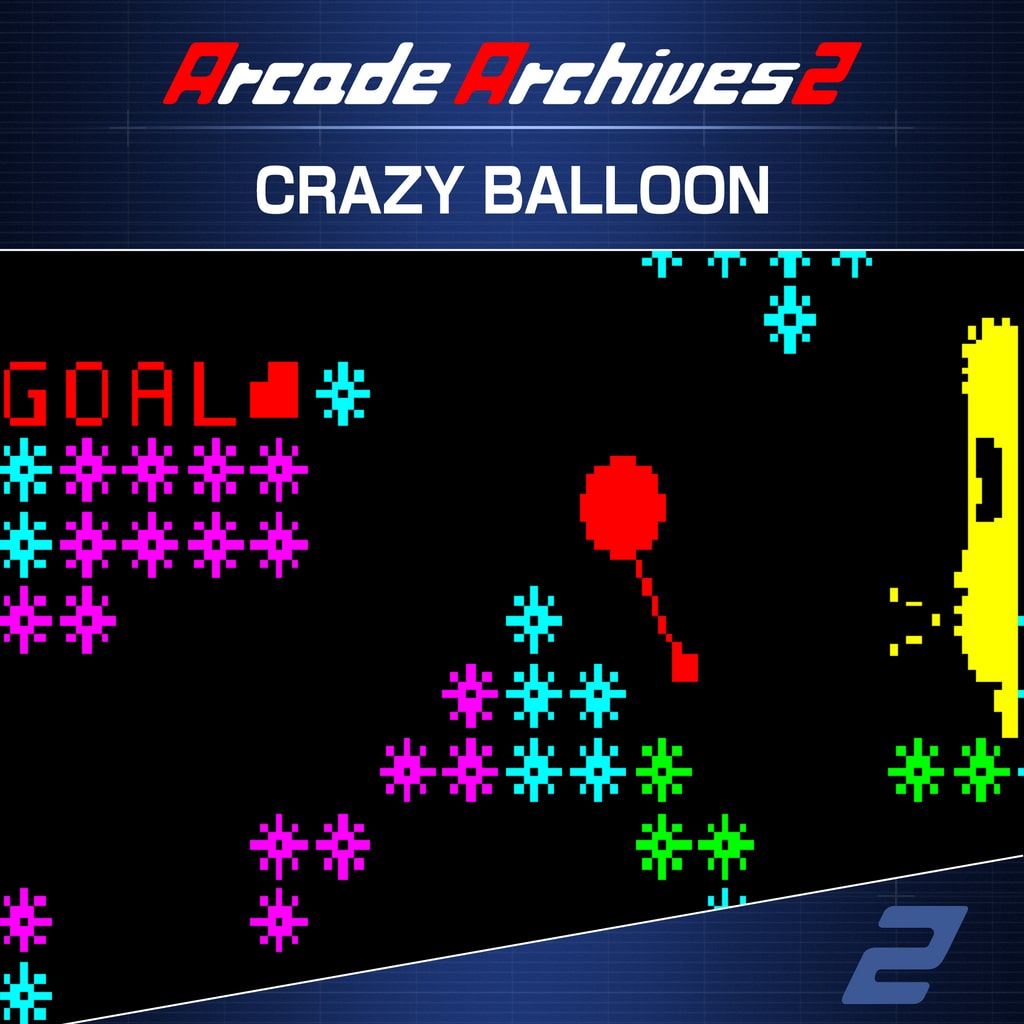
The basic objective is wonderfully straightforward. You control a balloon and must guide it through a narrow maze filled with stationary thorns, moving hazards and other obstacles, eventually reaching the goal without touching anything sharp. The catch is that the balloon is constantly swaying, which makes precise movement considerably more difficult than it might initially appear. Rather than simply steering smoothly through the corridors, you must account for its movement and carefully judge when to advance, when to pause and when to make small adjustments to avoid disaster.
That swaying motion is the heart of CRAZY BALLOON, giving the game a distinctive identity that separates it from more conventional maze-based arcade titles. The balloon never feels entirely obedient, and that slight unpredictability creates a constant sense of vulnerability. A passage that looks wide enough to navigate comfortably can quickly become a nerve-racking squeeze when the balloon drifts towards a thorn. You may know exactly where you want to go, but getting there without brushing against the surrounding hazards is an entirely different matter.
The controls are simple to understand, which makes the challenge particularly interesting. There is no lengthy introduction or complicated tutorial to work through before you can begin playing. You are quickly introduced to the basic movement and left to discover just how much precision is required to guide your balloon safely. It is an approach that feels entirely authentic to the arcade era, although players accustomed to modern games with generous collision detection and forgiving movement systems may find the experience rather unforgiving.
There is genuine satisfaction in successfully negotiating a particularly tight section of the maze. You begin to develop a feel for the balloon’s movement, learning when to make a correction and when it is better to allow it to settle before proceeding. The progress can be painfully slow at times, but that is precisely what makes a successful run feel worthwhile. CRAZY BALLOON transforms even the smallest movement into a meaningful decision, making its seemingly simple objective surprisingly absorbing.
One Wrong Move and It Is All Over
The maze itself is designed to keep players on their toes, with hazards that demand different approaches and careful consideration. Static thorns are the most immediately recognisable threat, but moving obstacles add another layer of uncertainty. These require more than simply identifying a safe route, as you must also judge the right moment to pass through. A gap that is perfectly safe one second may become a dangerous trap the next, leaving little room for hesitation or careless movement.
Scrolling mazes add further pressure by changing the environment as you progress. Rather than allowing you to settle into a comfortable rhythm, the game constantly asks you to adapt to what lies ahead. This creates an interesting contrast between the balloon’s delicate movement and the shifting maze around it. You are trying to maintain control over something inherently awkward while the surrounding environment continues to challenge your ability to plan ahead.
Collision detection and narrow passages can make the game particularly punishing. Even a seemingly minor brush against a thorn can end a promising attempt, and there will undoubtedly be moments when you feel your balloon has been punished for the slightest misjudgement. That strictness is part of the original design, but it can also become a source of frustration, especially when a lengthy sequence of careful manoeuvres ends in an abrupt collision. There is very little room for sloppy play, and the game makes that abundantly clear.
Adding to the pressure is the impish face that appears when you take too long, blowing the balloon towards the spikes. It is a wonderfully mischievous touch, almost as though the game itself has grown impatient with your cautious approach. Just as you begin to believe that taking things slowly is the safest strategy, this unexpected threat reminds you that hesitation has consequences too. It creates a delicate balance between being careful and being decisive, ensuring that simply waiting for the perfect opportunity is not always an option.
This combination of physical hazards and time pressure gives CRAZY BALLOON a surprisingly tense atmosphere. It may lack the dramatic presentation of modern action games, but the possibility of losing a run through one tiny mistake is enough to create genuine nerves. The challenge is not about reacting to dozens of enemies or unleashing complicated attacks. It is about remaining composed when the simplest movement could bring everything to an end.
A Little Game with Plenty of Personality
Visually, CRAZY BALLOON is unmistakably a product of its time. The presentation is basic by modern standards, with simple sprites, straightforward backgrounds and a limited colour palette that keeps the maze and its hazards easy to recognise. There are no elaborate animations or richly detailed environments, but the balloon itself has a certain charm that gives the game a memorable personality. Its fragile appearance makes the constant threat of bursting feel all the more fitting, while the maze provides a functional backdrop for the challenge.
The simplicity has its benefits. The screen is uncluttered, allowing players to focus on the narrow passages and dangerous obstacles without unnecessary distractions. The visual design serves the gameplay rather than competing with it, which is exactly what you would expect from a game created for the arcade machines of 1980. For those who enjoy exploring the history of the medium, there is also a certain appeal in seeing how effectively a game could communicate its entire premise through such a modest presentation.
The sound design is similarly restrained, with uncomplicated audio that feels rooted in the era. It does not deliver a particularly rich or varied soundtrack, and players expecting an immersive musical experience may find it somewhat repetitive. However, the simplicity is understandable given the game’s original purpose. CRAZY BALLOON was designed to deliver immediate, focused arcade action, and its presentation reflects that philosophy.
Of course, the lack of visual variety and the relatively basic audio can become noticeable over longer sessions. The core experience remains largely unchanged, and there is little in the way of additional spectacle to disguise the repetition inherent in mastering the maze. But there is a difference between a game that is simple because it lacks ideas and one that is deliberately focused on a single mechanic. CRAZY BALLOON firmly belongs in the latter category, and its distinctive movement system gives it enough character to remain interesting despite its minimal presentation.
The Arcade Archives 2 Treatment
HAMSTER Corporation’s Arcade Archives 2 release offers a welcome opportunity to experience this classic on modern hardware while preserving the original’s character. The series has always prioritised faithful reproduction of arcade games, and that preservation-focused approach is particularly fitting for a title like CRAZY BALLOON. Rather than modernising the underlying design or introducing unnecessary new mechanics, the package keeps the original gameplay intact while offering a range of useful options for contemporary players.
Difficulty and screen settings let you tailor the experience to your preferences, while rewind functionality lets you revisit mistakes and learn from particularly troublesome sections. Multiple save slots also make it easier to return to the game without having to complete a session in one sitting. These additions are especially useful in a game where progress can be lost in a single unfortunate collision. Rewind, in particular, helps clarify the timing and movement required to navigate a difficult passage, although traditionalists can simply choose not to use it.
VRR (Variable Refresh Rate) support is another welcome technical addition for compatible displays, helping deliver a presentation closer to the original arcade experience. While it may not be a feature every player will notice, it reflects the care taken to ensure these games function well on modern screens. Button remapping also gives players additional control over how they interact with the game, which is a useful inclusion for a title that demands such precise input.
Online rankings bring back something of the competitive spirit that helped define the original arcade experience. The opportunity to compare scores with players around the world provides an additional incentive to improve, particularly for those who enjoy refining their technique and chasing personal records. It is a natural fit for a game built around repeated attempts and incremental improvement, where mastering a difficult section can make a noticeable difference to the final result.
More Than One Way to Play
The additional modes in Arcade Archives 2 CRAZY BALLOON extend the experience beyond the traditional arcade format. ORIGINAL MODE preserves the core game, offering the straightforward experience players encountered in the original release. HI SCORE MODE shifts the emphasis towards achieving the highest possible score, while CARAVAN MODE offers another structured challenge for players who enjoy testing their skills under specific conditions.
TIME ATTACK MODE is an especially interesting addition, asking players to focus on clearing the game as quickly as possible rather than simply chasing the highest score. This changes how you approach the maze, encouraging a more confident style of play and placing greater emphasis on efficiency. The challenge is particularly fitting for CRAZY BALLOON, where moving too cautiously can be just as dangerous as rushing into a thorn. Finding the right balance between speed and precision becomes an important part of the experience.
These modes do not radically change the original gameplay, but they provide different goals for players who want to return after becoming familiar with the basic challenge. Those who enjoy competitive arcade gaming will appreciate the opportunity to compare their performances, while newcomers can use the different settings and assistance features to find a comfortable starting point. The additional content is not extensive enough to transform the game into a significantly larger experience, but it gives the original design a little more room to breathe.
A Test of Patience and Precision
The biggest challenge facing CRAZY BALLOON today is arguably its uncompromising design. There is a fine line between a game that is satisfyingly difficult and one that feels needlessly frustrating, and this classic occasionally straddles it. The strict collision detection, delicate controls and pressure to keep progressing can make it hard to settle into a consistent rhythm. Repeatedly losing progress to a tiny mistake may test the patience of players who prefer a more forgiving experience.
Its limited variety is another consideration. Once you understand the core mechanics, the experience is largely about refining your technique and learning to handle the hazards more effectively. There is no expansive narrative, character progression or extensive collection of unlockable content to keep you invested. The satisfaction comes from personal improvement, and players who do not enjoy repeating difficult sections may struggle to find a lasting reason to return.
Yet for the right audience, this is exactly where the appeal lies. CRAZY BALLOON is a game that rewards concentration, patience and persistence, and it offers a very particular kind of satisfaction when you finally overcome a section that has been causing you trouble. Its challenge feels rooted in the original arcade philosophy of learning through repeated attempts, and while that approach may not appeal to everyone, it remains a valid and engaging way to design a game. There is something refreshingly honest about a title that presents a simple objective and leaves you to develop the skills needed to achieve it.
Final Verdict
Arcade Archives 2 CRAZY BALLOON is a charming yet demanding revival of a distinctive arcade classic. TAITO’s original concept remains wonderfully inventive, turning the simple act of guiding a balloon through a maze into a tense test of timing, spatial awareness and precision. The balloon’s swaying movement gives the game a unique identity, while moving thorns, scrolling mazes and the mischievous face that blows the balloon towards danger ensure the challenge never feels entirely comfortable.
HAMSTER Corporation’s modern additions make the experience more accessible, with rewind, save slots, screen and difficulty settings, button remapping, VRR support and online rankings, helping the game find a place on contemporary hardware. TIME ATTACK MODE and the other arcade challenges also provide worthwhile alternatives for players who enjoy competing against themselves and others. However, unforgiving collision detection, limited presentation and repetitive gameplay mean it is unlikely to appeal to everyone, particularly those who prefer more forgiving modern experiences.
For retro enthusiasts and anyone with an appreciation for the history of arcade gaming, CRAZY BALLOON is a fascinating reminder of how much tension can be created from the simplest of ideas. It is occasionally frustrating, undeniably old-fashioned and sometimes downright cruel, but there is a genuine sense of achievement in guiding that fragile balloon safely through the maze. It may not have the breadth of a modern release, but its personality and deceptively demanding mechanics make it a worthwhile addition to the Arcade Archives 2 collection.