Before Bubble Bobble introduced the world to its lovable bubble-blowing dinosaurs, TAITO had already been experimenting with the colourful characters, inventive mechanics and mischievous gameplay that would help define its arcade legacy. Released in 1985 for 8-bit home consoles, Chack’n Pop is an important part of that history, offering a wonderfully eccentric action platformer built around a small yellow creature, a maze full of troublesome enemies and mechanics that feel refreshingly unusual even today. Now arriving on modern hardware through HAMSTER Corporation’s Console Archives series, this classic offers an opportunity to revisit a game that helped lay the foundations for one of TAITO’s most recognisable franchises.
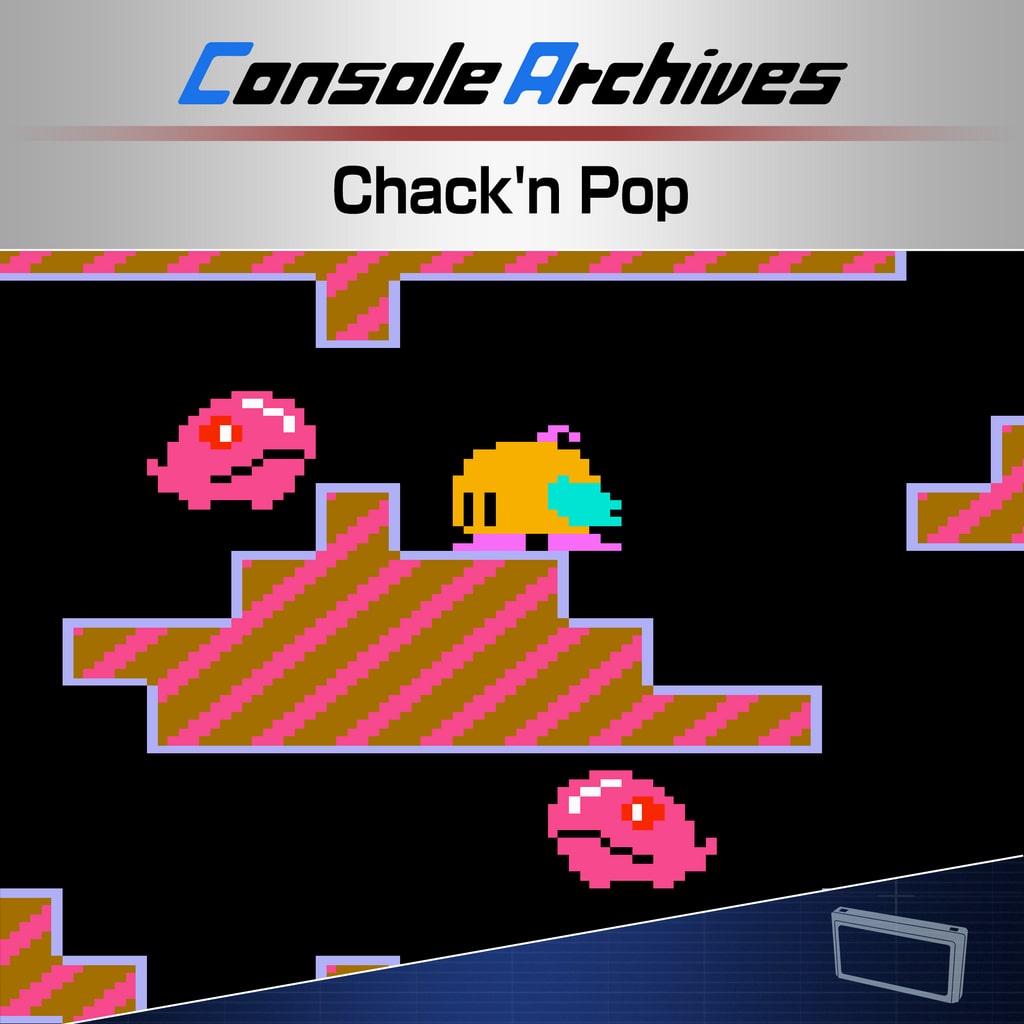
At its heart, Chack’n Pop is about rescuing hearts from the clutches of the mischievous Beluga and its troublesome companions, the Monstas. You control Chack’n as he explores compact, single-screen mazes, navigating walls, ceilings and platforms while avoiding enemies and using bombs to clear a path. The objective sounds straightforward enough, but the absence of a traditional jump button immediately sets it apart from many other platformers of its era. Instead, Chack’n relies on unusual movement techniques, including the ability to run along walls and ceilings, transforming what might otherwise be a familiar platforming experience into something altogether more distinctive.
There is a certain charm to discovering a game that refuses to follow the conventions we have come to expect from its genre. Chack’n Pop can feel awkward at first, particularly for players accustomed to conventional jumping and attacking mechanics, but beneath that initial unfamiliarity lies a surprisingly thoughtful design. Its combination of exploration, timing, enemy avoidance and explosive combat creates an experience that rewards experimentation and careful observation. It may be a little rough around the edges, but there is no denying that Chack’n has plenty of personality.
A Hero Who Walks on Walls
The most immediately striking feature of Chack’n Pop is its unconventional movement system. Rather than giving Chack’n the ability to jump over obstacles in the traditional fashion, the game allows him to extend his legs and run along walls and ceilings. This ability is central to the entire experience, giving players a different way to think about navigating the maze and avoiding the enemies that inhabit it. What initially seems like a limitation soon becomes one of the game’s most interesting mechanics, encouraging you to look at each screen from a different perspective.
Learning to use the walls and ceilings effectively is essential to making progress. Enemies may block a passage below, but the ability to travel overhead can provide an alternative route, allowing you to bypass danger or approach an objective from an unexpected direction. The mechanic also gives the environments a more interconnected feel, as the route to a heart is not always a simple matter of moving horizontally or vertically across the screen. You must learn how Chack’n responds to the terrain and develop a feel for when to change direction, climb or retreat.
There is a satisfying sense of discovery in mastering this unusual form of traversal. Once you begin to understand how the movement works, the maze starts to feel less restrictive, and routes that once seemed impossible become manageable with a little thought. It is a clever way of differentiating Chack’n Pop from more conventional action platformers, and it gives the game a distinctive identity that has endured far beyond its original release.
However, the movement can also be frustrating, particularly during the early stages when its mechanics may feel less intuitive than the familiar controls of a standard platformer. Precision is important, and a poorly judged manoeuvre can leave Chack’n exposed to enemies or unable to reach a safe position. The learning curve is not always especially forgiving, and players expecting immediate responsiveness may need to spend some time adjusting to the game’s particular rhythm. Nevertheless, once the controls begin to feel natural, the unconventional traversal becomes one of the game’s greatest strengths.
Bombs, Beluga and the Art of Survival
While movement provides the foundation of Chack’n Pop, its bomb mechanics add an extra layer of strategy to the action. Chack’n can deploy smoke bombs to eliminate enemies, but using them effectively requires careful timing and an understanding of how their explosions work. Rather than simply throwing explosives at anything that moves, players must consider where enemies are positioned, how they are likely to react, and whether Chack’n can remain safely out of harm’s way when the bomb detonates.
The ability to use Hanabi techniques to trigger bombs simultaneously adds another tactical consideration. When used effectively, this can create opportunities to clear multiple threats and open up sections of the maze that would otherwise be difficult to navigate. It is especially satisfying when everything comes together, allowing you to turn a dangerous situation into a carefully orchestrated bit of explosive problem-solving. There is a real sense of accomplishment in using the environment and your available tools to overcome a group of enemies rather than simply rushing towards the objective.
Of course, the bombs are not a guaranteed solution to every problem. Their timing and blast effects demand a degree of precision, and misjudging an explosion can leave Chack’n in an even more dangerous position than before. The game expects players to understand the relationship between their actions and the behaviour of their enemies, and it can be unforgiving when those decisions go wrong. It is a system that rewards patience and planning, but it can also produce moments of frustration when a promising attempt is ruined by a poorly timed detonation.
Beluga and the Monstas provide the opposition, turning each screen into a small but potentially hazardous puzzle. Their presence means that players cannot simply focus on collecting hearts and reaching the exit. You must constantly assess the immediate danger, decide whether to avoid or eliminate a threat, and consider how much time remains to complete the objective. This combination of platforming and combat gives Chack’n Pop a distinctive pace, balancing moments of cautious exploration with sudden bursts of frantic activity.
Hearts, Mazes and Mounting Pressure
Rescuing the hearts is the central objective, giving each maze a clear purpose and a satisfying sense of progression. The compact, single-screen design is characteristic of the period, but it works particularly well here, allowing players to study the layout and identify potential routes before committing to a course of action. Every screen becomes a small challenge to solve, with enemies, obstacles and the placement of objectives shaping how you approach the task.
The pressure comes from balancing this exploration with the need to stay alive. You may spot a heart that appears easy to reach, only to discover that the route is guarded by enemies or requires a carefully timed use of your bombs. A seemingly safe passage can quickly become dangerous, and the need to adapt your approach gives the gameplay a sense of unpredictability. There is a welcome feeling of accomplishment when you finally clear a troublesome screen, particularly when doing so requires you to combine movement techniques and explosive attacks in a way that was not immediately obvious.
The game’s difficulty is undoubtedly one of its defining characteristics. Chack’n Pop belongs to an era when arcade and home console games were often designed to demand repeated attempts, and its challenge can feel uncompromising by modern standards. The combination of unusual controls, precise bomb timing and persistent enemy pressure means that mistakes can be costly. Players who enjoy learning through trial and error will likely appreciate the challenge, while those looking for a relaxed platforming adventure may find its demands a little excessive.
There is also a sense that the game asks players to develop their own understanding of its mechanics rather than guiding them through every situation. That can be rewarding, as figuring out how to approach a particularly difficult screen feels like a genuine achievement. However, it can also make the experience seem somewhat opaque when you are still getting to grips with the controls and enemy behaviour. A little more guidance might have made the opening stages more welcoming, but the original design clearly places its faith in experimentation and persistence.
The Birth of a Bubble Bobble Legacy
For anyone familiar with Bubble Bobble, playing Chack’n Pop offers an interesting glimpse into the creative thinking that shaped TAITO’s later work. While the two games differ in their moment-to-moment gameplay, they share a recognisable spirit in their colourful presentation, unusual characters and imaginative approach to arcade action. Chack’n Pop feels like an earlier experiment in the kind of character-driven design that would later become a hallmark of TAITO’s output.
Chack’n himself is an appealing little protagonist, with a simple visual design that gives him an instantly recognisable presence. The game does not rely on elaborate storytelling or lengthy character introductions to make him memorable. Instead, his distinctive movement and the absurdity of his situation provide much of his personality. There is something endearing about this small creature taking on a maze full of dangerous enemies with little more than determination, unusual climbing skills and a supply of explosives.
The visual presentation is understandably modest, reflecting the limitations and design priorities of 8-bit gaming. The maze environments are relatively simple, and the characters are represented by small sprites rather than detailed animation. Yet the overall aesthetic has a playful quality that suits the game’s premise, and the uncluttered screens make it relatively easy to identify important objects and potential threats. It may not be visually impressive by modern standards, but its straightforward presentation has a certain nostalgic appeal.
The sound design is similarly rooted in its era. The audio is functional and helps reinforce the action, but it lacks the depth and variety expected from contemporary games. Players looking for a rich soundtrack or elaborate sound effects may find the presentation somewhat repetitive during longer sessions. However, the simple audiovisual style is part of the game’s historical character, and it is easy to appreciate how effectively it communicates the action within its technical limitations.
Preserving a Console Classic
HAMSTER Corporation’s Console Archives series has been developed to preserve notable games from earlier home console generations, making them accessible on modern platforms while retaining their original character. Console Archives Chack’n Pop follows that philosophy, offering a faithful reproduction of the original game rather than redesigning its mechanics for a contemporary audience. For a title with such distinctive controls and historical significance, this approach feels particularly appropriate.
The modern conveniences are welcome additions. Customisable button layouts allow players to adjust the controls to their preferences, while screen settings provide flexibility over how the game is displayed. The ability to save and load at any point is especially useful for a challenging title like this, allowing players to take a break or return to a difficult section without replaying everything from the beginning. These features make the experience more approachable without fundamentally altering the original gameplay.
The use of the Japanese ROM, with English in-game text as originally designed, is also worth noting. It means players can enjoy the intended English text while experiencing the preserved version of the game. This is a practical approach to presenting a classic that was originally designed with English text, and it helps make the release accessible to a wider audience without compromising its historical authenticity.
Online score rankings provide another reason to return, particularly for players who enjoy competing against others and refining their performance. While Chack’n Pop is not solely about achieving the highest score, the competitive element adds another layer of motivation for those who want to master its mechanics. Combined with the save features and customisable controls, the package offers a useful balance between preservation and modern convenience.
A Quirky Classic That Demands Commitment
The biggest obstacle to fully appreciating Chack’n Pop is that it can take time to become comfortable with its unusual approach to movement and combat. The game is not particularly interested in making things easy for newcomers, and its strict timing and challenging enemy encounters can make early progress feel slow. At times, the controls may seem awkward, and even a small mistake can be disproportionately frustrating. That is part of the game’s old-school identity, but it does mean that patience is essential.
Its limited variety may also affect its appeal to players accustomed to modern platformers with multiple worlds, evolving abilities and elaborate progression systems. Chack’n Pop is built around a focused set of mechanics, and much of its depth comes from learning to use them more effectively. Those mechanics are interesting enough to sustain the experience for a dedicated player, but the game does not offer the breadth that some modern audiences might expect.
Yet there is something refreshing about a game that places so much importance on mastering a small set of skills. The ability to run along walls and ceilings, combined with carefully timed bombs, gives Chack’n Pop a gameplay identity that remains distinctive decades after its release. It is a title that rewards curiosity and persistence, and its quirks are as much a part of its charm as its more polished moments. For retro enthusiasts, it offers not only an enjoyable challenge but also a valuable glimpse into the creative experimentation that helped shape the platforming and action games that followed.
Final Verdict
Console Archives Chack’n Pop is a wonderfully eccentric piece of TAITO history that deserves recognition for its inventive mechanics and its place in the Bubble Bobble lineage. Its unconventional wall and ceiling traversal gives it a unique identity, while the bomb mechanics add a welcome layer of tactical thinking to the action. Rescuing hearts from Beluga and the Monstas becomes a surprisingly demanding task, requiring careful movement, good timing and a willingness to learn from repeated mistakes.
HAMSTER Corporation’s preservation work makes this classic easy to revisit, with customisable controls, screen settings and save states providing useful flexibility for modern players. The original game’s unforgiving difficulty, strict timing and relatively simple presentation may limit its appeal outside the retro gaming community, but these qualities are also part of what makes it an interesting example of its era. It is not always an easy game to love, particularly during its more frustrating moments, but its distinctive character and clever design make it well worth exploring.
For fans of classic platformers, TAITO’s history or the origins of Bubble Bobble, Chack’n Pop is a fascinating and rewarding experience. It may feel a little awkward at first, but those willing to embrace its unusual mechanics will discover a charming action game with a surprising amount of depth beneath its simple exterior. A genuine piece of console history, it is a reminder that some of gaming’s most memorable ideas began with developers daring to do things a little differently.