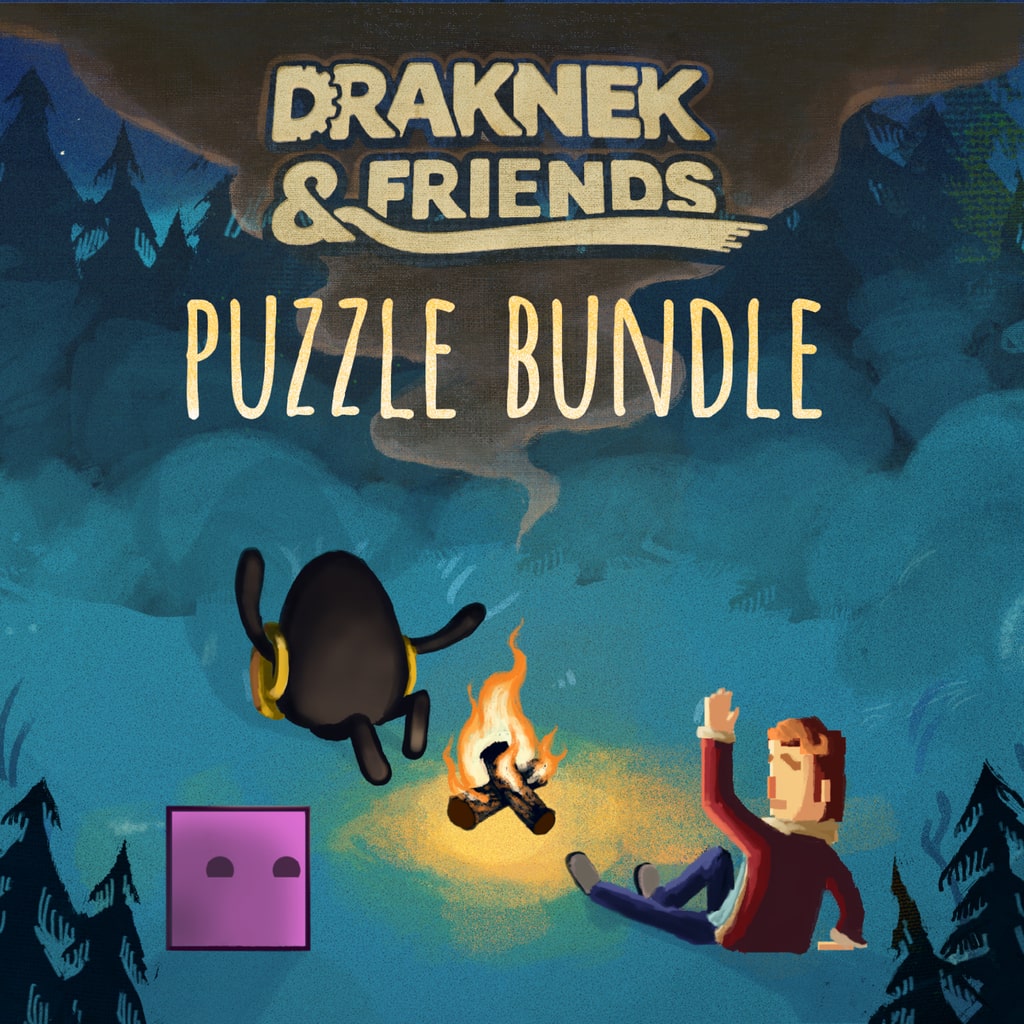
The Draknek and Friends Puzzle Bundle is less a conventional collection and more a statement of design philosophy. It brings together a curated set of puzzle games connected not by theme or narrative, but by a shared commitment to clarity, elegance, and mechanical honesty. These are games that trust the player’s intelligence, that derive challenge from rules rather than obfuscation, and that reward insight more than persistence. In an industry often enamoured with spectacle and scale, the bundle stands as a celebration of restraint and precision.
Rather than offering a single monolithic experience, the bundle presents a portfolio of ideas—each game exploring a distinct mechanical space, each refined to the point where every puzzle feels intentional. The result is a package that feels cohesive without being repetitive, and generous without being bloated. For fans of thoughtful, logic-driven design, this is not merely good value; it is a showcase of some of the finest contemporary puzzle craftsmanship.
A Curated Philosophy, Not a Random Collection
What immediately sets the Draknek and Friends Puzzle Bundle apart from many compilations is its sense of purpose. This is not a grab-bag of loosely related titles bundled for convenience. Each included game reflects a shared design ethos: simple rules, deep consequences, and puzzles that grow in complexity without ever becoming arbitrary.
There is no overarching narrative tying the games together, nor does there need to be. The connective tissue is intellectual rather than thematic. Across the bundle, puzzles are introduced carefully, mechanics are expanded incrementally, and difficulty emerges organically from the interaction of systems rather than from artificial constraints.
This cohesion makes moving from one game to another feel surprisingly natural. Even when mechanics differ significantly, the mental posture required—careful observation, hypothesis testing, and deliberate execution—remains consistent. It is a bundle that respects the player’s learning process across multiple experiences.
Core Gameplay — Rules That Do the Heavy Lifting
Each game in the bundle is built around a small set of rules that are easy to understand and difficult to master. Early puzzles often feel almost trivial, serving as demonstrations rather than challenges. This is deliberate. The games are not interested in tricking players early on; they want you to internalise the rules before they begin to test your understanding of their implications.
As puzzles progress, complexity arises not from adding new mechanics indiscriminately, but from combining familiar ones in increasingly demanding ways. The best moments come when a puzzle seems impossible until you reframe your understanding of the system—when the solution emerges not through brute force, but through a shift in perspective.
Importantly, failure is rarely punishing. Undo systems are generous, iteration is encouraged, and experimentation feels safe. This fosters a productive relationship between player and puzzle, where mistakes are informative rather than frustrating. It’s a design choice that reinforces the idea that these games are about thinking, not endurance.
Difficulty Curve — Challenging Without Being Cruel
The difficulty curve across the bundle is impressively well judged. Early sections ease players in gently, ensuring that core concepts are firmly grasped before any serious challenge is introduced. Mid-game puzzles demand deeper planning and more foresight, often requiring players to think several moves ahead or consider the consequences of actions that cannot be easily reversed.
Late-game content is unapologetically demanding. These puzzles ask for precision, creativity, and patience, and they will likely stop players in their tracks for extended periods. However, they rarely feel unfair. When you are stuck, it is usually because you have not yet found the right way to think about the problem, not because the game has withheld information or sprung a surprise.
This sense of fairness is crucial. Even when frustration creeps in, it is tempered by the knowledge that a solution exists within the established rules. The challenge is internal rather than imposed, and that makes eventual success deeply satisfying.
Presentation — Minimalism in Service of Clarity
Visually, the Draknek and Friends Puzzle Bundle embraces minimalism. Art styles are clean, readable, and deliberately understated. There is little in the way of decorative excess, and every visual element serves a functional purpose. Tiles, characters, obstacles, and interactive elements are immediately legible, allowing players to focus on logic rather than deciphering the interface.
This restraint extends to animation and effects. Movements are smooth but subtle, transitions are quick, and nothing distracts from the core interaction. The result is a visual language that supports problem-solving rather than competing with it.
Audio design follows a similar philosophy. Sound effects provide clear feedback without becoming intrusive, and music—where present—is ambient and unobtrusive. Silence is used effectively, allowing players to concentrate fully on the task at hand. The games understand that puzzles often require mental space, and they provide it.
Variety Within Consistency
One of the bundle’s strengths is the variety of mechanical ideas on offer. While each game adheres to a shared design ethos, they explore different conceptual territories. Some focus on spatial reasoning, others on movement constraints, state changes, or indirect control. This variety prevents fatigue and keeps the experience fresh, even across dozens of hours.
At the same time, the consistency of quality ensures that no game feels like filler. Each title earns its place in the bundle by offering a distinct and well-realised idea. There is a sense that these games have been chosen carefully, not simply because they exist, but because they represent strong examples of their respective approaches to puzzle design.
Accessibility and Approachability
Despite their depth, the games in the bundle are remarkably approachable. Controls are simple, tutorials are integrated seamlessly into early puzzles, and there is rarely a need for lengthy explanations. The games teach by doing, trusting players to learn through interaction rather than instruction.
This makes the bundle accessible to a wide audience, including players who may not traditionally gravitate toward puzzle games. At the same time, the later challenges ensure that experienced puzzle enthusiasts are well catered for. The design manages to be welcoming without being shallow, a balance that is difficult to achieve and even harder to sustain across multiple games.
Replayability and Longevity
In terms of sheer content, the Draknek and Friends Puzzle Bundle offers substantial value. Each game provides a lengthy sequence of puzzles, and completionists will find plenty to occupy them for dozens of hours.
Replayability, however, is more limited. Once puzzles are solved, there is little mechanical incentive to revisit them beyond personal satisfaction or the pleasure of re-solving. This is typical of the genre and not a flaw so much as an inherent characteristic. These are games about discovery and insight, and once that insight is gained, its impact naturally diminishes.
That said, the bundle’s breadth means that even if individual puzzles are one-and-done, the overall experience remains rich and varied.
Verdict
The Draknek and Friends Puzzle Bundle is an outstanding collection that exemplifies the best of modern puzzle design. It values clarity over complexity, insight over endurance, and respect for the player over artificial difficulty. Each game included feels purposeful, polished, and intellectually rewarding, contributing to a package that is greater than the sum of its parts.
This is not a bundle designed to chase mass appeal through spectacle or novelty. Instead, it offers a thoughtful, deliberate experience for players who enjoy engaging deeply with systems and solving problems through understanding rather than trial-and-error brute force. For fans of puzzle games, it is essential. For newcomers, it is an excellent introduction to what the genre can achieve when design is treated as an art form.