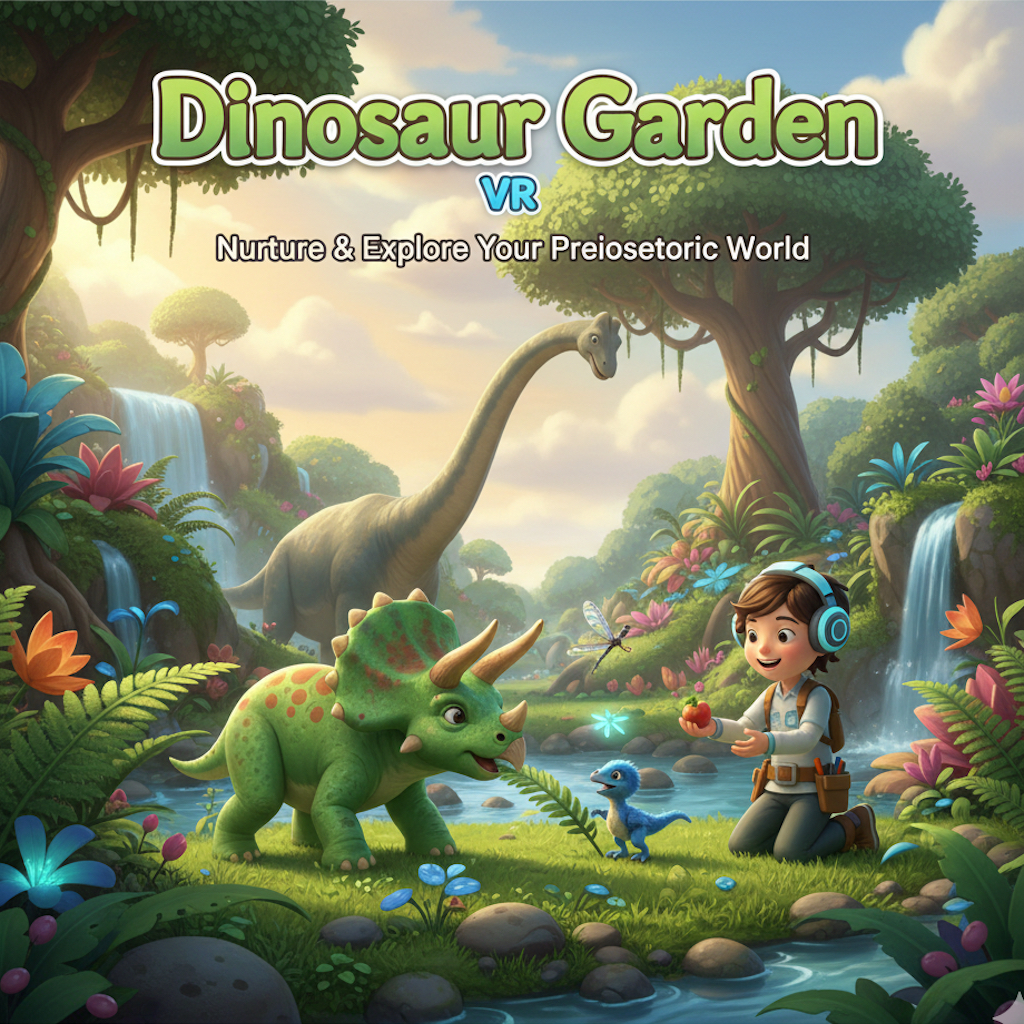
Virtual reality has steadily carved out a niche where presence matters more than spectacle, and nowhere is that more apparent than in simulation-driven, hands-on experiences. Dinosaur Garden on Meta Quest fits squarely into this space, offering a calm, creative, and tactile VR experience that blends light management mechanics with environmental interaction and a heavy emphasis on immersion. Rather than chasing high-intensity action or narrative spectacle, the game focuses on something far simpler and, in many ways, more effective: the joy of building, observing, and caring for something that feels alive around you.
After spending extensive time cultivating enclosures, experimenting with layouts, interacting with dinosaurs at different growth stages, and gradually expanding the scope of the garden, Dinosaur Garden reveals itself as a relaxed but thoughtfully designed VR title. It is not without limitations, particularly in depth and long-term variety, but its strengths lie in accessibility, atmosphere, and the unique sense of scale that only VR can provide.
Concept and Identity
At its core, Dinosaur Garden is exactly what its title suggests: a virtual space where players design, manage, and observe a small dinosaur habitat. You are not a corporate park tycoon racing against profit margins, nor a survivalist fending off prehistoric threats. Instead, you act as a caretaker and curator, shaping environments that support different dinosaur species while watching them roam, feed, and interact with their surroundings.
This gentler framing is central to the game’s identity. Dinosaur Garden positions itself closer to a meditative sandbox than a traditional management sim. Objectives exist, but they are secondary to experimentation and personal expression. The game wants players to slow down, appreciate scale, and enjoy the novelty of standing next to creatures that tower over them.
That identity makes the game immediately approachable, particularly for VR newcomers or players looking for a low-stress experience.
VR Interaction and Controls
One of Dinosaur Garden’s greatest strengths is how naturally it uses VR interaction. Controls are intuitive, relying on direct hand movement, simple gestures, and clear visual prompts. Placing terrain pieces, planting vegetation, or positioning feeding stations feels tactile and deliberate, reinforcing the sense that you are physically shaping the world rather than navigating menus.
Movement options are flexible. Players can teleport for comfort or use smooth locomotion for greater immersion, and the game performs well in both modes. Comfort settings are well-implemented, making it accessible to players with varying VR tolerance levels.
Interacting with dinosaurs is particularly effective in VR. Watching a creature respond to your presence, lean in curiously, or wander through an enclosure you’ve designed delivers a sense of scale and presence that flat-screen games simply cannot replicate. These moments are where Dinosaur Garden truly justifies its VR-only design.
Visual Design and Sense of Scale
Visually, Dinosaur Garden opts for a stylised, approachable aesthetic rather than hyper-realism. Dinosaurs are clearly identifiable and animated with personality, but the designs avoid excessive detail that could clutter performance or overwhelm players. This choice works well on standalone Quest hardware, ensuring stable performance while maintaining visual clarity.
The environments are colourful and readable, with terrain, foliage, and props designed to be easily distinguishable even at a distance. Lighting plays a key role in setting mood, with soft daylight cycles and gentle shadows adding depth without dramatic shifts that could distract from gameplay.
Scale is handled particularly well. Standing beside a large dinosaur and watching it move through your carefully arranged environment reinforces a sense of awe, even if the creature designs are not strictly realistic. The feeling of presence is more important than anatomical accuracy, and Dinosaur Garden understands this balance.
Gameplay Loop and Progression
The core gameplay loop revolves around expanding your garden, unlocking new dinosaurs, and customising habitats to suit their needs. Players earn progression by completing light objectives, experimenting with layouts, and maintaining healthy environments. This progression is intentionally relaxed; there are no harsh penalties or fail states, and mistakes are easy to undo.
As new dinosaurs are unlocked, players gain access to additional environmental tools and decorative options. These additions encourage creativity, allowing gardens to evolve visually and functionally over time. However, the progression system remains relatively shallow. While unlocking new species is satisfying, the underlying mechanics do not change dramatically as the game advances.
This simplicity is both a strength and a weakness. On one hand, it keeps the experience accessible and stress-free. On the other, players seeking deeper management systems or long-term strategic challenges may find the loop limited after extended play.
Audio and Atmosphere
Sound design in Dinosaur Garden is understated but effective. Ambient environmental sounds — wind through foliage, distant water, subtle wildlife noises — help ground the player in the space. Dinosaur vocalisations are present but restrained, reinforcing their presence without becoming intrusive.
The soundtrack is minimal, favouring soft, ambient music that fades into the background. This supports the game’s calming tone and encourages longer sessions without fatigue. Audio cues also provide gentle feedback for interactions, reinforcing actions without demanding attention.
Overall, the audio design complements the visual and interactive elements well, contributing to the game’s meditative quality.
Accessibility and Comfort
Accessibility is clearly a priority. The game includes multiple comfort options, adjustable movement settings, and simple controls that do not require precise or rapid input. This makes Dinosaur Garden suitable for a wide audience, including younger players and those new to VR.
The interface is clean and readable, with minimal reliance on small text or complex menus. Visual cues are clear, and tutorials are brief but sufficient, allowing players to start experimenting quickly.
However, more advanced accessibility features — such as extensive colour-blind options or deeper UI customisation — would further strengthen the experience.
Replayability and Longevity
Replayability in Dinosaur Garden is driven primarily by creativity rather than challenge. Players who enjoy redesigning spaces, experimenting with layouts, and simply spending time observing their creations will find plenty of value. The game lends itself well to short, relaxing sessions rather than extended marathons.
That said, long-term engagement may wane once all dinosaurs and tools are unlocked. Without deeper systems, dynamic events, or evolving challenges, the sandbox eventually reaches a plateau. This does not undermine the game’s core appeal, but it does define its lifespan.
Critiques and Limitations
While Dinosaur Garden succeeds as a relaxed VR experience, it has clear limitations. The most notable is the lack of mechanical depth. Management systems are light, and player decisions rarely carry meaningful consequences beyond aesthetic outcomes.
Additionally, dinosaur behaviour, while charming, is relatively simple. More complex interactions, social behaviours, or environmental responses could significantly enhance immersion and replay value.
Finally, players expecting a narrative or goal-driven experience may find the game aimless. Dinosaur Garden is at its best when approached as a creative toy rather than a structured game.
Final Verdict
Dinosaur Garden on Meta Quest is a gentle, immersive VR experience that leans into the strengths of the medium: presence, scale, and hands-on interaction. It offers a calming sandbox where players can experiment, observe, and create without pressure, making it an excellent choice for relaxed VR sessions.
While its systems lack depth and long-term complexity, the game succeeds in delivering a charming and accessible dinosaur experience that feels uniquely suited to virtual reality. For players seeking a peaceful, creative VR title rather than a demanding simulation, Dinosaur Garden is an enjoyable and worthwhile visit.