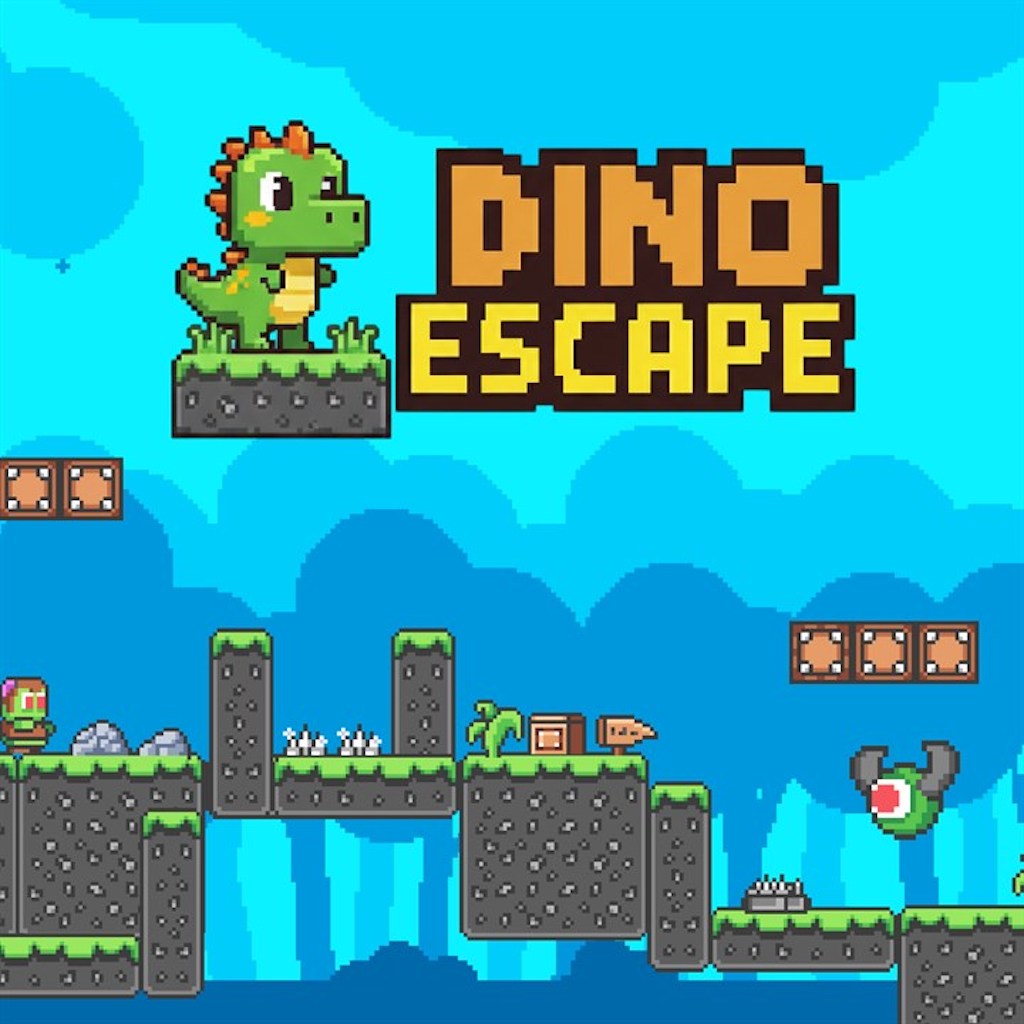
Precision platformers have enjoyed a quiet resurgence in recent years, carving out a space between nostalgia and modern challenge design. Titles inspired by classics like Celeste, Super Meat Boy, and retro-era action platformers continue to prove that tight mechanics and focused gameplay can still deliver powerful experiences without massive budgets or cinematic spectacle. Dino Escape, developed and published by PedroFStudio and released on February 18, 2026 for Xbox Series X|S, Xbox One, and PC, enters this space with a deceptively simple premise: guide a lost dinosaur through a haunted forest and survive long enough to find your way home.
At just £4.19, Dino Escape clearly positions itself as a compact indie experience. Yet beneath its modest price and minimalistic presentation lies a surprisingly tense, atmospheric platformer that blends precision movement with horror-tinged worldbuilding. It’s not a long game, nor an especially forgiving one — but for players willing to embrace repetition and mastery, it offers a focused and memorable challenge.
A Dinosaur Lost in Darkness
Dino Escape immediately sets itself apart through tone. While dinosaur-themed games often lean toward colorful adventure or family-friendly charm, PedroFStudio takes the opposite approach. The game opens in a desaturated forest filled with ruins, fog, and unsettling silhouettes. You control a small dinosaur separated from its pack — a vulnerable protagonist rather than an unstoppable hero.
There is minimal dialogue and almost no exposition. Storytelling happens through environment and implication:
- Broken stone structures hint at a forgotten civilization.
- Undead creatures wander aimlessly through the woods.
- The forest itself feels hostile and alive.
This environmental storytelling works remarkably well. The absence of explicit narrative encourages interpretation, allowing players to project emotion onto the lonely journey. The result is an experience that feels melancholic rather than frightening — closer to quiet dread than outright horror.
Precision Platforming at the Core
At its heart, Dino Escape is about movement mastery.
Your dinosaur has a small but versatile toolkit:
- A responsive jump
- A directional dash
- Momentum-based movement physics
That’s it — and that simplicity is intentional. Levels are built around combining these mechanics with exact timing. Many sections require players to chain jumps and dashes while avoiding spikes, airborne enemies, and collapsing platforms.
The controls are impressively tight. Input response feels immediate whether using a controller or keyboard and mouse (which is fully supported even on console versions). Success or failure rarely feels unfair; when you die — and you will die often — the cause is almost always player error.
The best platformers create a rhythm between failure and improvement, and Dino Escape understands this loop perfectly. Each death teaches positioning, timing, or route optimization. Eventually, sequences that once seemed impossible become muscle memory.
Hazard Design and Environmental Challenges
What elevates Dino Escape beyond basic platforming is its environmental variety.
Levels introduce hazards gradually:
- Spike corridors demanding dash precision
- Flying beasts forcing mid-air adjustments
- Crumbling platforms that punish hesitation
- Swamps that swallow stationary players
The swamp mechanic deserves particular praise. Bubbling water telegraphs danger subtly, requiring players to plan their next movement before landing. These moments shift gameplay from reaction-based platforming to strategic foresight.
Environmental puzzles also appear throughout the game. Ancient switches unlock paths or deactivate traps, forcing brief pauses in the otherwise frantic pacing. These segments provide welcome breathing room and help prevent gameplay fatigue.
Importantly, puzzles never overstay their welcome. Dino Escape remains firmly focused on movement rather than turning into a logic-heavy experience.
Atmosphere Through Pixel Art
Visually, Dino Escape embraces a restrained pixel-art aesthetic that prioritizes mood over detail.
The color palette leans heavily into:
- Muted greens and greys
- Shadow-heavy environments
- Soft lighting contrasts
Animation is subtle but effective. The dinosaur’s movements convey vulnerability, while enemies animate with eerie, unnatural motion. Background layers add depth without distracting from gameplay clarity — essential for a precision platformer.
The haunted forest never becomes visually noisy, ensuring hazards remain readable even during fast sequences.
Sound design reinforces the tension. Ambient noises — distant wind, faint echoes, and subdued musical cues — create an isolating atmosphere. Music rarely dominates, instead fading into the background to emphasize concentration.
It’s minimalist worldbuilding done right.
Difficulty: Fair but Demanding
Dino Escape does not aim to be relaxing. This is a game built around repeated attempts and incremental mastery.
Checkpoints are generally fair, minimizing frustration after difficult sections. Respawn times are nearly instant, maintaining momentum and encouraging “one more try” persistence.
However, players should expect:
- Frequent deaths in later stages
- Precision timing windows
- Increasingly dense obstacle combinations
The difficulty curve ramps steadily rather than spiking unpredictably. New mechanics appear gradually, allowing players to adapt before challenges escalate.
For platforming enthusiasts, this balance feels rewarding. Casual players may find the later levels demanding, but the short stage structure makes progress feel achievable in small bursts.
Xbox Ecosystem Features
Dino Escape benefits from strong integration within the Xbox ecosystem.
Key additions include:
- Full achievement support for Gamerscore hunters
- Cloud saves across Xbox and Windows versions
- Cross-platform progression
- Keyboard and mouse compatibility on console
These features make the game particularly appealing as a portable challenge experience across devices. Jumping between PC and console feels seamless, reinforcing its pick-up-and-play design.
Its inclusion in PC Game Pass also makes it an easy recommendation for subscribers curious about indie platformers.
Replay Value and Length
Dino Escape is not a sprawling adventure. A skilled player can complete it in a few hours, though mastery runs and achievement hunting extend playtime considerably.
Replay value comes from:
- Perfecting movement routes
- Improving completion times
- Unlocking achievements
- Refining execution through repeated runs
The game embraces arcade philosophy: short runtime, high skill ceiling.
This design works well given its price point, though players expecting expansive content may find the experience brief.
Where Dino Escape Stumbles
Despite its strengths, a few limitations hold it back from greatness.
Limited Enemy Variety
Enemy behaviors repeat frequently, reducing surprise in later stages.
Minimal Narrative Payoff
While atmosphere is strong, players seeking a clearer story resolution may feel unsatisfied.
Occasional Visual Ambiguity
Some darker areas slightly obscure hazards, leading to avoidable early deaths.
These issues rarely derail the experience but highlight the game’s small-scale development.
Final Verdict
Dino Escape succeeds by committing fully to its identity: a focused, atmospheric precision platformer that values control, tension, and mastery over spectacle.
Its somber tone sets it apart from genre peers, transforming what could have been a simple retro homage into something moodier and more introspective. Tight controls, smart hazard design, and a cohesive visual style create a satisfying gameplay loop that rewards persistence without feeling unfair.
It won’t revolutionize platforming, nor does it aim to. Instead, Dino Escape delivers exactly what it promises — a challenging, atmospheric journey built on skill and patience.
For fans of precision platformers looking for a compact but memorable experience, this little dinosaur’s desperate journey is well worth taking.