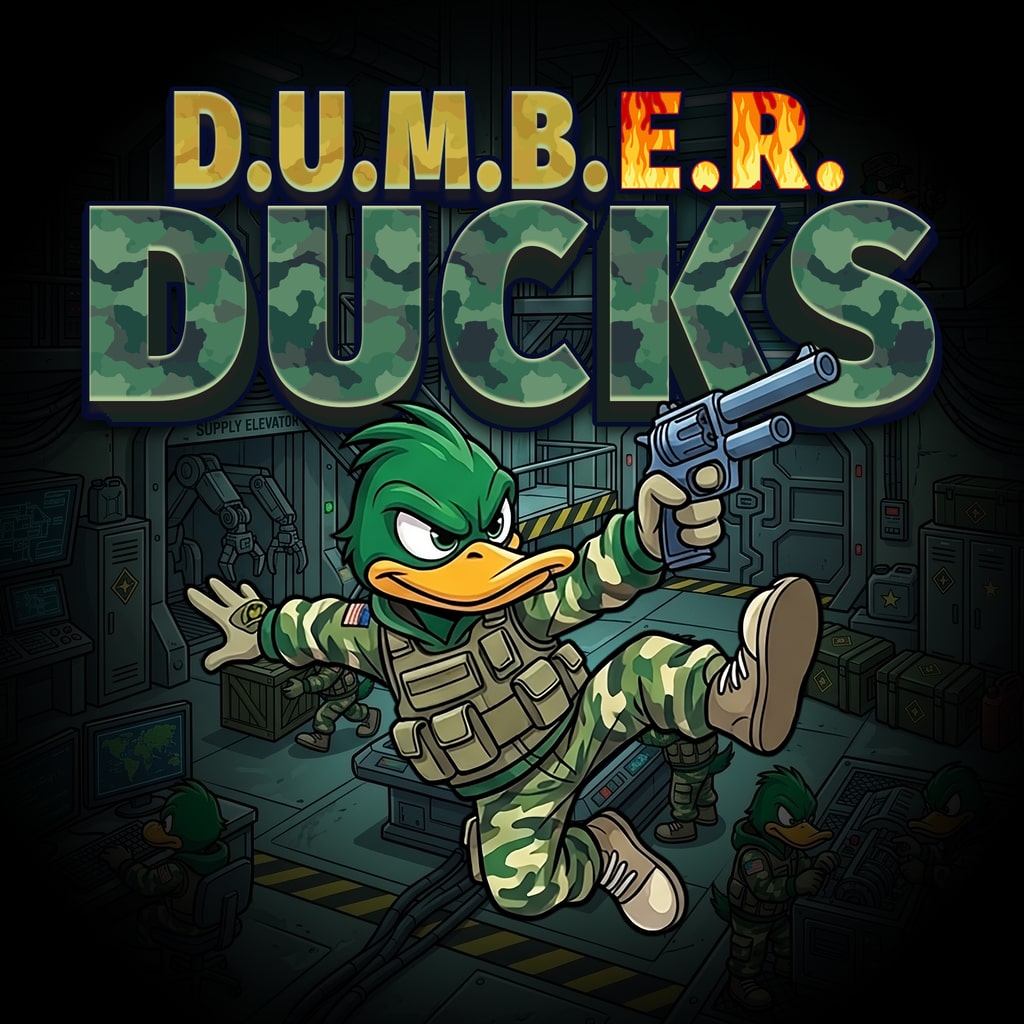
There is something refreshing about a game that knows exactly what it wants to be. In an era when many releases chase sprawling open worlds, endless progression systems, or live-service ambitions, D.U.M.B.E.R. Ducks arrives with a simple mission statement: arm a squad of reckless ducks with an absurd number of weapons and send them underground to rescue their fellow feathered comrades from giant man-eating snails.
That premise alone is enough to raise an eyebrow. Fortunately, Cascadia Games understands that a ridiculous concept only works when backed by solid mechanics. Rather than relying solely on its humour, D.U.M.B.E.R. Ducks delivers a genuinely enjoyable action-platforming experience, packed with frantic combat, clever level design, and an infectious sense of personality. It may not reinvent the run-and-gun genre, but it absolutely understands why players fell in love with games like it in the first place.
Feathers, Firepower, and Pure Chaos
The story wastes no time getting started. A distress signal rises from deep beneath the earth, and an elite, heavily armed duck rescue team is dispatched to investigate. Their objective is straightforward: rescue stranded ducks, recover valuable equipment, and demolish the underground caverns before escaping with their feathers intact. It is gloriously silly, and the game never pretends otherwise.
The narrative largely serves as a framework for the action, and that simplicity works in its favour. The focus remains squarely on movement, combat, and survival, allowing the gameplay to take centre stage without interruption. Every level feels like a new episode of a forgotten Saturday morning cartoon, with writers fuelled by too much sugar and an unrestricted imagination. The result is a world that feels playful and energetic from beginning to end.
The Four-Gun Revolution
What immediately sets D.U.M.B.E.R. Ducks apart from many of its retro-inspired contemporaries is its weapon system. Most run-and-gun games force players to choose between a primary and a secondary weapon. Here, you can carry up to four weapons at once and switch between them on the fly. It sounds like a small addition, but it fundamentally changes how combat unfolds.
Instead of committing to a single loadout, encounters become miniature tactical puzzles. A rocket launcher might be perfect for clearing heavily armoured enemies, but a rapid-fire plasma weapon proves more effective against swarms. Shotguns dominate close-range engagements, while precision weapons excel in tight, hazard-packed corridors.
The freedom to adapt instantly keeps combat dynamic throughout the campaign. Rather than hoarding ammunition for the perfect moment, the game actively encourages experimentation. Weapons become tools rather than precious resources, creating a constant rhythm of adaptation and improvisation.
The system also complements the game’s pacing beautifully. Combat rarely slows down, and the ability to swap weapons seamlessly keeps momentum flowing even during the most chaotic encounters.
Snails Have Never Been This Terrifying
For a game starring armed ducks, the enemy design deserves far more credit than might first be expected. The giant carnivorous snails are far more threatening than their slow-moving real-world counterparts. These monstrous creatures leap from walls, launch toxic projectiles, and use their massive shells as defensive barriers. They constantly pressure players to stay mobile, preventing combat from devolving into simple shooting galleries.
As the campaign progresses, enemy variety expands steadily. New snail variants introduce fresh attack patterns, environmental hazards become more complex, and larger encounters demand greater awareness of positioning and weapon selection.
The best action games keep players engaged, and D.U.M.B.E.R. Ducks consistently succeeds in that regard. There are very few moments when your attention can wander without consequence.
Destruction with Purpose
Level design proves to be one of the game’s strongest assets. Rather than building straightforward corridors, Cascadia Games has crafted a network of interconnected underground environments filled with hidden paths, rescue targets, and secrets. Exploration is rewarded without disrupting the overall pace, creating a satisfying balance between discovery and action.
The most memorable moments come during extraction sequences. Once objectives are completed and explosives are planted, the mission shifts dramatically. Suddenly, the caverns begin to collapse around you, pathways disappear, and new routes emerge as the countdown ticks down.
These sequences inject a strong sense of urgency into each level. What was once a careful exploration mission becomes a desperate race for survival. The transition keeps the campaign feeling fresh while reinforcing the game’s energetic personality. Few things are as satisfying as narrowly escaping a collapsing cave while unloading rockets into pursuing snail-like monstrosities.
A Love Letter to the 16-Bit Era
Visually, D.U.M.B.E.R. Ducks is a delight. The pixel art immediately evokes classic action games from the Mega Drive and Super Nintendo era, yet it avoids feeling like a simple imitation. Character animations are packed with charm, from exaggerated recoil reactions to comical feather explosions when taking damage.
The ducks themselves possess an incredible amount of personality despite limited dialogue. Their movements convey confidence, panic, determination, and occasional stupidity in equal measure.
The environmental design also deserves praise. Underground caves could easily become repetitive, but the game constantly introduces new visual themes. Glowing fungal forests, abandoned mining facilities, high-tech research stations, and lava-filled caverns all provide distinct identities that help maintain visual variety. Every area feels handcrafted rather than procedurally assembled, giving the adventure a welcome sense of place.
Chiptunes and Controlled Mayhem
Audio design plays a major role in conveying the game’s chaotic energy. The soundtrack blends classic chiptune influences with heavier rock and metal elements, creating a pulse-pounding backdrop for the action. The music rarely takes centre stage, but it constantly enhances the atmosphere, propelling players through increasingly intense encounters.
Weapon sound effects are particularly satisfying. Every firearm feels weighty and impactful, making combat tactile and rewarding. Heavy weapons deliver booming blasts that echo through tunnels, while rapid-fire weapons provide a constant barrage of audio feedback. Combined with the energetic soundtrack, the audio presentation creates a strong sense of momentum that rarely lets up throughout the campaign.
Short But Sweet
One area where some players may want more is overall length. A standard playthrough lasts roughly three to four hours, depending on difficulty and exploration habits. That may sound brief by modern standards, but it feels appropriate for the experience on offer. More importantly, the game avoids unnecessary padding.
Every level introduces new challenges, and the campaign concludes before repetition becomes a serious issue. Hidden collectibles, equipment recovery objectives, and additional challenge modifiers provide reasons to revisit stages, particularly for completionists chasing every secret. Given the modest asking price, the value proposition remains extremely strong.
Final Verdict
D.U.M.B.E.R. Ducks understands an important truth many games forget: fun need not be complicated. Its premise is ridiculous, its heroes are ducks armed with enough weaponry to destabilise a small nation, and its villains are giant carnivorous snails. Yet beneath that absurd exterior lies a genuinely polished action-platformer built on excellent pacing, satisfying combat, and a wonderfully flexible weapon system.
The campaign may be relatively short, and occasional difficulty spikes can catch players off guard, but these issues barely diminish the experience. Every moment feels crafted with enthusiasm and affection for the arcade classics that inspired it.
D.U.M.B.E.R. Ducks is loud, chaotic, unapologetically silly, and immensely entertaining. It captures the spirit of old-school action games while adding enough modern refinements to feel fresh rather than nostalgic for nostalgia’s sake. For retro enthusiasts and action fans alike, this feathered rescue mission is well worth answering.