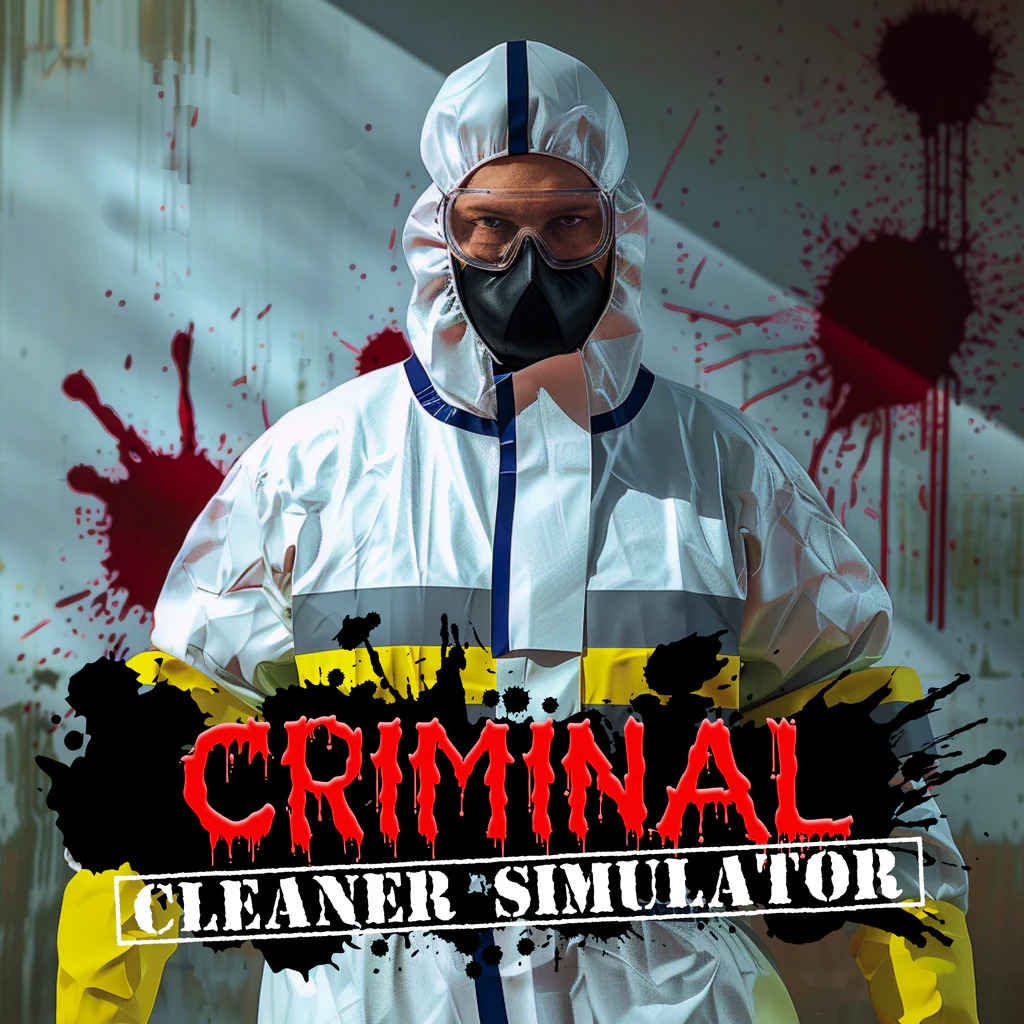
There’s a peculiar breed of simulation games that revel in the mundane. Whether it’s mowing lawns, driving trucks, or running a tavern kitchen, these titles find play in everyday (or decidedly irregular) tasks. Criminal Cleaner Simulator sits firmly in that niche — but it does so with an unexpected blend of dark comedy, procedural challenge, and surprisingly deep mechanical systems. At first glance, it appears to be little more than a “crime scene janitorial” simulation, but by the time its complexity unfolds, the experience reveals layers of strategy, situational adaptation, and meticulous choreography that defy its offhand premise.
After extensive playtesting across multiple stages, difficulty levels, and cleaning scenarios, Criminal Cleaner Simulator emerges as both a curiously addictive simulator and a study in systems design. It’s not for everyone, but for players who enjoy simulated tasks elevated by emergent challenge and personality, this is a title with real traction.
Concept and Identity
At its surface, Criminal Cleaner Simulator is simple: you are hired (or obliged) to clean up after criminal incidents. Blood, bodies, debris, graffiti, bullet casings, chemical spills — all of these elements are on the menu, and your job is to clear, disinfect, document, and sanitize. There’s no morally pure reason for this work; rather, the game embraces its absurdity. You’re a hired cleaner working bizarre, often gruesome environments with a toolkit that spans mop, bucket, saw, hazmat suit, and industrial cleaners.
This abstraction of a typically grim task into game form requires a delicate tonal balance, and the developers strike it well by infusing the game with just enough levity to offset the implicit morbidity. The title never glorifies crime, nor does it revel in gore — instead, it subtly tilts the scenario from grotesque to performative strategy: you are not a voyeur in a crime scene, but a technician executing a procedural challenge.
This emphasis on task over spectacle gives the game a distinct identity. It’s not a gritty crime drama; it’s not a horror game; it’s a systems puzzle with real visceral texture.
Gameplay and Mechanics
Make no mistake: Criminal Cleaner Simulator is not about rote sweeping. The core loop — assess, clean, sanitise, document — is undergirded by a surprisingly deep simulation model that factors in stain density, surface type, contamination risk, and time management.
Assessment Phase
Each map begins with a survey. You don’t know what you’re walking into; you are given a general briefing and must navigate the environment to locate zones requiring attention. A minimap with hot/cold gradient indicators helps, but initial exploration remains essential. Blood trails, chemical burns, shattered glass, and bodily remains are all indicated visually, requiring careful observation.
Preparation Phase
Before cleaning begins in earnest, you select your equipment. Choices matter. Heavy-duty disinfectants excel on organic stains but cost more and can saturate certain surfaces; dry sweepers handle broken glass without creating dust clouds; hazmat suits are protective but reduce movement speed. Budget limitations and time constraints turn equipment choice into a tactical consideration.
Execution Phase
Once you’ve gathered your tools, the real work begins: applying solvent X before scrubbing with brush Y, neutralising acid spots, bagging evidence appropriately, disposing of hazardous waste according to safety protocols. Each action has feedback — surface absorption levels, contamination markers, and tool wear all influence success. A mop left too long on a stain won’t clean as effectively as repeated focused swipes. Worse, ignoring hazard signs results in penalties, both procedural and — in higher difficulty modes — financial.
Documentation Phase
Once the physical cleanup is complete, you must document your work. Photographs, checklist submissions, and hazard reports must be completed before job closure. This transforms the act of cleaning into forensic housekeeping, doubling back on the game’s thematic tension between banality and grim reality.
Visuals and Sound Design
Graphically, Criminal Cleaner Simulator embraces a slightly stylised but grounded aesthetic. Environments are detailed with sufficient fidelity that blood spatters, debris patterns, and surface textures communicate information clearly. This clarity is essential; unlike some simulation titles where visual noise undermines readability, here every spill and stain is both purposeful and legible.
Character models move with deliberate weight. Cleaning actions are not instantaneous button presses but observable processes. The game’s animation design reinforces the sense of physical labour without feeling sluggish. Harsh fluorescent lighting, scattered debris, and industrial interiors contribute to an atmosphere that is sterile without being oppressive.
Audio design is equally nuanced. Ambient office hums, the squeak of rubber boots, the dull sponge sound of a mop hitting tile, and even the sharp metallic ring of cleaning tools bouncing off a steel surface all anchor the experience. Music is sparse, often absent during core tasks, allowing focus to settle on procedural sound cues — footsteps, equipment interaction noises, and verbal checklist confirmations.
Progression System
A robust progression system elevates Criminal Cleaner Simulator from isolated tasks to long-term engagement. You begin with basic jobs — small apartments, minor break-ins — where mess is limited and time allowances generous. As you climb tiers, scenes become larger, contamination levels increase, and hazards become more volatile.
Experience unlocks new tools, faster cleaning liquids, specialised protective gear, and quality-of-life upgrades like tool carrying capacity or enhanced vision aids that highlight contamination layers. This progression feels meaningful; each tier introduces challenge spikes that demand not just speed but strategy.
Side contracts, randomised events, and client demands further enrich the loop. Some clients want rapid turnaround with high cleanliness thresholds, while others penalise chemical overuse. Balancing efficiency, budget, and tool optimisation becomes a satisfying meta-game, encouraging players to revisit earlier jobs with improved techniques and equipment.
Difficulty and Accessibility
Difficulty in Criminal Cleaner Simulator is adaptable. Casual players can enjoy the core loop with generous timers and forgiving budgets; hardcore sim fans can opt into very strict thresholds, punishing penalties, and environmental hazards that require meticulous planning. Difficulty doesn’t respawn enemies or ramp up combat — instead, it demands procedural precision.
The learning curve is well-paced. Early jobs introduce mechanics gradually, while later stages expect players to leverage mastered systems. Tooltips, audio cues, visual indicators, and optional tutorials help newcomers acclimate, although the depth of systems may feel intimidating to those unfamiliar with simulation titles.
One minor frustration is interface complexity when managing multiple tasks simultaneously. Documentation menus and hazard reporting panels can feel clunky under pressure — likely intentional to mimic real world paperwork tedium, but potentially a friction point in tight runs.
Replayability and Longevity
Replayability is strong. Procedural variation ensures no two jobs are identical, and the incentive to optimise routes, tool choices, and procedural sequences rewards repeated engagement. Community challenges, leaderboards (based on efficiency, thoroughness, and speed), and optional modifiers (such as environmental hazards or time anomalies) extend longevity beyond the base campaign.
While the pure core idea is narrow compared to genre heavyweights, what the game does, it does well — and that makes repeated runs compelling for strategy shoppers and simulation enthusiasts alike.
Critiques and Minor Limitations
No game is without flaws, and Criminal Cleaner Simulator has a few:
- Narrative Context: The game’s world is light on broader narrative beyond job briefs. Players seeking story richness may find the framing sparse.
- Interface Density: Some menus, particularly around documentation and hazard tracking, feel overloaded and could benefit from refinement.
- Visual Variety: After many hours, environments begin to feel visually similar. Greater locale diversity would enhance long-term engagement.
These shortcomings don’t undermine core enjoyment, but they are areas where future updates could elevate experience dramatically.
Final Verdict
Criminal Cleaner Simulator is one of those rare simulation titles that takes a quirky premise and builds systems around it with intelligence, depth, and purpose. It turns a bizarre concept — cleaning up crime aftermath — into a thoughtful, engaging simulation where strategy, precision, and procedural mastery matter. Its blend of tone, mechanics, progression, and challenge makes it a standout in a category often dominated by surface-level ideas.
For players who love simulations that blend strategy with tactile interaction, this is a title that rewards both patience and experimentation. It may not be mainstream entertainment, but for its audience it offers meaningful engagement and repeated satisfaction.