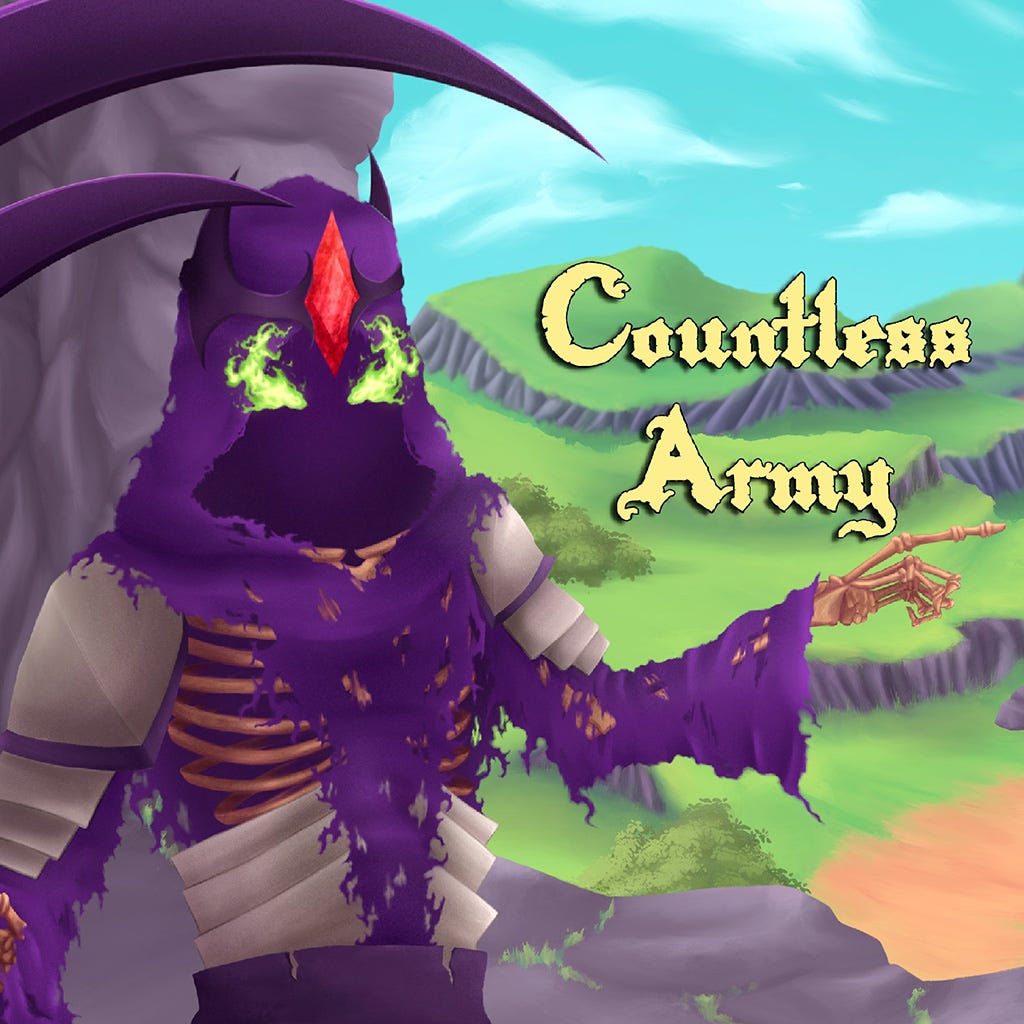
What happens when you stop defending the castle… and start trying to destroy it?
Countless Army by Daniel Navarro Olmedo takes one of gaming’s most familiar genres and turns it completely on its head. Instead of carefully placing towers and watching waves of enemies crash against your carefully prepared defenses, you are the wave. You are the villain. You are the commander sending relentless troops into heavily fortified enemy territory, trying to break through their defenses with smart planning, upgrades, and sheer numbers.
This “reverse tower defense” concept is the hook, and it’s an immediately intriguing one. Rather than reacting to enemy movements, you become the strategist dictating the assault. And while the core idea is simple, Countless Army finds surprising depth in how you manage troops, routes, professions, spells, and long-term progression across a world made up of six distinct kingdoms and 52 maps.
Being the Bad Guy Feels Refreshingly Different
The novelty of playing the aggressor never really wears off. Watching lines of your own units march toward an entrenched wall of cannons, traps, and towers flips the usual emotional dynamic of the genre. You’re not protecting fragile ground; you’re trying to crack a nut that’s designed to stop you.
Each map is essentially a puzzle. Enemy defenses are pre-built, and your job is to figure out how to dismantle them by choosing the right units, sending them in the right order, and sometimes choosing different paths through the level. It’s less about reflexes and more about strategic sequencing.
The first few maps ease you into this idea gently, but the challenge ramps up quickly. You realise that brute force rarely works. Instead, you begin to think like a general: soften this section first, sacrifice cheaper units to trigger traps, send tougher troops after the defenses have been weakened, and time your spells to keep the momentum going.
Troops, Professions, and Customisation
You unlock 12 different troop types throughout the campaign, and each one can be assigned one of two professions. This is where Countless Army starts to reveal real tactical depth. A basic unit might be turned into a more defensive version with higher survivability, or into a faster, more aggressive variant that can slip past certain defenses before being destroyed.
This choice matters. The profession system doesn’t feel cosmetic — it changes how you approach maps. Some layouts favour speed, others reward durability, and some require a clever mix of both.
On top of that, you can upgrade stats, unlock skins, and invest in a sizeable skill tree with over 50 unlocks. The skill tree provides long-term progression that makes you feel like your army is evolving, not just repeating the same tactics over and over.
Map Variety and Kingdom Design
The game spans six kingdoms: plains, forests, coasts, wastelands, snowy mountains, and deserts. While the core objective remains the same, each region introduces new defensive layouts and environmental flavour that keeps things visually and strategically fresh.
Some maps have tighter paths that funnel your troops into deadly choke points. Others offer branching routes, allowing you to split waves and attack from multiple angles. The variety in map design is crucial, because without it the reverse tower defense idea could have become repetitive.
Instead, each new kingdom feels like a new test of your growing tactical toolbox.
Spells and Timing
You also have access to six spells that can turn the tide of a wave. These might boost your units, damage defenses, or create short windows of opportunity for your troops to push through.
Spells add an active element to what could otherwise feel like a purely observational experience. You’re not just sending units and waiting — you’re watching the battlefield closely, looking for the perfect moment to intervene.
Using a spell at the wrong time often means watching your entire wave collapse. Using it at the right moment can be the difference between total failure and watching your army finally punch through to the end.
The Rebellion Mechanic
One of the more interesting features is that conquered states can rebel. This prevents the campaign from feeling like a straight line from start to finish. You’re encouraged to maintain control of territories rather than simply racing forward.
It adds a layer of light management to the conquest, making the world feel a little more dynamic than a standard level-select screen.
Weather and Atmosphere
Dynamic weather — rain, mist, storms, clouds — is a small touch but helps keep the presentation from feeling static. It doesn’t drastically alter gameplay, but it reinforces the feeling that you’re fighting across a living world rather than a series of sterile maps.
Where the Formula Shows Its Limits
As clever as the concept is, Countless Army can start to feel repetitive over long play sessions. The core loop remains largely the same: assess defenses, choose units, send wave, repeat. While new maps and units help, the fundamental interaction doesn’t evolve dramatically.
There’s also a slight sense of distance from the action. Because you’re sending units rather than controlling them, you sometimes feel like a spectator once a wave is in motion. If a plan fails, there’s little you can do besides adjust for the next attempt.
A Smart Twist on a Familiar Genre
Despite these limitations, Countless Army succeeds because its central idea is strong and well executed. It doesn’t try to overwhelm you with unnecessary mechanics. Instead, it takes a simple reversal of a familiar formula and explores it thoroughly with smart progression systems and thoughtful map design.
You’re constantly experimenting, refining your approach, and learning from failures. That sense of strategic iteration is where the game shines.
Final Verdict
Countless Army proves that even well-worn genres can feel fresh with the right perspective shift. By turning tower defense inside out and putting you in charge of the invading force, it delivers a satisfying and surprisingly deep tactical experience.
While repetition can creep in over time, the combination of troop customisation, clever map design, and steady progression makes this a reverse tower defense well worth conquering.