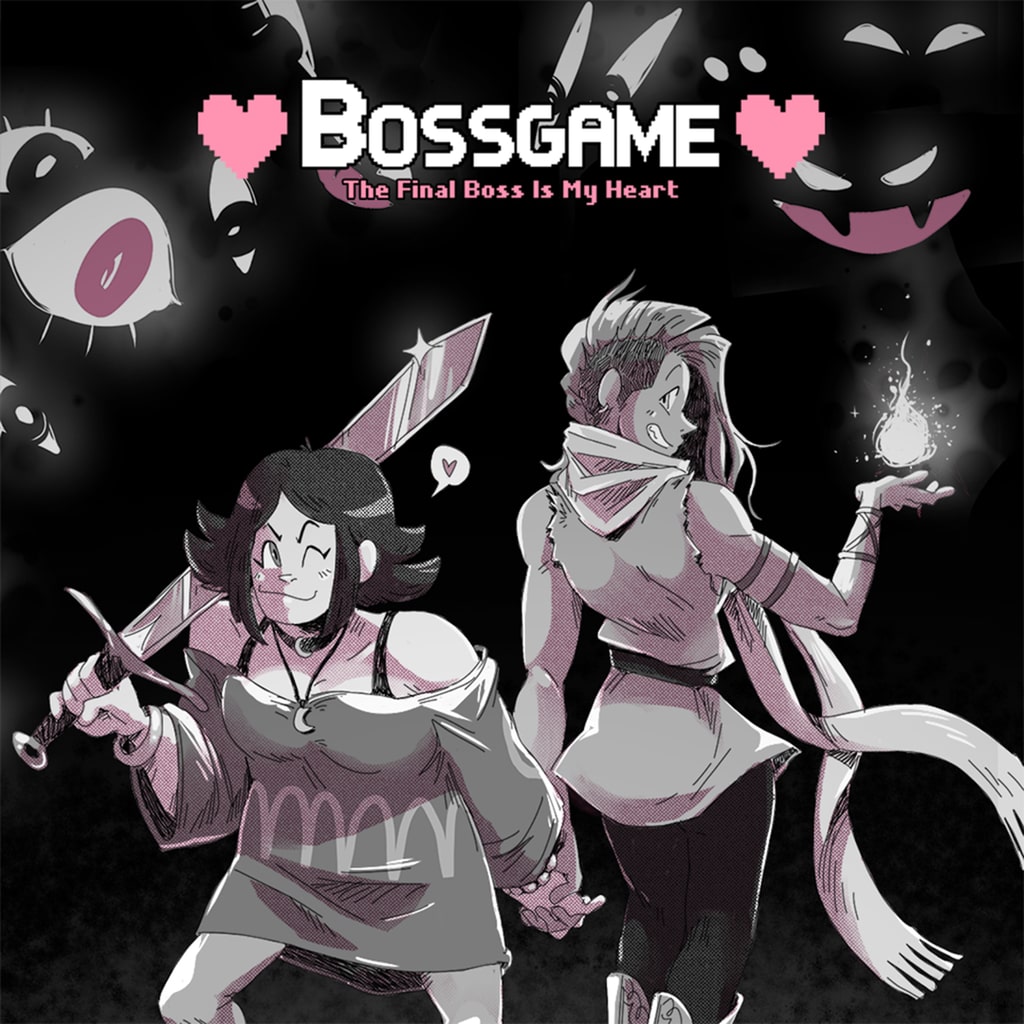
At first glance, BOSSGAME: The Final Boss Is My Heart presents itself as a playful inversion of familiar videogame tropes. The title alone signals intent: this is a game that understands the language of boss fights, power escalation, and heroic confrontation—and is more than willing to undermine all of it. What initially appears to be a tongue-in-cheek riff on action games gradually reveals itself as something more introspective, using humour and genre awareness to explore vulnerability, identity, and emotional consequence.
BOSSGAME is not content to simply parody videogames; it interrogates them. It asks what happens when the language of challenge and domination is turned inward, and whether victory still means the same thing when the opponent is not external, but personal.
Presentation and First Impressions
Visually, BOSSGAME adopts a deliberately exaggerated style. Character designs are bold, expressive, and occasionally absurd, leaning into stylisation rather than realism. Bosses are larger-than-life, often bordering on caricature, reinforcing the game’s self-awareness and satirical tone.
Environments are compact but distinct, designed less as immersive worlds and more as stages for confrontation. This theatrical framing works in the game’s favour, allowing each encounter to feel purposeful rather than incidental. While the presentation may appear simplistic at first, it becomes clear that restraint is part of the design philosophy. The game wants players focused on interaction and meaning, not visual spectacle.
Menus and interface elements are clean and readable, reinforcing accessibility. There is little friction between the player and the action, an important consideration given the game’s reliance on pacing and emotional timing.
Core Gameplay and Boss-Centric Design
As the title suggests, BOSSGAME is structured almost entirely around boss encounters. There is little filler content, no sprawling exploration, and minimal downtime between confrontations. Each boss serves as both a mechanical challenge and a thematic statement, often reflecting an aspect of the protagonist’s internal struggle.
Mechanically, combat is straightforward but responsive. Attacks, dodges, and abilities are easy to grasp, allowing players to focus on pattern recognition and adaptation rather than complex inputs. This accessibility ensures that difficulty comes from execution and understanding rather than system mastery.
Boss fights escalate in complexity, introducing new mechanics and behaviours that require players to rethink strategies. However, BOSSGAME avoids the trap of artificial difficulty. Challenges feel designed to test attention and timing rather than endurance. Failure is frequent, but rarely feels unfair.
What distinguishes these encounters is how mechanics often tie directly into narrative themes. Boss patterns are not just obstacles; they are expressions of emotional states, insecurities, or internal conflicts. This integration elevates the experience beyond simple action gameplay.
Narrative and Emotional Subtext
Despite its playful exterior, BOSSGAME carries a surprising emotional weight. The story unfolds gradually, often through brief dialogue exchanges, visual symbolism, and the structure of encounters themselves. Rather than relying on lengthy cutscenes, the game allows meaning to emerge through repetition and contrast.
The central conceit—that the final boss is the protagonist’s own heart—frames the entire experience. As players progress, it becomes increasingly clear that the battles are metaphorical, representing internal struggles rather than external threats. Themes of self-doubt, fear of failure, and emotional vulnerability recur throughout, often juxtaposed with humour to soften their impact.
This tonal balancing act is one of BOSSGAME’s greatest strengths. Comedy is used not to trivialise emotion, but to make it approachable. Moments of levity coexist with genuine introspection, preventing the experience from becoming either overly cynical or self-serious.
However, the narrative’s subtlety may not resonate with all players. Those expecting explicit storytelling or clear emotional resolution may find the game’s approach elusive. BOSSGAME prefers implication over explanation, trusting players to connect the dots.
Pacing and Structure
BOSSGAME benefits from a tight, focused structure. By centring the experience around boss encounters, the game maintains momentum and avoids unnecessary padding. Each new confrontation feels purposeful, contributing either mechanically, thematically, or both.
Pacing is generally strong, with difficulty rising at a steady rate. The game allows brief moments of reflection between major encounters, giving players space to process both gameplay and narrative developments. These pauses are essential, as the emotional weight of later sections can be surprisingly heavy.
The overall runtime is modest, but this brevity works in the game’s favour. BOSSGAME delivers its ideas concisely, avoiding repetition or overextension.
Audio Design and Tone
Sound design plays a crucial role in reinforcing mood. Music shifts dynamically during boss encounters, often mirroring emotional intensity rather than simply escalating tension. Tracks range from energetic and playful to subdued and introspective, supporting the game’s tonal shifts.
Sound effects are crisp and informative, providing clear feedback during combat. Voice work, where present, is used sparingly but effectively, adding personality without overwhelming the experience.
Silence is also employed deliberately, particularly in moments of narrative significance. These quiet beats allow themes to settle, reinforcing the game’s reflective qualities.
Accessibility and Limitations
From a mechanical standpoint, BOSSGAME is accessible, with intuitive controls and a manageable difficulty curve. However, its thematic focus and genre subversion may limit broader appeal. Players seeking a traditional action game with clear goals and power progression may find the experience unconventional.
Additionally, while the boss-centric structure is largely successful, it does limit variety. Players who prefer exploration, character customisation, or systemic depth may feel constrained by the game’s narrow focus.
Final Verdict
BOSSGAME: The Final Boss Is My Heart is a confident, self-aware experience that uses familiar videogame language to explore unfamiliar emotional territory. It balances humour and sincerity with surprising finesse, delivering a game that is both entertaining and introspective.
While its minimalist structure and metaphor-driven narrative will not appeal to everyone, those open to its approach will find a memorable experience that lingers beyond its final encounter. BOSSGAME does not redefine action gameplay, but it recontextualises it in a way that feels thoughtful and sincere.
This is a game that understands the power of bosses—not just as obstacles, but as mirrors—and it uses that understanding to tell a story about vulnerability that feels refreshingly honest.