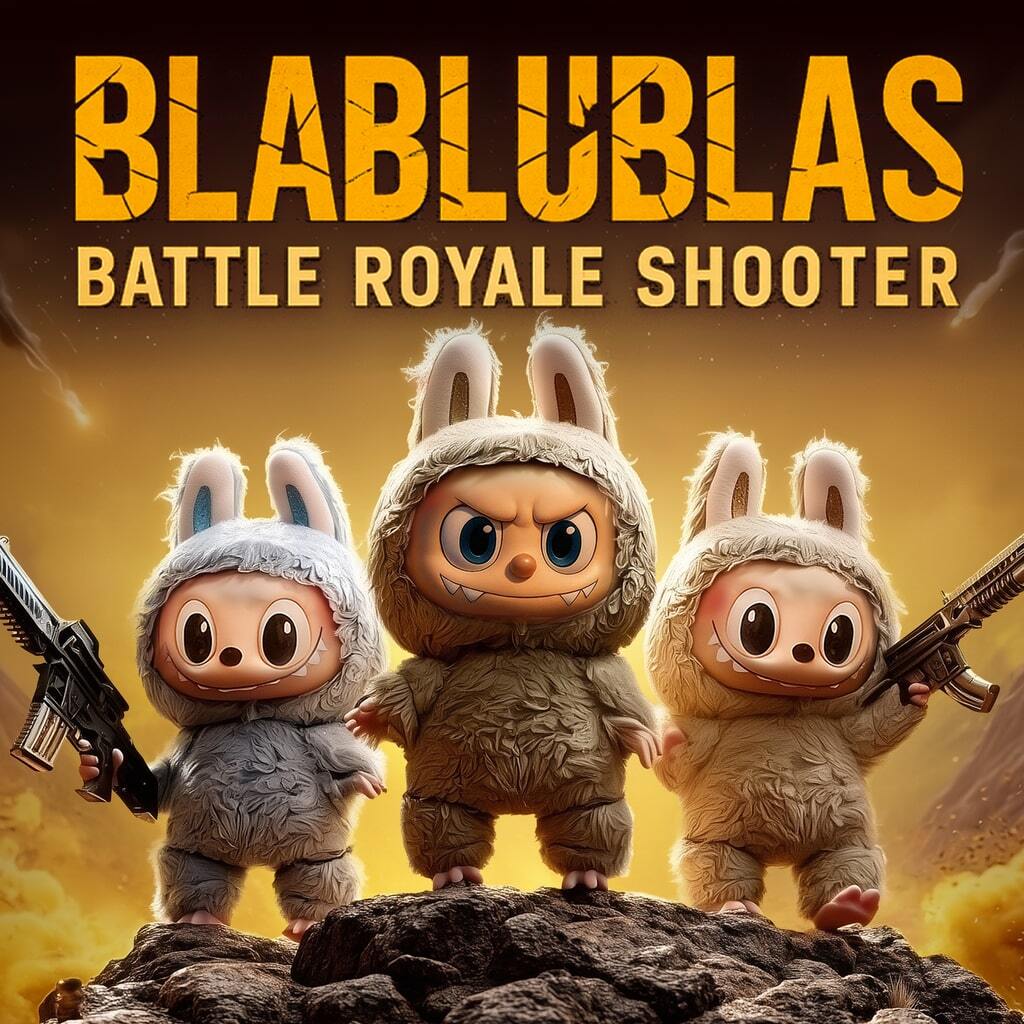
Blablublas Battle Royale Shooter steps into the crowded arena of last-player-standing shooters with a colourful, chaotic spin that blends frantic action with whimsical design. In a genre defined by tension, emergent moments, and decisive encounters, Blablublas stakes its claim by trading ultra-realism for unfiltered fun—leaning into exaggerated physics, playful visuals, and pick-up-and-play sensibilities. The result is a title that’s easy to enjoy in short bursts, though its depth and long-term appeal wobble beneath its buoyant surface.
This is not a revolution in the battle royale category, nor does it aspire to be. Instead, it’s an interpretation that borrows familiar systems—shrinking play zones, loot tiers, fast respawns—and dresses them in a nonsensical, slapstick aesthetic designed to maximise chaos and minimise pretension. If your ideal battle royale experience is “mayhem first, meta second,” then Blablublas Battle Royale Shooter is worth a look.
Premise and Style — Mayhem in a Colourful Package
The Blablublas concept is immediately made clear by its title and presentation: a battle royale shooter where the arbitrary and absurd is the default state. You drop onto a vibrant island populated by other players, loot weapons, evade or engage enemies, and try to be the last one standing as the play area shrinks. That’s classic battle royale. Where this game diverges is in its tone and visual identity.
Characters are small, squishy, and cartoon-ish. Guns fire with exaggerated effects, and explosions evoke confetti more than carnage. The game doesn’t take itself seriously; taunts, emotes, and randomised effects (like sudden slippery zones or unexpected physics oddities) keep a smile on your face—even if victory remains elusive.
Visually, the environments are bright and readable, with enough variety in biomes that matches feel visually distinct. The art style isn’t technically groundbreaking, but its charm lies in clarity: bullets are easy to track, enemies are easily distinguishable, and item pickups never hide behind visual noise. This clarity is a practical advantage in a chaotic shooter, but it also reinforces the game’s playful tone.
Core Gameplay — Pick Up, Panic, Survive
At the heart of Blablublas is a responsive movement system and a suite of weapons that feel immediate even when violence is nonsensical. Movement is floaty by design—think less tactical military simulator and more slippery cartoon slide—encouraging players to dance around threats rather than deliberate slowly. Verticality, bouncing surfaces, and unpredictable physics contribute to the sense that every engagement is a moment of improvisation.
Weapon behaviour varies appropriately. Close-range shotguns dish out big numbers with wild recoil, SMGs spray with satisfying chaos, and rifles feel weighty (even in a buoyant physics environment). Explosives are less about precision and more about spectacle, often resulting in hilarious knockback effects that send foes tumbling off cliffs or into unsuspecting traps.
A weakness here is that weapon differentiation, while present, lacks mechanical depth. There are modest stat differences between guns, but there are few opportunities for nuanced choice or trade-offs beyond “this does more damage” or “that reloads faster.” In a title that leans into chaos, this is an understandable design choice, but it also limits the game’s long-term strategic richness.
Loot and Progression — Familiar, Functional, Unremarkable
Loot in Blablublas adheres to familiar battle royale conventions: tiers of rarity, randomly scattered gear, armour pickups, and limited special items like temporary shields or speed boosts. Picking up gear feels satisfying in the moment, and the randomness keeps early matches fresh.
However, the progression systems outside individual matches are shallow. There are cosmetic unlocks, weapon skins, and a basic reward track, but there’s little in the way of persistent upgrades that alter playstyle or allow targeted specialisation. This keeps matches balanced—everyone starts the same—but also removes longer-term motivational hooks that players expect from contemporary shooters.
In isolation, this design is fair: it emphasises equality of opportunity within each match. Over repeated play, though, the absence of persistent progression beyond skins and emotes can make the loop feel thin, especially for players who enjoy meta-level goals or incremental improvement systems.
Matchflow and Arena Design — Dynamic but Chaotic
Matches start with a classic drop-in, followed by an immediate rush to secure gear and positioning. The play area contracts in predictable pattern bubbles, forcing engagement rather than encouraging camping. Maps are varied enough to support different styles—open plains for long-range duels, dense foliage for stealth, and urban ruins for frantic close-quarters combat.
One of Blablublas’s strengths is that no match plays exactly the same. Randomised item spawns, physics quirks, and mid-game hazards (like sudden bouncy floors or temporary low-gravity zones) inject unpredictability. These elements help mitigate one of the genre’s common pitfalls: strategic repetition.
The downside is that this unpredictability sometimes undermines agency. A perfectly timed crane drop might catapult you to safety one match and leave you helplessly spinning into enemy fire the next. Because the physics and environmental surprises can be so chaotic, outstanding play doesn’t always feel rewarded with consistency. For some players, this will read as humour and variety; for others, it will feel like arbitrary interference in competitive outcomes.
Multiplayer and Social Play — Fun in Groups
Blablublas Battle Royale Shooter is at its best when played with friends. Squads amplify chaos into coordinated bedlam, and voice chat hijinks quickly become a core part of the experience. Shared misfortune—like two players launching one another into the storm—often creates more memorable moments than perfect victories.
Solo play, by contrast, can feel less compelling over time. The random elements that make group play hilarious—physics shenanigans, unexpected bounces, surprise weapon drops—can feel like frustration when you’re on your own and trying to execute a precise strategy. In that sense, the game’s design feels more suited to casual group sessions than serious solo grinders.
Presentation — Playful, Functional, Sometimes Sparse
Visually, the game embraces a simplistic, cheerful aesthetic. Characters are stylised, terrains are bright, and effects emphasise clarity over fidelity. This supports fast decision-making in the chaos of combat, but it also reinforces that Blablublas doesn’t aspire to aesthetic realism or visual depth.
Sound design follows suit. Weapons have punchy signatures, explosion effects are satisfying, and ambient cues help orientation. Music is energetic without overwhelming players, though it rarely makes a lasting impression.
There are occasional lapses in polish—UI elements that feel generic, unremarkable menu transitions, and cosmetic unlocks that don’t always feel meaningful. None of this breaks the experience, but it does underscore that Blablublas prioritises gameplay vibe over AAA presentation values.
Accessibility and Learning Curve
Accessibility is one of the game’s strengths. Controls are intuitive, systems are easy to understand, and the chaos doesn’t obscure fundamental objectives. This makes Blablublas easy to pick up even for players unfamiliar with battle royale shooters.
The learning curve is relatively gentle, though mastery remains elusive. Because the physics and unpredictability are built into the core loop, skill expression is less about mechanical precision and more about adapting to emergent circumstances. This makes the game feel approachable, but also means that players seeking a high-skill competitive rhythm may feel constrained.
Verdict
Blablublas Battle Royale Shooter delivers on its promise of frenetic, colourful battle royale action with a twist of the absurd. Its strengths lie in chaotic fun, accessible mechanics, and group play moments that can create genuinely hilarious outcomes. The physics weirdness, unpredictable environmental effects, and lighthearted tone give it an identity distinct from more serious shooters.
However, its lack of deeper progression systems, limited weapon differentiation, and the occasional feeling that chaos trumps agency reduce its long-term appeal for competitive players. Solo players may find the random elements more frustrating than entertaining over extended periods, though casual and social sessions with friends will remain joyful.
In a crowded genre, Blablublas earns its place as a party-friendly, unpretentious take on battle royale—best enjoyed in short bursts and shared with friends rather than as a grind-heavy competitive staple.