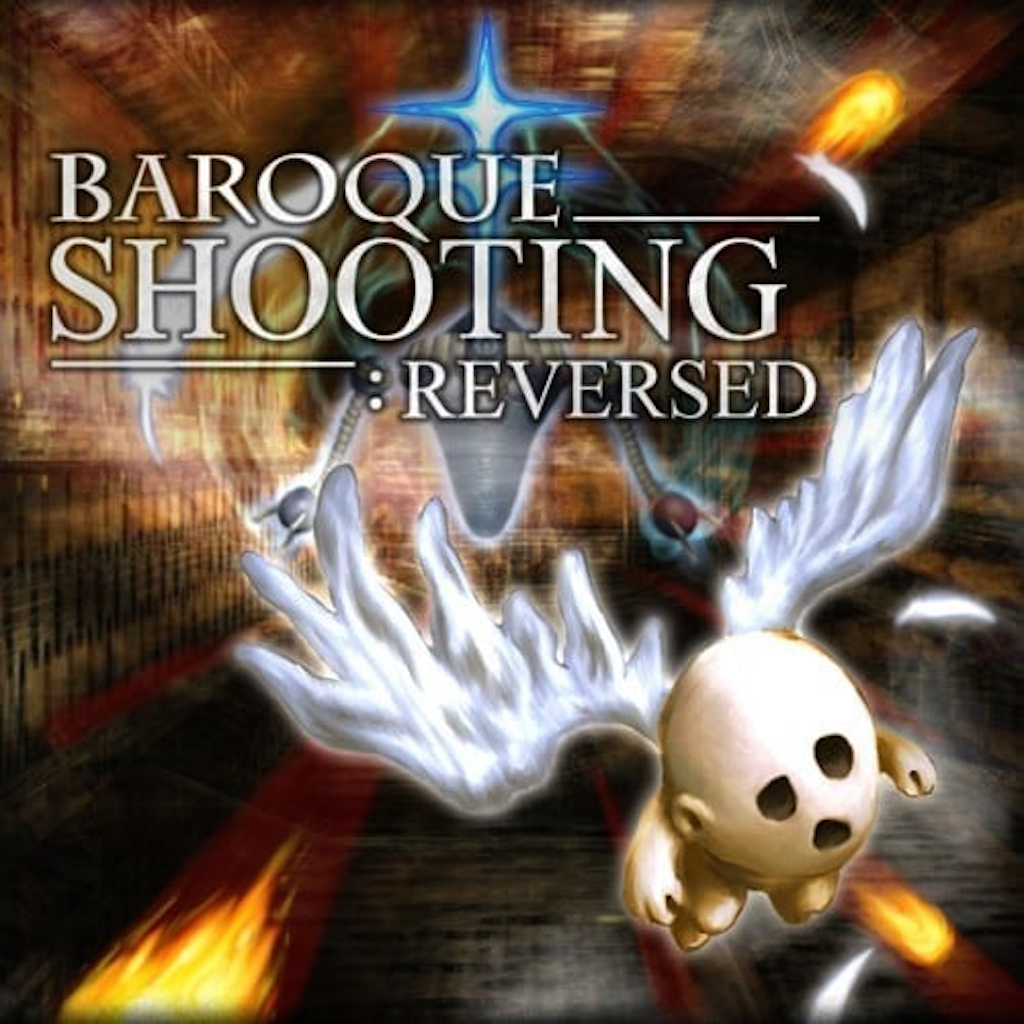
BAROQUE SHOOTING: REVERSED is a title with a name that immediately signals duality: an homage to classic shooter lineage, but with an explicit twist—one that promises inversion rather than iteration. It is rare to see a shooter lean into the concept of reversal not merely as a gimmick but as a structural identity. The question that Baroque Shooting: Reversed poses to players is deceptively simple: what happens when you take everything that makes arcade shooters familiar and turn key expectations on their head?
In execution, the answer is energetic and unpredictable, but also uneven. The game earns praise for its boldness and mechanical precision, yet its conceptual audacity occasionally outpaces its capacity to remain consistently engaging. Reversed, in this case, means you’ll find yourself rethinking familiar mechanics, reconfiguring reflexes, and re-engaging with genre conventions as if encountering them anew.
A Redefined Shooter Framework
From the outset, Baroque Shooting: Reversed rejects the conventional shooter roadmap. Instead of straightforward “enter, clear, exit” missions, the game’s structure emphasises inversion—whether through reversed movement dynamics, aim inversion, or stages where enemies behave according to inverted logic. This layered approach immediately differentiates it from the pack.
Rather than simply playing against waves of projectiles, players are introduced to scenarios where traditional inputs yield unconventional outcomes. Aiming might feel intuitive in one moment and subtly inverted in the next. Movement that previously offered cover can suddenly become a liability. These shifts are not merely cosmetic; they require active recalibration of reflexes and spatial awareness.
This design choice is the core strength and greatest differentiator of Reversed. Where many shooters evolve through incremental additions—new weapons, new enemies—this game evolves through redefinition. Each chapter challenges its own internal logic rather than simply ramping up speed or density.
Visual Presentation and Clarity
Visually, Baroque Shooting: Reversed blends the aesthetics of classic arcade shooters with a slightly modernised palette. Effects are crisp, enemy types remain recognisable even amid chaotic screen states, and projectile visibility is prioritised. This clarity is critical given the game’s pace and inversion mechanics; without it, the experience would quickly become inscrutable.
The visual language supports both tradition and innovation. Players familiar with the patterns of top-down or side-scrolling shooters will recognise core archetypes: patterned bullets, shielded foes, and arena layouts that emphasise spatial negotiation. But the reversed elements—colour shifts, inverted motion trails, and feedback cues tied to unconventional behaviours—keep attention keen.
That said, visual variance across levels varies in impact. Some areas distinguish themselves through thematic design and enemy palette changes, while others feel more functional than memorable. This inconsistency does little to harm the core experience, but it means that visual flair is not always matched to mechanical ingenuity.
Sound Design and Tactical Feedback
Sound plays a key role in creating coherence where the mechanics might otherwise subvert expectation. Weapon effects are sharp and distinct, ensuring that firepower feels impactful. Audio cues for enemy actions and incoming hazards are reliably informative, which is crucial in a game that constantly toys with player expectation.
Music follows a similarly supportive philosophy. Rather than dominating action with thematic tracks, the score operates more as tension reinforcement—subtle, cyclical, and designed to match the ebb and flow of combat rather than dictate emotional peaks. This restraint works in favour of long sessions, as extended exposure to high-intensity combat can otherwise become aurally exhausting.
Combat and Reversed Mechanics
At its core, Baroque Shooting: Reversed features combat anchored in rapid reaction, pattern recognition, and spatial awareness. But unlike traditional shooters where enemies scale in predictability or aggression, this game’s enemies behave according to dynamic rules that periodically invert expected behaviour. This is not inversion for surprise’s sake; it is systematic, often foreshadowed, and sometimes triggered through player action or environmental interaction.
Early missions ease players into this dynamic. Familiar enemies are introduced in relatively predictable patterns, but gradually their behaviours adapt. Missed shots might become hazards. Bullets that once homed may scatter. Walls that were once cover may become pathways. These fluctuations require players to remain mentally flexible rather than strictly reflex-driven.
This adaptive framework has advantages. It keeps encounters feeling fresh and encourages players to think beyond rote memorisation of patterns. It emphasises an iterative rather than repetitive learning loop, where understanding nuance trumps simple execution.
However, the execution is not flawless. There are moments—particularly in mid-game challenge spikes—where inversion feels abrupt rather than evolutionary, leading to frustration rather than revelation. When mechanics flip without sufficient contextual cueing, the gameplay momentarily breaks from strategy into confusion.
Difficulty and Player Agency
Baroque Shooting: Reversed is unapologetically challenging. Skill ceilings are high, and progress often depends on player adaptation rather than brute force. This is not a game for passive players. Instead of mastering pre-defined patterns, the player must master pattern flexibility—an elevated cognitive load for a genre already known for high-intensity decision loops.
That said, the game avoids becoming inaccessible. Checkpoints, incremental progression, and contextual hints provide safety nets. These design decisions strike an effective balance between rewarding mastery and not alienating players who might struggle with immediate precision. There is a strong sense that improvement comes from understanding rather than grind, reinforcing the game’s intellectual core.
Narrative and Contextual Framing
Baroque Shooting: Reversed does not prioritise narrative weight. Story exists primarily as context—enough to frame progression and justify aesthetic shifts. This choice allows the game to stay focused on mechanics without burdening them with extended exposition.
However, the lack of narrative depth also means that emotional engagement is tied almost exclusively to mechanical satisfaction. For players seeking story-rich shooters or emergent character arcs, this focus can feel undernourished. The payoff, therefore, is mechanical mastery rather than narrative resolution.
Longevity and Replayability
Replayability in Reversed is organic rather than artificial. There are no sprawling branching paths or currency-based unlocks; instead, mastery itself is the reward. Levels feel ripe for repeat playthroughs as patterns become more readable and inverted mechanics more familiar.
Challenge modes, time trials, and score-centric objectives extend longevity for players inclined toward optimisation. Competitive players will find room to refine approaches, while casual players can appreciate incremental improvement without punitive design.
Final Verdict
BAROQUE SHOOTING: REVERSED is a daring reinvention of a familiar genre. Its core innovation—dynamic inversion of mechanics and expectation—sets it apart from conventional shooters that prioritise escalation over adaptation. While not every inversion lands perfectly, the game’s commitment to systemic novelty over rote pattern repetition is laudable.
Combat is responsive, audiovisual clarity supports complex engagement, and the learning loop rewards thoughtful reaction over mere reflex. Occasional pacing issues and abrupt difficulty transitions slightly detract from an otherwise coherent experience, but these are not fatal flaws.
This is a shooter that challenges not just reflexes, but mindset. It demands that players think about the genre rather than simply play through it.