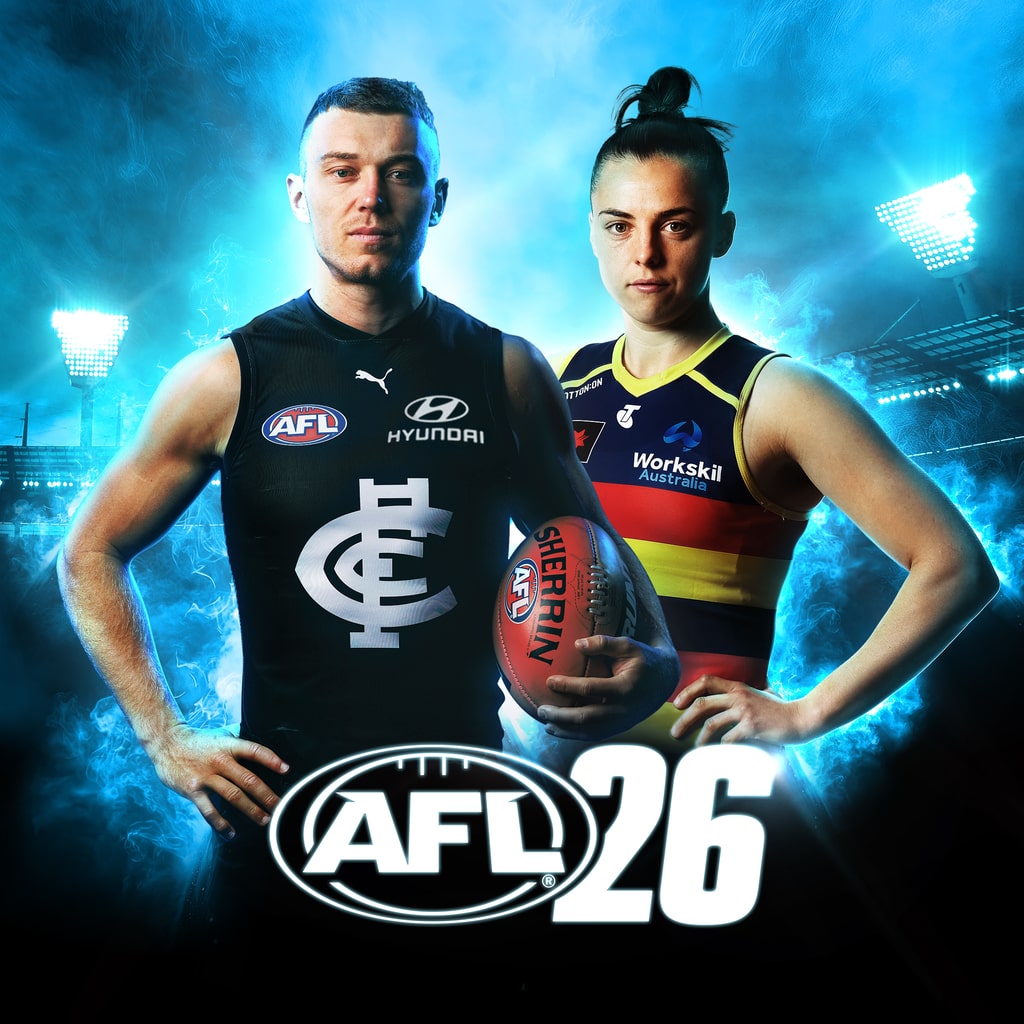
Initially released on May 7–8, 2025 across PC and consoles, and later reaching a major milestone with its Nintendo Switch 2 launch on March 31, 2026, AFL 26 from developer Big Ant Studios and publisher Nacon is the most ambitious entry yet in the long-running AFL video game series. Available on nearly every major platform—including PS5, PS4, Xbox Series X|S, Xbox One, PC, and Switch 2—it positions itself as a definitive, all-encompassing football simulation.
With expanded career modes, deeper management mechanics, and a significant leap in player realism through photogrammetry scanning, AFL 26 is clearly meant to be the franchise’s “next-generation identity statement.”
But as always, ambition comes with its compromises.
Footy, Rebuilt for a New Generation
From the opening bounce, AFL 26 makes one thing clear: this is a game focused on presentation and immersion as much as on sport simulation.
Matches are styled with broadcast-style camera angles, lively commentary, and crowd sounds that aim to replicate the atmosphere of a packed stadium on match day. The roar of the crowd, the thud of contested marks, and the whistle of quick breaks are all emphasised to reinforce the feeling of watching—and playing—elite-level AFL.
On the surface, it succeeds. Matches feel energetic, physical, and chaotic in a way that mirrors the real sport. The sense of momentum shifts and contested ball situations is strong, and when everything comes together, the experience can feel genuinely authentic.
However, beneath the presentation layer, the gameplay still carries some of the series’ long-standing quirks. Animations sometimes lock into predictable patterns, player responsiveness can fluctuate under intense congestion, and collisions occasionally lack the physical nuance expected from such a high-fidelity simulation.
The result is a game that looks and sounds like elite AFL broadcast coverage—but doesn’t always feel as consistently smooth as it appears.
Player Career: A True Journey Mode
One of the key new features in AFL 26 is the expanded Player Career mode, which allows players to experience a complete journey from draft day to achieving stardom in both the AFL and AFLW pathways.
This mode is where the game feels most emotionally engaging. You start as an unknown prospect, going through training sessions, facing selection pressure, and meeting performance expectations. Over time, your decisions and on-field performances influence your career path, creating a sense of personal growth that makes each match meaningful.
There is a clear effort to mimic the pressures of professional sport—not just the games themselves, but also the emotional weight of selection, injury setbacks, and performance scrutiny.
Although the narrative progression is relatively straightforward, the mode succeeds in fostering an attachment to your created player. It provides context to otherwise standard matches, turning them into career-defining moments.
However, some off-field interactions remain quite superficial, and dialogue systems lack depth when compared to more story-driven sports titles. The emotional highs are present but not always fully developed.
Management Career: Strategy Under Pressure
For players who prefer control from the sidelines, the Management Career mode provides a deeper tactical experience. Here, you assume the roles of coach and list manager, responsible for team selection, tactical adjustments, player development, and long-term squad building.
This mode is where AFL 26 most heavily leans into simulation territory. Managing player workloads, nurturing young talent, and adjusting strategies based on opposition matchups all contribute to success.
Matchday decisions carry significant weight, especially when tactical changes can shift momentum in closely contested games. There is a satisfying sense of responsibility—victories feel earned through planning as much as execution.
However, the interface can sometimes feel cluttered, and certain systems lack the detail that hardcore management sim players may expect. While the foundations are solid, there remains room for more advanced statistical modelling and more dynamic AI behaviour.
Visual Fidelity and Player Authenticity
One of the most heavily marketed features of AFL 26 is its use of high-fidelity photogrammetry scanning for player models. Every AFL and AFLW athlete has been recreated with a focus on facial accuracy, body structure, and signature movement styles.
This marks a clear generational leap for the game. Player likenesses are noticeably more realistic than in previous editions, and on-field presentation benefits greatly from this attention to detail.
The stadium environments also see incremental improvements, with more detailed lighting, improved turf textures, and enhanced crowd rendering. While not groundbreaking compared to global AAA sports titles, it marks a significant step forward for the series.
However, visual consistency can vary between platforms, with older hardware models understandably scaling back some finer details.
Gameplay Flow and Core Mechanics
At its core, AFL 26 continues to rely on the established framework of previous entries: contested marking, handball chains, tactical kicking, and positional play.
When the system functions well, it creates moments that feel distinctly AFL—rapid transitions, desperate tackles, and last-minute scoring chances. The unpredictability of ball movement enhances excitement and reflects the sport’s chaotic nature.
However, the game still faces issues with consistency in player control during congested situations. Response to inputs can feel slightly delayed when multiple players converge, and AI positioning sometimes results in awkward stoppages or unrealistic spacing.
These problems do not ruin the experience, but they serve as a reminder that beneath the broadcast polish, the underlying simulation still has some rough edges.
Customisation and Community Creation
The addition of expanded Academy Tools is another strong point. Players can design clubs, customise kits, create stadiums, and share content with a broader community.
This greatly extends the game’s longevity, especially for players engaged in offline leagues or custom competitions. It also helps offset the somewhat structured nature of official game modes.
Community creations differ widely in quality, but the flexibility offered is one of the game’s most user-friendly features.
Presentation vs. Precision
Perhaps the key tension in AFL 26 is between presentation and mechanical accuracy. The game clearly excels in the former—broadcast visuals, crowd immersion, commentary, and player likenesses are all strong.
However, the latter—consistent gameplay from moment to moment—still feels like a work in progress.
This is not unusual for long-standing sports franchises, especially those trying to simulate a sport as complex and fluid as Australian rules football. But it does mean AFL 26 sometimes feels more like an excellent sports broadcast simulator than a thoroughly refined competitive sports game.
Final Verdict
AFL 26 is the most ambitious and feature-rich entry in the series so far. With its expanded career modes, in-depth management systems, and significant visual upgrade through photogrammetry, it offers a strong package for Australian rules football fans.
However, its on-field consistency and mechanical refinement still fall slightly short of its presentation ambitions. While it captures the spirit and spectacle of AFL exceptionally well, it does not always fully translate that authenticity into perfect gameplay.
It is immersive, packed with features, and clearly evolving—yet not quite definitive.