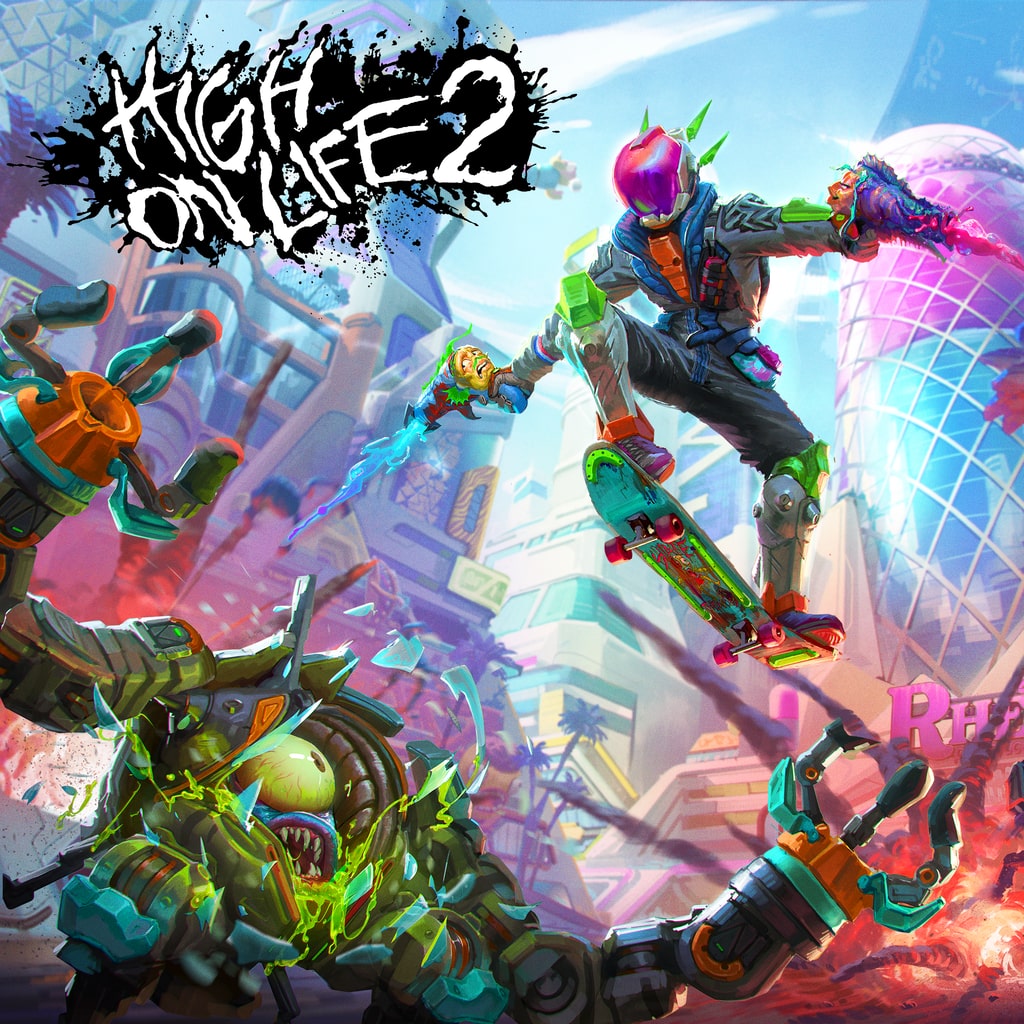
Few games have split opinion quite like High On Life. Released in 2022, Squanch Games’ irreverent first-person shooter was impossible to mistake for anything else on the market. Its bizarre alien worlds, living weapons and relentless stream of jokes earned it an enthusiastic following, while others found its style exhausting long before the credits rolled. Love it or hate it, though, it was undeniably memorable. That left High On Life 2, released today on the Nintendo Switch 2, with an unenviable challenge. Following the departure of the studio’s original creative force, the sequel needed to prove the series had more to offer than sheer novelty.
It doesn’t take long to realise those concerns were misplaced. Rather than attempting to recreate the original beat for beat, Squanch Games has approached this sequel with surprising confidence. The comedy remains wonderfully absurd, but it is no longer determined to fill every second with overlapping dialogue. The writing trusts its punchlines, allowing quieter moments to breathe before unleashing another wonderfully ridiculous scenario. It feels sharper, more mature and considerably funnier because of that restraint.
The story begins after your victory over the G3 cartel, with humanity safe and your exploits turning you into an unlikely galactic celebrity. You’re enjoying the perks of fame, complete with interviews, luxurious transport and more attention than anyone could reasonably want. Naturally, the peaceful lifestyle doesn’t last. A colossal pharmaceutical corporation arrives with plans to exploit humanity for profit, treating people as little more than ingredients for its latest miracle medication. It is a wonderfully cynical premise that immediately gives the sequel a more focused direction than its predecessor.
Replacing an intergalactic drug cartel with a legal corporate empire proves an inspired decision. The satire feels more pointed, poking fun at unchecked greed, corporate image management and consumer culture without ever becoming preachy. The humour still thrives on complete nonsense, but there is a stronger narrative backbone underpinning every bizarre encounter. Whether you are tracking eccentric billionaires across distant planets or stumbling into bizarre scientific experiments gone horribly wrong, each mission contributes to a campaign that feels far more cohesive than before.
One standout sequence perfectly captures what the sequel does well. Senator Muppy Doo begins as another eccentric villain before transforming into one of the game’s most inventive boss fights. Rather than relying solely on bullets and explosions, he invades your pause menu, interferes with settings and plays mind games that blur the line between the game and the player. It is a clever piece of fourth-wall breaking that feels genuinely surprising without overstaying its welcome.
Gameplay
If the improved storytelling lays a stronger foundation, the gameplay is what truly elevates High On Life 2. The original offered competent shooting wrapped in memorable humour, but combat often lacked urgency. Encounters frequently devolved into slow exchanges of fire while waiting for abilities to recharge. This sequel throws that philosophy out of the nearest airlock.
The single biggest addition is the skateboard, and it completely changes how the game feels from the moment you unlock it. What initially sounds like a novelty mechanic quickly becomes central to every aspect of exploration and combat. You can launch into aerial tricks, grind effortlessly along magnetic rails, ride along walls, and chain movements with dashes and double jumps to create an almost uninterrupted flow across each environment.
The beauty of this system lies in how naturally it integrates into firefights. Instead of ducking behind cover and peeking around corners, battles become fluid displays of movement. You are constantly weaving through arenas, launching yourself into the air before raining fire down on enemies below, then landing directly onto a rail that carries you into the next engagement without missing a beat. Every encounter feels faster, more dynamic, and infinitely more satisfying than anything the first game attempted.
That increased mobility also transforms exploration. Rather than relying on a single central hub, High On Life 2 introduces several expansive regions packed with optional activities, hidden pathways, and rewarding discoveries. These interconnected environments encourage curiosity without becoming overwhelming, rewarding players who take time to explore every corner. Hidden upgrades, strange side quests, and wonderfully bizarre NPCs ensure there is almost always something worth investigating beyond the main objective.
Combat benefits just as much from the redesigned arsenal. The talking Gatlians return with plenty of personality, but the newcomers quickly steal the spotlight. Travis and Jan immediately establish themselves as fan favourites thanks to their hilarious relationship dynamic. Rescuing Travis from his midlife crisis before reuniting him with his estranged wife unlocks the game’s first proper dual-wielding mechanic, allowing players to unleash devastating firepower while the married couple continue bickering throughout every battle. Their constant arguments somehow remain funny long after most games would have run the joke into the ground.
Sheathe offers a completely different flavour. Fused to the decapitated head of a deeply cynical alien and voiced with unmistakable gravitas by Ralph Ineson, this brutal burst rifle delivers some of the most satisfying weapon feedback in the entire game. Every trigger pull carries real impact, making firefights feel weightier than ever before. It quickly became my preferred weapon simply because of how responsive and rewarding it feels during prolonged engagements.
Bowie rounds out the highlights by introducing a precision weapon that rewards careful aim instead of frantic shooting. Landing a fully charged arrow creates a localised field of slow motion, briefly altering the pace of combat and opening opportunities for creative takedowns. Used effectively, it allows you to isolate dangerous enemies or create breathing room when encounters become particularly chaotic. Every weapon feels designed around a unique role rather than simply replacing another with higher damage numbers.
Visuals & Audio
While the gameplay receives the biggest overhaul, the presentation deserves just as much credit. Built in Unreal Engine 5, High On Life 2 embraces its wonderfully bizarre identity with complete confidence. Every planet bursts with colour, strange architecture and bizarre lifeforms that constantly tempt you to pause and take in your surroundings. The worlds feel handcrafted rather than procedurally assembled, each carrying its own personality while still fitting comfortably within the game’s offbeat universe.
Character animation has also seen noticeable improvement. The Gatlians are more expressive than ever, reacting to your performance in combat with exaggerated facial expressions, nervous glances and smug celebrations after particularly satisfying kills. They feel less like weapons and more like travelling companions, making their conversations far more engaging throughout the campaign.
Voice acting remains one of the series’ greatest strengths. The cast delivers every ridiculous line with complete commitment, allowing even the most absurd scenarios to feel believable within this strange universe. Richard Kind is a standout as Senator Muppy Doo, bringing infectious energy to one of the game’s most memorable antagonists, while Ralph Ineson gives Sheathe an intimidating presence that perfectly complements the weapon’s devastating stopping power. John Waters also steals every scene he appears in as the eccentric alien shopkeeper running an abandoned space station that has somehow been transformed into an intergalactic Spirit Halloween. It is exactly the sort of surreal detour fans expect, and it becomes one of the funniest moments in the entire adventure.
The soundtrack also deserves quiet praise. It knows when to step into the spotlight during hectic firefights and when to fade into the background during exploration, helping maintain the game’s energetic pace without overwhelming the action. Combined with punchy sound effects and satisfying weapon feedback, every encounter feels appropriately explosive.
Performance
As polished as much of the experience feels, High On Life 2 is unfortunately held back by technical shortcomings that are difficult to ignore. Across both consoles and PC, performance can become inconsistent during the busiest encounters. Large firefights filled with particle effects, enemy projectiles and environmental destruction often cause noticeable frame-rate drops that interrupt the otherwise smooth flow of combat.
Visual issues also appear more regularly than they should. Texture pop-in occasionally breaks immersion while moving quickly across larger environments, and collision problems can leave players snagging on scenery during high-speed traversal. Enemy pathfinding also struggles from time to time, particularly in the game’s more vertical arenas, where opponents can become stuck on geometry or hesitate before engaging.
Weapon balance could also use another tuning pass. While the new Gatlians are almost universally enjoyable to use, some returning favourites struggle to remain relevant. Sweezy, in particular, feels noticeably weaker than the newer additions, making it difficult to justify keeping the weapon in your rotation once the expanded arsenal becomes available. It is not a game-breaking issue, but it does reduce the variety that made the original’s weapon selection so entertaining.
None of these problems are severe enough to derail the experience, but they do prevent the sequel from reaching its full potential. Fortunately, they also feel like the sort of issues that can be improved through post-launch patches rather than fundamental design flaws. The core game is simply too enjoyable for these technical blemishes to overshadow everything else it gets right.
Final Verdict
Sequels often promise to be bigger and better, but few manage to improve on their predecessor as comprehensively as High On Life 2. Squanch Games has listened carefully to fans and critics, refining nearly every aspect of the original experience without sacrificing the personality that made the series stand out. The humour is more focused, the writing has greater confidence, exploration feels genuinely rewarding, and the introduction of the skateboard elevates movement into one of the most enjoyable traversal systems in a first-person shooter for quite some time.
Perhaps the sequel’s greatest achievement is that it no longer relies solely on its comedy to leave an impression. Beneath the outrageous dialogue and wonderfully bizarre alien worlds lies a genuinely excellent action game, one that encourages experimentation, rewards skill and constantly surprises with inventive encounters and memorable set pieces. Even players who found the original’s pacing or humour difficult to embrace may be pleasantly surprised by how much tighter and more refined this adventure feels.
Technical performance remains the biggest obstacle standing between High On Life 2 and true greatness. Frame-rate instability, occasional bugs and a handful of balancing issues remind you that the game still needs further optimisation. Even so, those frustrations rarely linger for long because the moment-to-moment gameplay is simply so enjoyable. Every successful grind along a glowing rail, every perfectly timed trick into a firefight and every ridiculous conversation with your increasingly dysfunctional arsenal reinforce just how much confidence Squanch Games now has in this universe.
High On Life 2 is exactly what a sequel should be. It respects the identity of the original while boldly improving its weakest ideas, resulting in an experience that is faster, funnier and far more satisfying from beginning to end. For returning bounty hunters, it is the follow-up they were hoping for. For newcomers, it is easily the best place to discover one of gaming’s strangest and most entertaining universes.