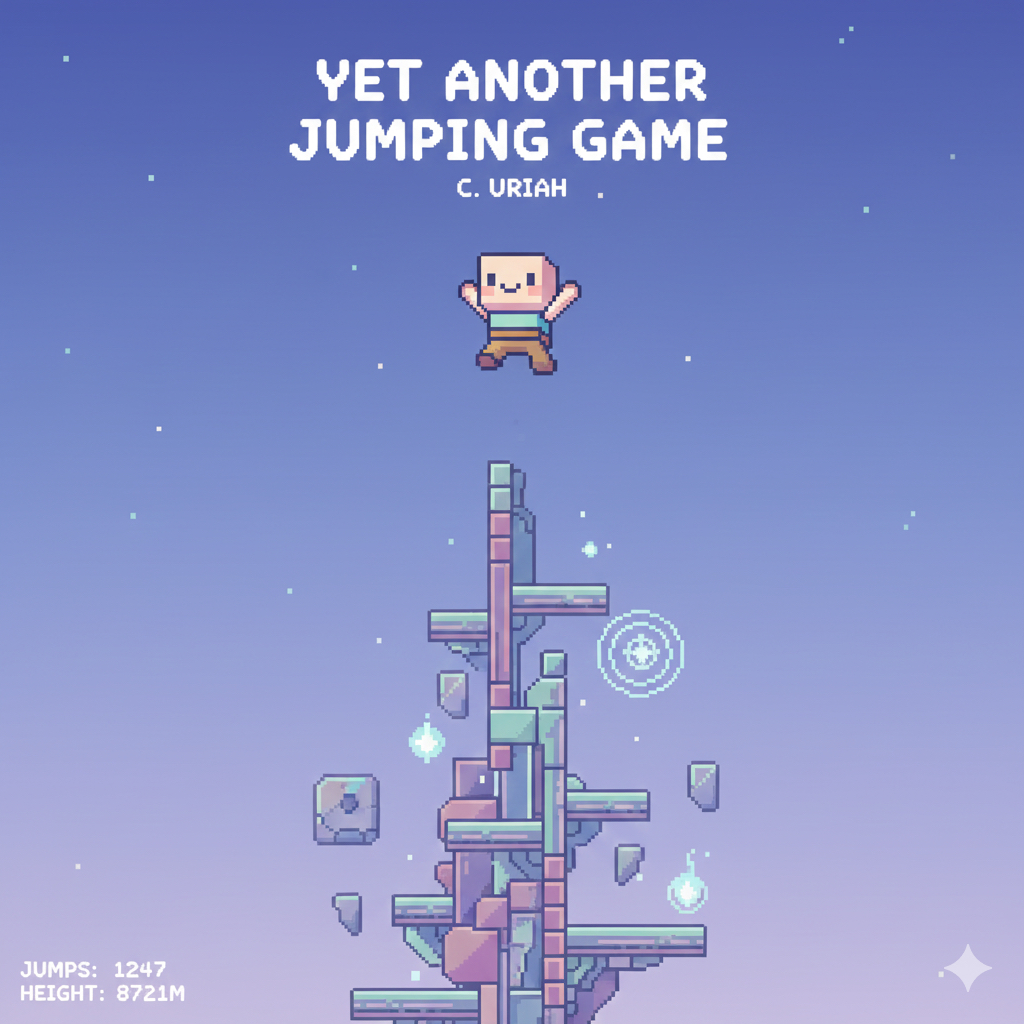
At first glance, Yet Another Jumping Game appears almost deliberately dismissive of originality. The title is self-aware to the point of provocation, openly acknowledging the crowded space it inhabits. Precision platformers are everywhere, and players have been trained to expect either brutal difficulty, ironic humour, or some mechanical gimmick designed to justify their existence. What’s surprising about Yet Another Jumping Game is that it largely rejects gimmickry altogether. Instead, it commits to fundamentals—jump timing, spatial awareness, and repetition—then asks whether doing the basics extremely well is still enough.
The answer, for the most part, is yes. While Yet Another Jumping Game rarely reinvents the genre, it understands it intimately. This is a game about control, consistency, and personal improvement, and it finds its identity not through novelty, but through refinement.
A Familiar Premise Embraced Honestly
There is little narrative framing here, and that feels intentional. You are not saving the world, uncovering lore, or following a character arc. You are jumping from platform to platform, avoiding hazards, and trying not to fail. The game’s honesty about this simplicity is refreshing. It does not dress itself up with unnecessary story beats or artificial stakes. The challenge is the content.
By stripping away narrative obligation, Yet Another Jumping Game places full responsibility on its mechanics to carry the experience. That is a risky decision, but one that ultimately defines the game’s appeal. If you enjoy platformers for their tactile satisfaction rather than their storytelling, this approach feels appropriate.
Movement and Controls — Where the Game Lives or Dies
In any jumping-focused platformer, movement is everything. Here, Yet Another Jumping Game excels. Controls are tight, responsive, and predictable. Jump arcs are consistent, mid-air adjustments feel deliberate rather than floaty, and player input is never in doubt. When you fail, it is clear why—and that clarity is essential in a genre where repetition is expected.
The game avoids overcomplicating movement with excessive abilities. There is no sprawling skill tree or constant mechanical escalation. Instead, difficulty increases through level design rather than player power. This keeps the focus squarely on execution and learning, allowing mastery to come from familiarity rather than unlocks.
This restraint also ensures that the game rarely feels unfair. Precision is demanded, but not obscured. The challenge is demanding without being spiteful, which places Yet Another Jumping Game closer to traditional skill-based platformers than to deliberately punishing “rage” games.
Level Design — Incremental Complexity Done Right
The level design is where Yet Another Jumping Game quietly shines. Stages are compact, clearly structured, and built around specific movement challenges. New ideas are introduced gradually, combined thoughtfully, and then tested under pressure. This creates a strong learning curve that rewards observation and muscle memory.
Importantly, levels rarely overstay their welcome. When a concept has been explored, the game moves on. This keeps frustration in check and ensures that repeated failures do not become exhausting. Checkpoints are placed with care, respecting player time while still preserving tension.
That said, the game does occasionally flirt with repetition. Certain late-game sections rely heavily on familiar patterns with increased speed or tighter spacing, rather than introducing genuinely new ideas. While this escalation is effective in raising difficulty, it can make some sections feel like endurance tests rather than fresh challenges.
Difficulty — Demanding Without Malice
Yet Another Jumping Game understands that difficulty is most satisfying when it feels earned. The game does not surprise players with cheap tricks or sudden rule changes. Hazards behave consistently, timing windows are learnable, and visual language is clear.
This design philosophy makes failure productive rather than demoralising. Each attempt teaches something, whether it’s an improved route, a better timing window, or a more efficient rhythm. Success feels like the natural result of refinement rather than luck.
However, players looking for extreme punishment or sadistic design may find the challenge a little restrained. The game aims for firmness rather than cruelty, which makes it more accessible but slightly less memorable for those chasing truly punishing experiences.
Presentation — Minimalism With Purpose
Visually, Yet Another Jumping Game adopts a clean, minimal style that prioritises readability. Platforms, hazards, and backgrounds are clearly differentiated, ensuring that the player’s focus remains on movement rather than interpretation. There is little visual clutter, and animations are functional rather than expressive.
This minimalism suits the game’s design goals, but it also limits its personality. While nothing looks bad, very little stands out. The aesthetic supports gameplay effectively, yet rarely elevates it. The same is true of the audio design, which remains understated throughout. Sound effects provide necessary feedback, and the music stays out of the way, but neither element leaves a lasting impression.
Pacing and Replayability
The game’s pacing is tight and respectful. Sessions can be short, making it easy to dip in and out, while longer play sessions benefit from the clear progression of difficulty. This structure makes Yet Another Jumping Game well-suited to players who enjoy incremental improvement without long-term narrative commitments.
Replayability largely depends on personal motivation. There are no major alternate modes or branching paths, but players who enjoy shaving seconds off runs or perfecting execution will find value in revisiting levels. The game does not aggressively incentivise replay, but it does not discourage it either.
Verdict
Yet Another Jumping Game is a confident example of how far strong fundamentals can carry a game. It does not attempt to redefine the platforming genre, nor does it hide behind irony or excessive difficulty. Instead, it delivers a polished, honest experience built around precise controls, thoughtful level design, and fair challenge.
Its minimal presentation and limited mechanical variety prevent it from standing out in a crowded field, but for players who value clarity, responsiveness, and skill-based progression, it delivers exactly what it promises.
Sometimes, “yet another” is enough—provided it’s done properly.