
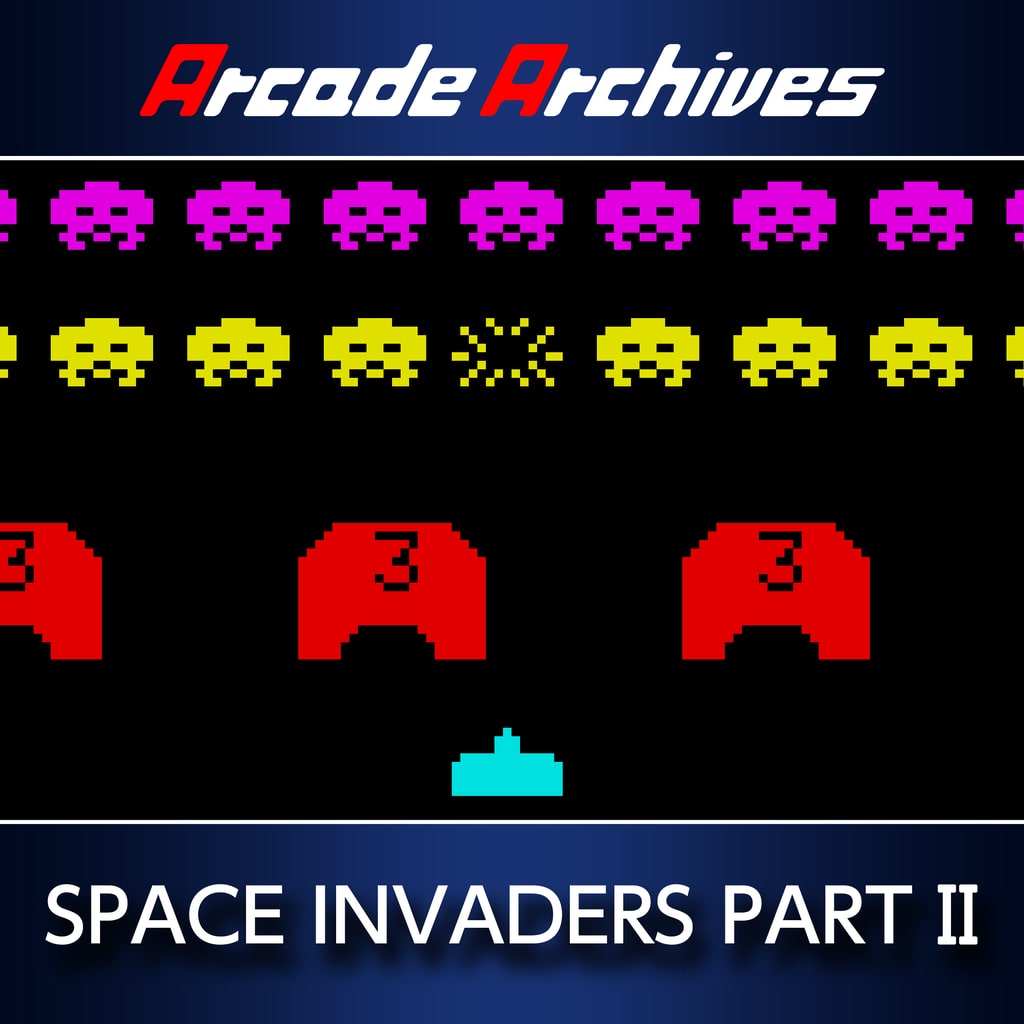
Few titles in video game history carry as much weight as Space Invaders. Its influence on the shoot-’em-up genre, its role in popularising coin-ops worldwide, and the cultural footprint it left on the arcade era are indisputable. Arcade Archives 2: Space Invaders Part II isn’t just another retro port: it’s a refined and revitalised revisiting of a core chapter in that legacy. While built on the foundational mechanics that made the original a phenomenon, Space Invaders Part II introduces enough enhancements and strategic variation to feel like both a nostalgic return and a worthwhile evolution.
For players seeking a genuinely classic experience in a modern wrapper — with visuals faithfully reproduced, sound faithfully preserved, and mechanics unquestionably timeless — this is a welcome addition to the Arcade Archives series. But it’s more than a museum piece. In its best moments, it captures the addictive simplicity and evolving challenge curve that made the original so enduring.
First Impressions: Retro Style, Polished Delivery
From the moment the title screen appears, Space Invaders Part II feels like a carefully restored arcade classic. The presentation faithfully replicates the look and feel of early-’80s hardware: monochrome vector-like sprites, crisp animations, and a layout that places the player’s cannon at the bottom of the screen facing rows of advancing invaders.
Unlike many arcade reissues that simply dump an emulation onto your screen with minimal thought, Arcade Archives adds useful modern comforts. There are options for screen filters that mimic CRT scanlines, framing variations that echo arcade cabinets, and adjustable aspect ratios that let you choose between authenticity and widescreen comfort. These settings are small but meaningful, allowing players to tailor the experience to their taste without compromising the core gameplay.
Sound design remains stark and simple, but in exactly the right way. The iconic zap of each shot, the increasing tempo of alien movement, and the dramatic descending blips that signal impending doom are all present and accurate. Those sounds aren’t mere nostalgia triggers; they are functional cues that feed directly into gameplay tension.
Core Gameplay: Timeless, Tactical, Terrifying
On paper, Space Invaders Part II doesn’t appear to expand dramatically on the original formula: you control a lone cannon, fire upward, and eliminate waves of descending aliens determined to reach the bottom of the screen. Shields dot the field, offering protection — until the relentless barrage erodes them into nothing.
Where Part II differentiates itself is in the way enemy behaviour and pacing evolve. The invaders’ movement patterns are more varied and less predictable than the first game, introducing adversaries that behave differently or require multiple hits. This makes each wave feel less like a rote repetition and more like a curated challenge. The result is a shooter that rewards not just reflexes but memorisation, pattern recognition, and strategic prioritisation.
It’s still fundamentally simple, but its simplicity is deliberate: mechanics are easy to grasp, yet mastery is difficult. The game’s difficulty curve is thoughtful, ratcheting up challenge in a way that feels fair rather than punitive. Early waves feel manageable, almost meditative, but as you progress the screen begins to feel cramped, your dodging options narrow, and the pace—driven by that characteristic increasing movement tempo—becomes intense.
This tension between simple mechanics and escalating challenge is where Space Invaders Part II succeeds beautifully. There’s a reason the genre of “fixed shooters” persists: it’s instantly approachable and infinitely replayable.
Modern Presentation Meets Classic Design
What sets the Arcade Archives release apart from playing the original bootleg or a bare-bones emulator is how it bridges past and present. The menu system is clean and intuitive, allowing players to jump into action without wrestling with outdated UI. There are save state options — an almost indispensable feature for contemporary players who want to practice specific stages or attempt high-score runs without repeating entire sessions.
Leaderboards add a sense of community competition that the original arcade simply couldn’t offer. There’s an intrinsic motivation in trying to place your initials atop a global board, benchmarking your skills against players worldwide. This modern twist harmonises with the game’s legacy without feeling tacked on or gimmicky.
Visually, while the game pays homage to its arcade roots, it doesn’t feel sterile. The careful balance between original sprite work and optional modern shaders gives players choice: purists can enjoy pixel accuracy with CRT simulation, while newcomers can experience a cleaner presentation with none of the visual noise.
Learning Curve and Accessibility
The genius of Space Invaders Part II lies in its inherent accessibility. No tutorial is required; the controls are instantly comprehensible. Movement is limited to lateral motion and firing, but those two inputs, in the context of rising alien pressure, create a surprisingly rich space for skill expression.
Novices may find the difficulty steep at first — alien rows accelerate alarmingly, and missteps can quickly spiral into a game over. But the tight responsiveness of the controls, combined with the game’s predictable enemy patterns, means improvement is always within reach. Your first few sessions are humbling; your tenth session feels like discovery.
For players who crave structured progression, the Arcade Archives implementation could benefit from optional challenge modes or scenario maps. At present, the experience is essentially the classic mode with cosmetic toggles and quality-of-life features. While that preserves purity, it also feels like a missed opportunity to expand Part II beyond its historical form.
Longevity and Replay Value
This is a title built on repetition — but not in the negative sense of the word. The core attractor here is replayability rooted in mastery. There are no branching narratives, no sprawling campaign trees, no loot systems. Your reward comes from beating your own scores, outlasting tighter waves, and slowly learning to navigate the increasingly aggressive formations.
Some players might find this narrow focus limiting; modern players conditioned on layered progression systems or narrative beats might yearn for more context or variety. Yet for the intended audience — fans of classic arcade action and score-based mastery — Space Invaders Part II has staying power. Simple doesn’t mean shallow here: it means every attempt feels like a meaningful confrontation between player and pattern.
Final Verdict: A Worthy Retro Resurgence
Arcade Archives 2: Space Invaders Part II is more than a historical curiosity. It’s a thoughtfully curated reissue that honours one of the foundational pillars of arcade gaming while offering enough modern comfort to make it viable in 2026. The design remains firmly rooted in elegant simplicity, yet those mechanics continue to offer depth and challenge more than forty years after the original release.
Its appeal lies not in spectacle, but in tension — in the rising tempo of alien movement, in the deliberate scarcity of player tools, and in the quiet satisfaction of tightening your precision and timing with every wave. For players seeking pure, distilled arcade action and a touch of video game history, this is a release worth returning to time and again.













[…] of the joys of revisiting these titles today is recognising their influence. Arcade Archives 2 SPACE INVADERS remains foundational, but its design echoes across countless modern shooters. Arcade Archives 2 […]