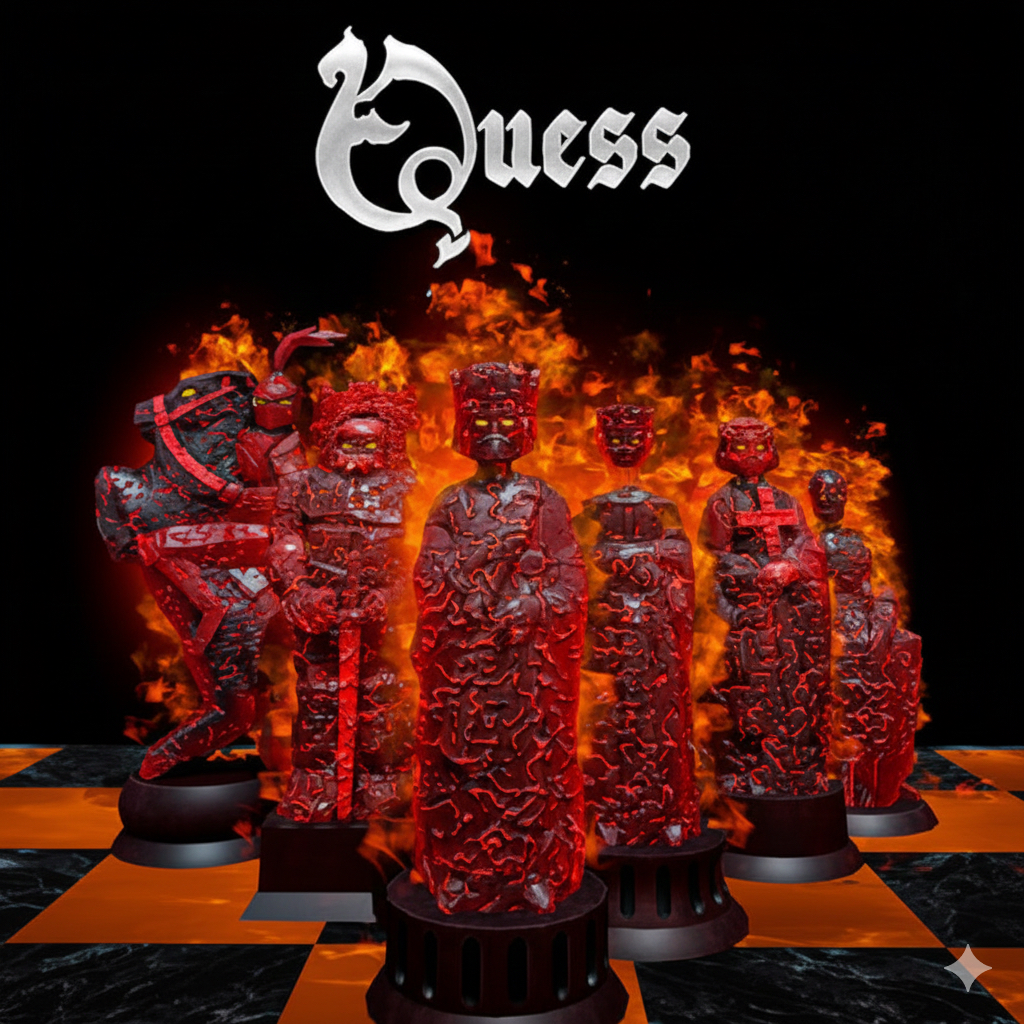
In an age where strategy games are constantly reinventing classic templates, Quess distinguishes itself by unapologetically reimagining three of the most enduring board games of all time — Chess, Checkers, and Backgammon — into a single competitive experience built for up to four players. Rather than presenting these classics as straightforward digital recreations, Quess blends them into a stylised, elemental arena that prioritises adaptability, spatial awareness, and multi-directional strategy.
The ambition behind Quess is immediately apparent. It seeks not only to modernise traditional board games but to fundamentally alter how they are played by introducing multiple opponents, shifting power dynamics, and a strong visual identity. The result is a title that feels both familiar and experimental: accessible on the surface, yet capable of producing complex, unpredictable matches once players begin to understand its systems. However, while the concept is compelling, execution is uneven in places, and the game occasionally struggles to fully capitalise on its ideas.
Reinventing the Classics
At the heart of Quess is its bold reinterpretation of familiar rule sets. Chess, Checkers, and Backgammon all retain their foundational mechanics, but each has been adapted to support four players simultaneously. This change alone dramatically alters the strategic landscape. Traditional one-on-one mind games give way to broader situational awareness, where threats can emerge from multiple directions and alliances — temporary or otherwise — naturally form.
In the Chess variant, established opening strategies quickly lose relevance. Players must constantly reassess positioning, deciding when to press an advantage and when to retreat to avoid becoming the next target. The Checkers mode leans heavily into momentum and opportunism, with rapid swings in power as players capitalise on others’ missteps. Backgammon, traditionally a duel between probability and planning, becomes a tense exercise in risk management, where a single roll can provoke reactions from multiple adversaries.
This four-player structure is Quess’s defining feature. It transforms cerebral, methodical games into lively contests of adaptation and foresight. While purists may bristle at the departure from traditional formats, the changes feel intentional and well-considered rather than gimmicky.
Elemental Identity and Presentation
Adding to the reimagining is Quess’s elemental theming. Players align with one of four elements — Earth, Fire, Water, or Air — each represented through visual effects, board designs, and piece aesthetics. These elements do not fundamentally alter gameplay mechanics, but they provide strong visual identity and help players track opponents in the chaos of four-way matches.
The presentation is polished and readable. Boards are rendered in clean 3D environments that balance spectacle with clarity, ensuring that even complex positions remain legible. Piece designs are distinct without being distracting, and subtle animations reinforce the elemental theme without obscuring gameplay.
Audio design supports the experience with understated ambient soundscapes and responsive effects that enhance immersion without pulling focus away from decision-making. The result is a presentation that elevates traditional board gameplay into something that feels theatrical yet respectful of its strategic roots.
Strategy, Depth, and Balance
Strategically, Quess offers a refreshing challenge. Success depends less on memorised patterns and more on situational awareness, timing, and an understanding of player psychology. Because no single opponent can be focused on indefinitely, matches demand constant reassessment of priorities.
That said, the depth of strategy can sometimes feel uneven. While the multiplayer dynamic adds complexity, the game lacks advanced analytical tools that seasoned board-game players may expect. There are limited post-match breakdowns, minimal guidance for advanced tactics, and few systems to help players refine high-level play. As a result, learning often occurs through repetition rather than insight.
Artificial intelligence opponents are serviceable but inconsistent. In some matches, AI players apply pressure intelligently and punish mistakes; in others, they behave passively or predictably, reducing tension. This inconsistency limits the appeal of solo play and places greater emphasis on multiplayer for long-term engagement.
Accessibility and Learning Curve
One of Quess’s strengths is its approachability. The interface is intuitive, movement is clear, and tutorials explain the basics efficiently. Newcomers to strategy games can quickly grasp the fundamentals, while veterans will appreciate the streamlined presentation.
However, accessibility does not always translate to mastery. As matches grow more complex, the lack of deeper instructional support becomes apparent. Players seeking to improve strategically must rely on experimentation rather than structured learning tools. This creates a gap between casual enjoyment and competitive refinement.
Multiplayer and Longevity
Multiplayer is where Quess truly comes alive. The unpredictable nature of four-player matches creates memorable moments, dramatic turnarounds, and emergent narratives that simply do not exist in traditional board games. Playing with friends or in online lobbies amplifies the game’s strengths and mitigates many of its weaknesses.
That said, the multiplayer ecosystem currently feels underdeveloped. The absence of robust ranked systems, spectator modes, and community-driven features limits the game’s long-term competitive potential. With additional infrastructure, Quess could evolve into a compelling strategy platform rather than a clever novelty.
Final Verdict
Quess is an inventive and engaging reinterpretation of classic board games that succeeds in injecting fresh energy into centuries-old designs. Its four-player format introduces meaningful strategic complexity, and its elemental presentation adds flair without compromising clarity. While the game stops short of offering the depth and support expected by hardcore strategy enthusiasts, it provides a lively, accessible experience that thrives in social and multiplayer settings.
With further refinement — particularly in AI behaviour, competitive tools, and analytical features — Quess has the potential to grow into something truly distinctive within the digital strategy space.