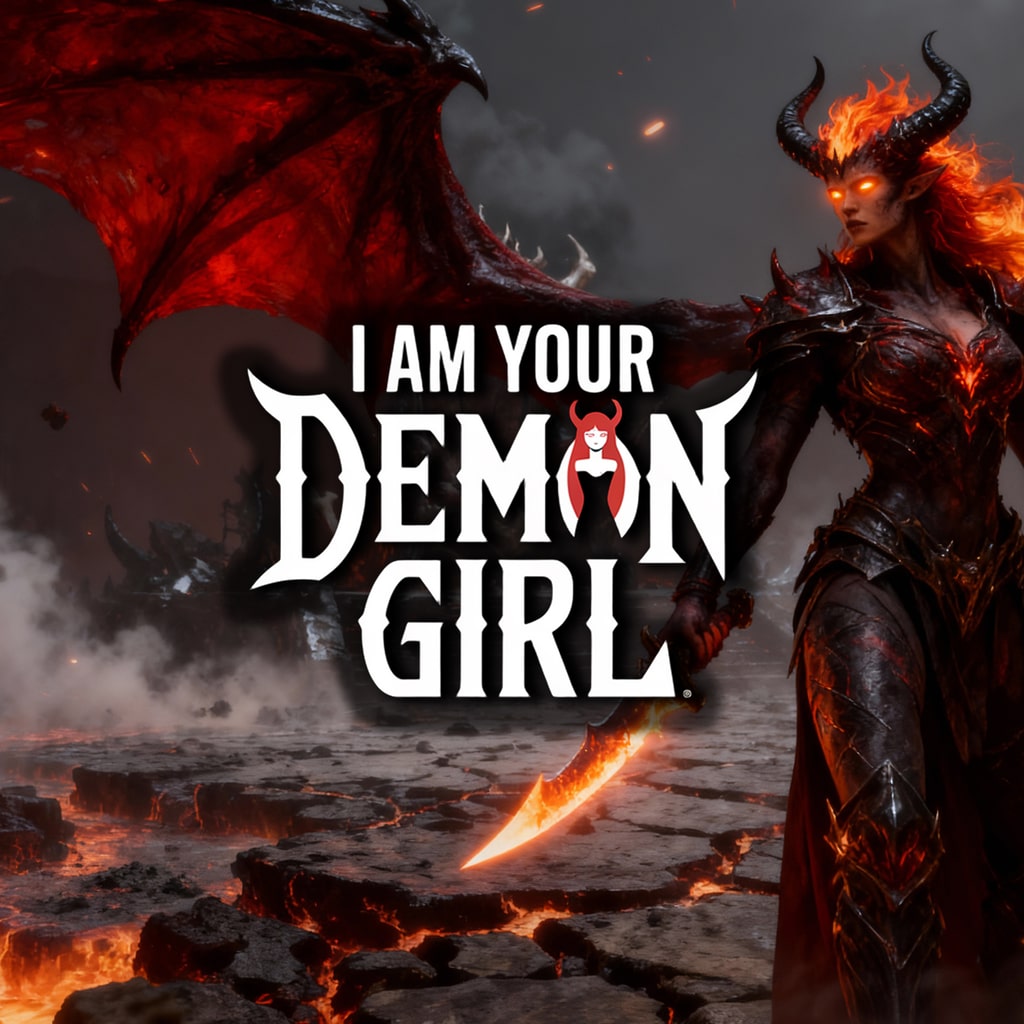
I Am Your Demon Girl enters a crowded field of visual-narrative games with a title that promises edge and attitude. From its opening moments, it signals a commitment to tonal contrast: humour and darkness, affection and alienation, playfulness and burden. Despite the apparent whimsy of its premise, the game aims to explore the dynamics of connection and consequence within a compact interactive framework.
The outcome is neither conventional nor simplistic. I Am Your Demon Girl is best understood not as a romance simulator or a pure narrative adventure, but as a character-centred experience that uses thematic friction to prompt reflection. Whether this approach resonates depends largely on player expectations—particularly around pacing, agency, and emotional tone.
Premise and Narrative Structure
At its core, I Am Your Demon Girl centres on an unusual dynamic: the player’s character encounters a demon girl whose presence defies both expectation and convention. Rather than a straight horror parody or a lighthearted anime pastiche, the game situates this figure in a narrative that balances intimacy with conflict.
The story unfolds through dialogue-heavy interactions, branching choices, and episodic scenes that alternate between personal moments and surreal interludes. Story is delivered primarily through text, with character portraits, background illustrations, and occasional animated sequences reinforcing emotional beats.
The narrative does not rush. Instead, it lingers, letting conversations unfold at their own pace. This can be a strength, allowing subtle emotional shading to emerge. At the same time, it demands patience; players seeking rapid progression or dramatic plot twists may find the pacing measured rather than compelling.
Characters and Interpersonal Dynamics
Characters are the heartbeat of I Am Your Demon Girl, and the central relationship defines the experience. The demon girl herself is voiced with deliberate ambiguity—playful at times, serious at others, and always operating within her own inscrutable logic. This duality reinforces the game’s thematic ambition: it wants players to negotiate not just dialogue options, but emotional states.
Interactions hinge on choice, but rarely offer clear “right” or “wrong” decisions. Instead, choices emphasise tone, curiosity, and personal orientation. The impact of these choices is not always immediately obvious, leading to consequences that unfold over time rather than in neat binary outcomes.
This design amplifies the sense that relationships are complex and resistant to simple resolution. It rewards attentive reading and thoughtful engagement, but it also risks frustration when narrative direction feels opaque.
Gameplay Mechanics and Agency
Mechanically, I Am Your Demon Girl is anchored in visual-narrative conventions. Dialogue selection is the primary mode of interaction, with occasional branching paths that subtly alter character response or scene context.
There are no reflex challenges, puzzles, or resource management systems. Instead, player agency is exercised through tone and intent. This emphasis complements the game’s focus on dialogue and emotional state, but it also limits interactive diversity. For players accustomed to systems-driven narrative games, the lack of mechanical variation may feel constraining.
That said, the game uses choice thoughtfully within its remit. Decisions shape how the demon girl perceives the player, how scenes unfold, and which emotional registers are foregrounded. The result is not a tightly branching narrative tree, but a mosaic of possibilities that reflect nuance rather than spectacle.
Writing and Thematic Depth
Writing is one of I Am Your Demon Girl’s most significant assets. Dialogue ranges from sharp and humorous to reflective and melancholic, often within a single exchange. Characters speak with voice and rhythm, and the script balances levity with existential weight.
Themes of connection, identity, and expectation recur throughout the experience. The demon girl is not merely a supernatural trope; she is a lens through which human vulnerability is examined. Her presence—both disruptive and illuminating—reveals the emotional architecture of the protagonist and, by extension, the player.
Thematic exploration is not heavy-handed. Rather, the game invites contemplation, using ambiguity and contrast to encourage interpretation rather than dictation.
Visual Presentation and Design
Visually, I Am Your Demon Girl adopts a contemporary anime-influenced aesthetic. Character portraits are expressive and detailed, with a range of emotions conveyed through subtle changes in posture, gaze, and expression. Backgrounds are minimalist but effective, reinforcing tone without distraction.
Animated sequences are limited, but when they occur they punctuate key moments with impact. This sparing use of motion ensures that animation remains meaningful rather than ornamental.
The user interface supports readability and immersion. Text boxes are clear, choices are presented without clutter, and visual cues emphasise emotional inflection rather than mechanical distraction.
Audio and Atmosphere
Sound design is understated but effective. Ambient tracks are sparse, reinforcing the intimacy of dialogue scenes rather than imposing mood. The soundtrack leans toward atmospheric and electronic textures, supporting reflection without overwhelming the narrative.
Voice work, where present, is limited and selective—used to highlight emotional peaks rather than constitute aural narration. This approach reinforces the primacy of text while adding depth at key moments.
Pacing and Emotional Rhythm
Pacing in I Am Your Demon Girl varies with narrative focus. Early sections are exploratory, allowing players to settle into the dynamic without pressure. As the experience unfolds, scenes build emotional complexity, but rarely escalate into melodrama.
This pacing rewards players willing to engage without haste. It also means that moments of emotional impact are spread out rather than intensified through dramatic acceleration. For some, this measured rhythm will feel meditative and resonant; for others, it may feel slow or unstructured.
Accessibility and Audience Appeal
The game is accessible in terms of controls and interface. There are no mechanical challenges, and choices are clearly presented. However, its narrative focus and thematic subtlety may limit broad appeal. Players looking for action, traditional branching RPG structure, or clear-cut moral feedback may find the experience too introspective.
Conversely, players who enjoy character-driven storytelling, ambiguous emotional arcs, and dialogue-focused design will find much to appreciate.
Final Verdict
I Am Your Demon Girl is a narrative experience that trades spectacle for nuance, reflection for reaction, and intimacy for clarity. It does not redefine visual-narrative genre conventions, but it uses them with uncommon subtlety—especially in how it frames interpersonal tension and emotional ambiguity.
Its strengths lie in writing quality, tonal cohesion, and willingness to embrace complexity rather than clarity. Its limitations stem from narrow interactive scope and pacing that privileges contemplation over momentum.
This is not a game for every player. Its rewards are emotional and interpretive rather than mechanical or kinetic. But for players attuned to tone, voice, and relational intricacies, I Am Your Demon Girl offers a thoughtful, stylistically confident journey.