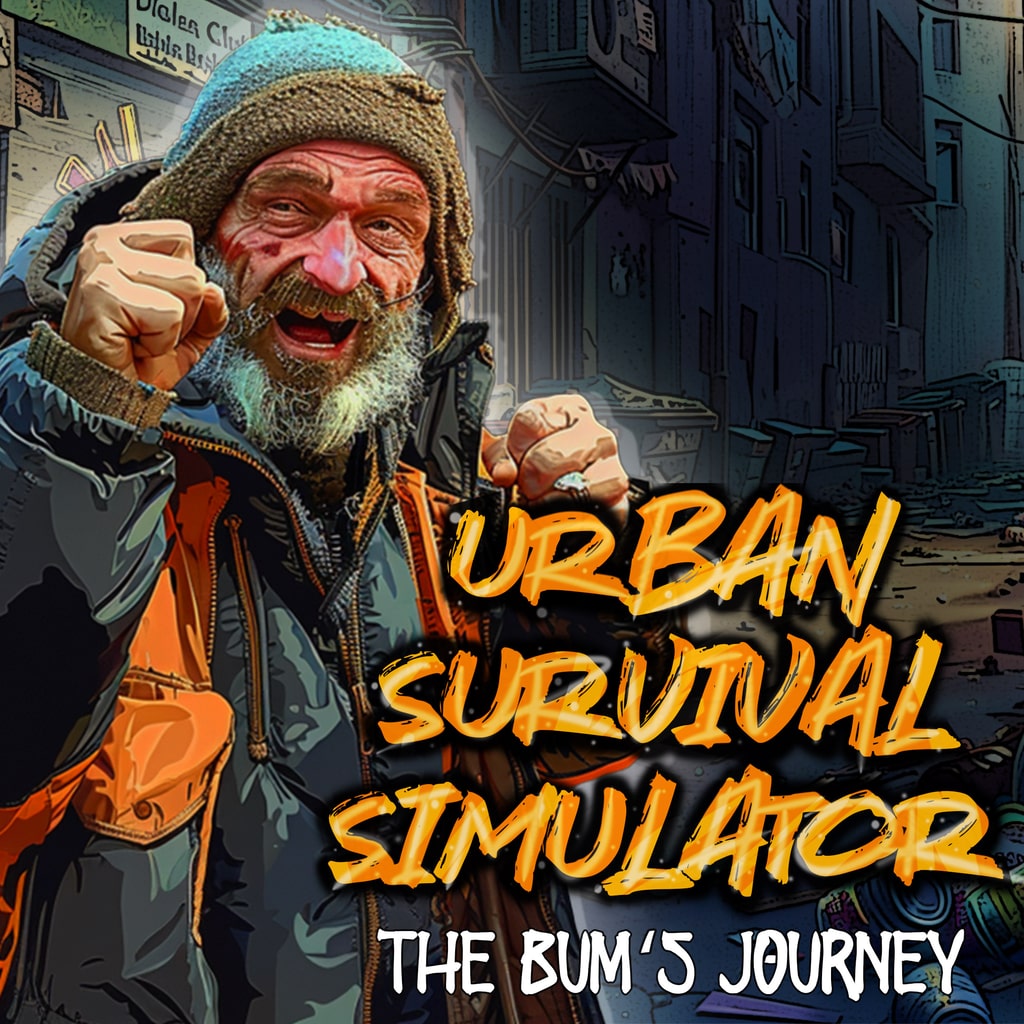
Urban Survival Simulator: The Bum’s Journey is a game that deliberately situates itself in uncomfortable territory. Rather than exploring survival through fantasy wilderness, zombie outbreaks, or post-apocalyptic collapse, it focuses on modern urban homelessness—portraying survival as an everyday struggle shaped by scarcity, social systems, and routine compromise. This is not a power fantasy, nor is it designed for escapism in the traditional sense. Instead, it offers a slow, system-driven experience rooted in vulnerability and persistence.
The result is a game that is often grim, occasionally insightful, and mechanically uneven—but one that attempts something few games are willing to approach directly.
Premise and Tone
From the outset, Urban Survival Simulator: The Bum’s Journey establishes a grounded, sober tone. You play as a character navigating city streets with limited resources, no stable shelter, and constant pressure to meet basic needs. Hunger, fatigue, health, and mental well-being are persistent concerns, and there is no narrative framing designed to soften the experience.
Importantly, the game avoids sensationalising its subject matter. There is no exaggerated misery, nor is there overt melodrama. Instead, the game leans heavily into routine: finding food, locating safe places to sleep, avoiding danger, and managing time. This understated approach lends credibility to the experience, even when individual mechanics lack refinement.
However, this restraint also means the game rarely offers emotional contrast. Moments of relief are muted, and long-term progress feels incremental at best. This consistency reinforces realism but can be emotionally draining.
Core Gameplay Systems
At its core, Urban Survival Simulator: The Bum’s Journey is a survival-management game. Players must balance a web of interconnected systems that govern daily life: hunger, energy, hygiene, health, and money. Each decision has consequences, often delayed, forcing players to think in terms of sustainability rather than immediate gain.
Food acquisition, for example, may involve scavenging, low-paying work, or relying on limited charitable resources. Sleep is constrained by location and safety. Certain areas offer shelter but introduce risk; others are safer but inaccessible without resources.
This interdependence is the game’s strongest mechanical element. Actions rarely exist in isolation, and poor planning can spiral into cascading failure. When the systems align, survival feels earned rather than granted.
That said, the systems are not always well balanced. Some mechanics feel overly punishing early on, while others become trivial once optimal strategies are discovered. The lack of dynamic scaling limits long-term challenge.
Progression and Player Agency
Progression in The Bum’s Journey is subtle and slow. There are no dramatic upgrades or power spikes. Improvement is measured through marginal stability—slightly better income options, marginally safer sleeping arrangements, or improved access to services.
This slow progression reinforces the theme but also limits player agency. While choices exist, they often funnel players toward the same optimal paths, reducing experimentation. The illusion of freedom sometimes outweighs actual mechanical diversity.
Narrative progression is minimal. There are events and encounters, but they rarely form a cohesive story arc. Instead, the game presents a series of loosely connected situations, reinforcing the idea that life in this context is defined more by continuity than resolution.
World Design and Environment
The urban environment is compact but functional. Streets, public spaces, shelters, and service locations are clearly delineated, allowing players to learn the layout quickly. This familiarity becomes important as time management plays a key role in survival.
Visually, the game adopts a utilitarian style. Environments are serviceable but repetitive, and character models lack detail. While this limits immersion, it also avoids glamorisation. The city feels indifferent rather than hostile—a place that simply exists, regardless of the player’s condition.
Environmental interaction is limited. Most engagement occurs through menus and prompts rather than physical exploration, reinforcing the game’s systems-first design.
Audio and Atmosphere
Sound design is restrained. Ambient city noise—traffic, distant voices, wind—grounds the experience without drawing attention to itself. Music is sparse, often absent, allowing silence to dominate.
This audio restraint reinforces isolation, but it also contributes to emotional flatness. There are few moments where sound elevates tension or relief. The atmosphere is consistent, but rarely dynamic.
Difficulty and Emotional Weight
Urban Survival Simulator: The Bum’s Journey is not difficult in the traditional sense of reflex or skill, but it is demanding in terms of attention and planning. Mistakes compound, and recovery can be slow or impossible without restarting.
The emotional difficulty may be more significant than the mechanical challenge. The game’s refusal to offer catharsis or dramatic payoff can be draining. While this aligns with its themes, it also limits accessibility.
Players seeking challenge through mastery may find the systems shallow once understood. Those seeking emotional engagement may struggle with the game’s detachment.
Ethical Framing and Execution
The game deserves credit for treating its subject matter with restraint rather than exploitation. It does not mock its protagonist, nor does it frame survival as a joke or novelty. However, the lack of narrative context or character development can make the experience feel clinical rather than empathetic.
By focusing almost exclusively on systems, the game risks reducing a human experience to mechanical optimisation. While this may be intentional, it creates distance where deeper insight might have emerged.
Final Verdict
Urban Survival Simulator: The Bum’s Journey is a thoughtful but limited survival simulation that attempts to depict urban homelessness through systems rather than spectacle. Its strengths lie in its interconnected mechanics, grounded tone, and refusal to sensationalise its subject matter.
However, limited progression variety, repetitive environments, and emotional detachment prevent it from achieving greater impact. It is a game that asks players to endure rather than overcome, offering insight through persistence rather than revelation.
For players interested in unconventional survival scenarios and system-driven realism, The Bum’s Journey offers a sobering, occasionally compelling experience. For others, its restraint and repetition may feel more exhausting than enlightening.