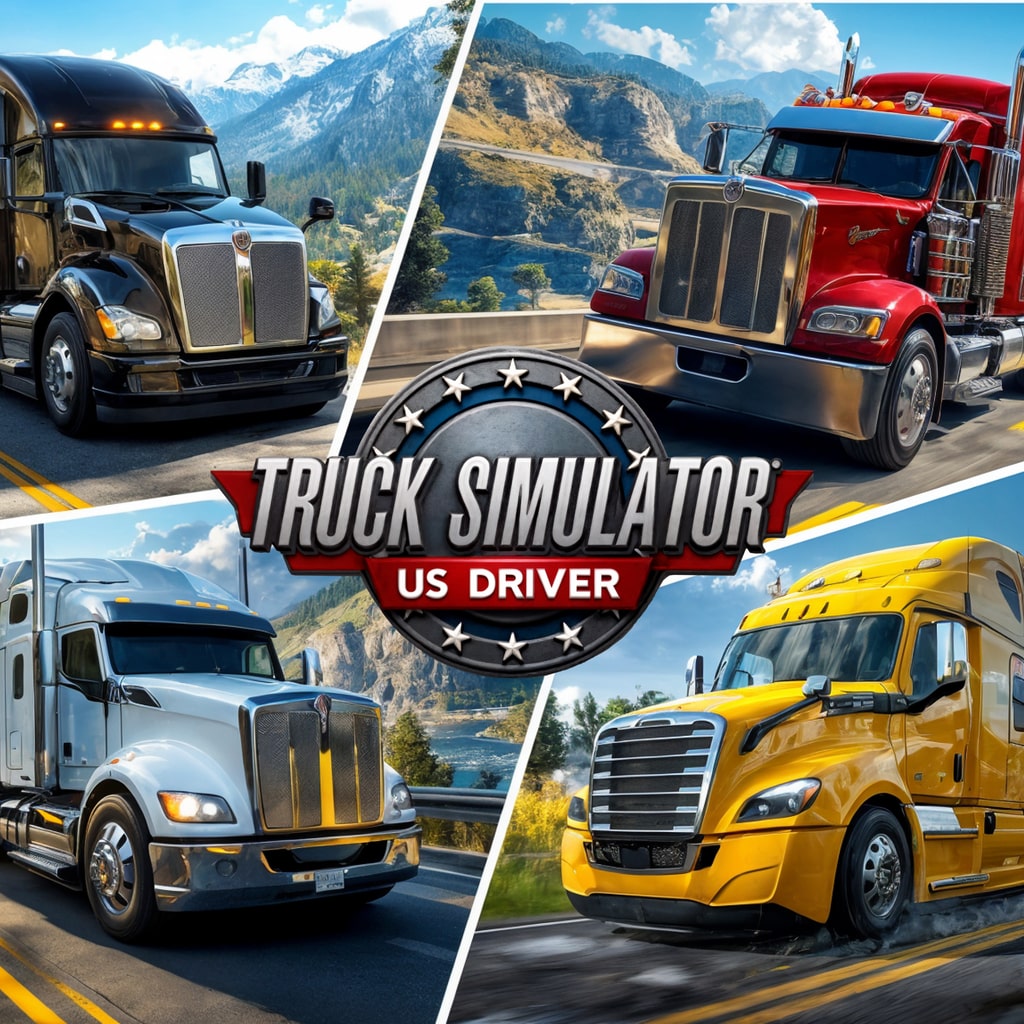
TRUCK SIMULATOR US DRIVER enters a well-established genre with a familiar promise: the open road, the weight of a loaded trailer, and the steady rhythm of long-haul driving across American highways. It is a game clearly inspired by larger, more complex trucking simulators, but it approaches the concept with a lighter touch—prioritising accessibility and routine over deep simulation systems.
The result is an experience that feels modest but coherent. TRUCK SIMULATOR US DRIVER does not attempt to redefine the genre, nor does it compete directly with its most simulation-heavy counterparts. Instead, it offers a pared-back interpretation of the trucking fantasy, one designed to be approachable, relaxed, and mechanically undemanding.
Presentation and Sense of Place
Visually, TRUCK SIMULATOR US DRIVER presents a simplified but recognisable vision of the American road network. Highways stretch through deserts, plains, and light urban environments, framed by wide skies and familiar roadside elements. While the environments lack fine detail, they succeed in conveying scale and direction, which is essential for a game built around long-distance travel.
Truck models are functional rather than luxurious. Cab interiors are readable but sparse, and exterior designs are serviceable without standing out. There is little in the way of customisation detail, but the basics are in place: mirrors, dashboards, and lighting behave predictably, reinforcing a sense of control.
Lighting and weather effects add modest variation. Day-to-night cycles are effective at changing mood, even if weather systems are limited in scope. The world rarely surprises visually, but it remains consistent, which supports immersion over extended drives.
Core Driving Mechanics
At its heart, TRUCK SIMULATOR US DRIVER is about maintaining momentum and managing basic vehicle behaviour. Driving physics are forgiving, favouring stability over realism. Trucks feel heavy enough to convey mass, but they are far easier to handle than in more demanding simulators.
Steering is smooth and predictable, braking is generous, and collisions are rarely punishing. This design choice lowers the barrier to entry significantly, making the game accessible to players unfamiliar with simulation-heavy driving mechanics.
However, this accessibility comes at a cost. There is limited nuance in handling, and advanced driving considerations—such as detailed gear management, realistic traction loss, or nuanced damage modelling—are either simplified or absent. For players seeking authenticity, the driving model may feel shallow.
Job Structure and Progression
The game’s progression revolves around accepting delivery jobs, transporting cargo between locations, and earning money to unlock additional routes, trucks, or upgrades. This structure is straightforward and easy to understand, reinforcing the game’s relaxed tone.
Jobs are clearly defined, with minimal preparation required. There is little in the way of logistical planning beyond selecting a destination and following the route. Timers exist, but they are forgiving, and failure is rare unless the player actively ignores objectives.
Progression is steady but unremarkable. Unlocks provide incremental improvement rather than transformational change, and there is little sense of long-term strategic growth. You are always a driver, performing variations of the same task, with limited opportunity to expand into fleet management or deeper business simulation.
Navigation and World Interaction
Navigation is simple and largely automated. GPS guidance ensures that players are rarely lost, and road layouts are intuitive. While this reduces frustration, it also removes a layer of engagement. The world feels more like a track than a network of interconnected systems.
Traffic is present but predictable. AI vehicles behave consistently, rarely creating complex scenarios that demand quick decision-making. This contributes to the game’s low-stress identity, but it also limits tension and realism.
Interactions outside of driving are minimal. Fueling, rest stops, and deliveries are handled through simple prompts rather than interactive systems. These elements support the fantasy but do not deepen it.
Audio Design and Atmosphere
Sound design is functional and understated. Engine noises vary slightly between trucks, providing basic auditory feedback without much texture. Road noise, environmental ambience, and traffic sounds are present but subdued.
Music is minimal, often fading into the background or absent entirely during long stretches of driving. This reinforces the meditative quality of the experience, allowing players to settle into a rhythm. However, it also contributes to a lack of emotional variation. There are few moments where audio elevates the experience beyond ambient comfort.
Radio-style features, if present, are limited, reducing one of the genre’s traditional immersion tools.
Pacing and Player Engagement
TRUCK SIMULATOR US DRIVER is deliberately slow-paced. It encourages relaxed play, making it well-suited for unwinding rather than focused challenge. Sessions can be as long or short as the player prefers, and the game rarely pressures you to optimise or rush.
This pacing is a strength for its intended audience, but it also exposes repetition. Over time, routes blur together, and the lack of mechanical variation becomes more apparent. Without deeper systems or evolving challenges, long-term engagement relies almost entirely on the player’s enjoyment of driving itself.
Accessibility and Limitations
Accessibility is one of the game’s strongest qualities. Controls are intuitive, objectives are clear, and difficulty is forgiving. Players new to the genre will find it easy to settle into the experience without extensive tutorials or prior knowledge.
However, this simplicity also defines the game’s limitations. There is little room for mastery beyond basic route efficiency, and advanced simulation fans will quickly encounter the ceiling of what the systems offer.
Technical performance is generally stable, though presentation remains modest. Visual repetition and limited environmental detail remind players that this is a smaller-scale production.
Final Verdict
TRUCK SIMULATOR US DRIVER is a calm, approachable entry into the truck simulation genre that prioritises comfort and routine over realism and depth. It delivers a functional driving experience that captures the broad strokes of long-haul trucking without engaging deeply with its complexities.
For players seeking a low-pressure driving game to relax with, it offers a steady, predictable experience that does not demand constant attention or technical expertise. For genre veterans looking for authenticity, system depth, or long-term progression, it will feel underdeveloped.
Ultimately, TRUCK SIMULATOR US DRIVER succeeds by knowing its scope. It does not overreach, and while it rarely surprises, it provides a consistent, accessible interpretation of life on the open road.