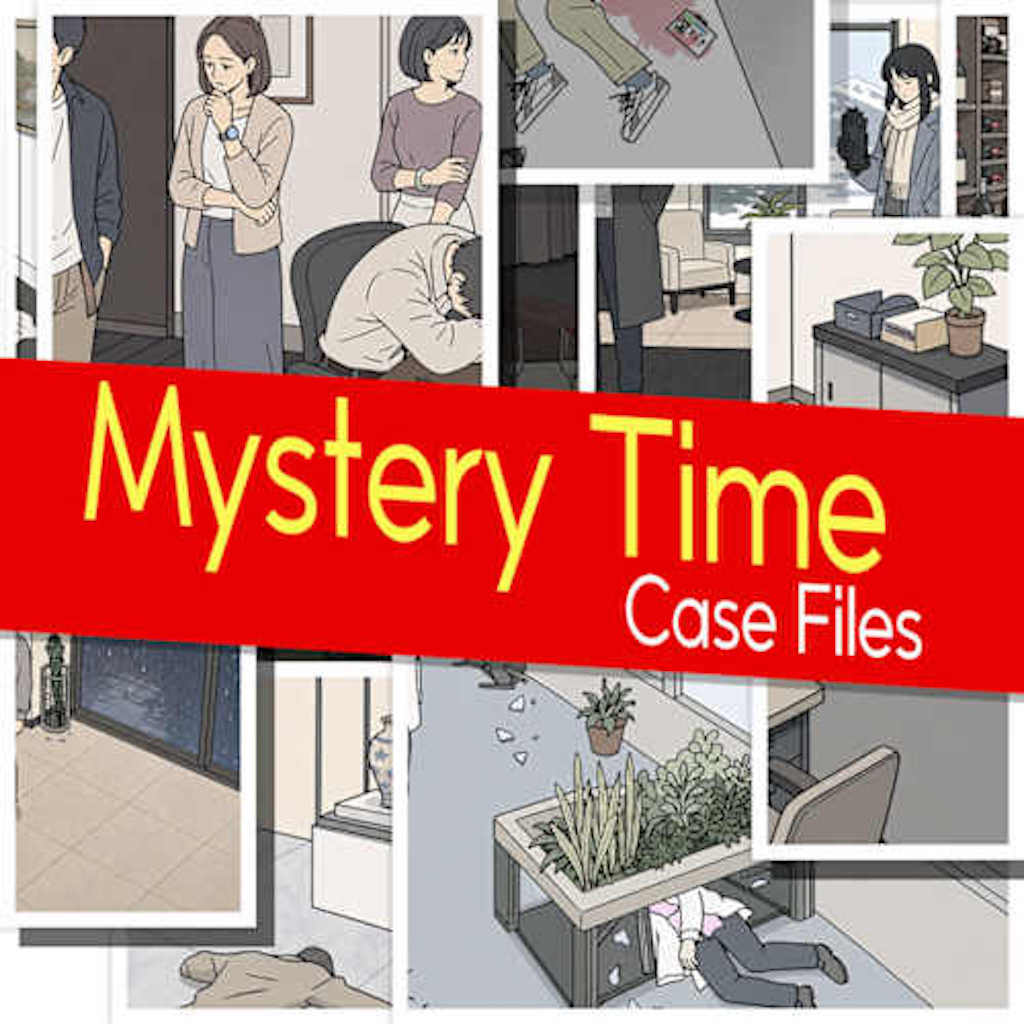
There is something wonderfully satisfying about a mystery that makes you feel clever without requiring you to be a detective in the traditional sense. You do not need a magnifying glass, a corkboard covered in red string, or years of police experience to crack the cases in Mystery Time: Case Files. All you really need is patience, a sharp eye, and the willingness to look at an apparently ordinary scene and ask yourself one simple question: what am I missing? Developed and published by Tokyo Tsushin Group, this illustration-based deduction puzzle puts the player in the role of an investigator, with each case presenting a carefully constructed visual scene that hides the clue that will reveal the truth.
It is an appealing concept because the game does not overwhelm you with complicated mechanics. Instead, you are presented with a brief situation, given a question to consider, and then left to examine the illustration for anything suspicious. People, objects, and seemingly insignificant details can all become important, and the satisfaction comes from spotting the one element that makes the pieces fall into place. It is a simple formula, but when it works, there is something genuinely enjoyable about that little flash of insight when you realise you have finally worked out what the game has been trying to show you.
Put Your Detective Hat On
The basic gameplay loop is wonderfully easy to understand. Read the case information, study the illustration, and identify the precise location that provides the answer. Once you think you have found the crucial clue, select it and see whether your deduction is correct. There is no complicated inventory to manage, no dialogue tree to memorise, and no elaborate crime scene simulation getting between you and the mystery.
That simplicity is one of the game’s greatest strengths. Mystery Time: Case Files can be picked up almost immediately, making it accessible to players who may not normally play deduction games. You do not need to learn a collection of mechanics before the fun begins because the real challenge is already sitting in front of you on the screen. The game trusts your eyes and your ability to make connections, which gives the experience a pleasingly direct quality.
The questions accompanying each case are particularly important. Rather than simply asking you to find anything unusual, the game gives you a specific clue about what to look for. That means the challenge is not just about scanning every pixel of an illustration, but about interpreting the information you have been given and applying it to what you can see. When the question and the image come together properly, the result can be surprisingly satisfying.
The Art of Looking Twice
The illustrations are effectively the game’s crime scenes and need to do a lot of heavy lifting. Each image contains characters, objects and environmental details that initially appear to be part of an everyday situation. The trick is recognising that not everything is as innocent as it seems. A suspicious object, unusual behaviour or a small inconsistency can provide the crucial evidence you need to solve the case.
This creates an interesting relationship between the player and the artwork. At first, you might scan the obvious areas for something dramatic, only to realise the answer is tucked away somewhere much less conspicuous. The game encourages you to slow down and examine the image as a whole rather than immediately focusing on the most obvious character or object. That process of looking again is where much of the entertainment comes from.
There is also something appealing about the fact that the game rewards attention rather than speed. You are not necessarily competing against a clock, so there is room to take your time and consider what you are seeing. In an industry where many games constantly push players towards the next objective, Mystery Time: Case Files is happy to let you sit with an image for a while. Sometimes the most important clue is the one you almost ignored.
Those Wonderful “Aha!” Moments
A good deduction puzzle needs to create a sense of discovery, and Mystery Time: Case Files understands that very well. There is a particular satisfaction in studying an illustration, noticing something that seems slightly out of place, and suddenly understanding why it matters. It can be as simple as an object being somewhere it should not be, or a character behaving in a way that does not fit the situation. Once you see it, the solution can suddenly feel obvious.
That is where the game manages to create more engagement than its simple point-and-click mechanics might suggest. You are not merely hunting for a highlighted object. You are trying to understand the relationship between the question, the scene and the suspicious detail. When those three elements align, the answer feels earned.
The quick-fire structure also suits the concept. Individual cases can be approached in short sessions, making the game ideal for anyone who wants something to play for a few minutes rather than committing to a lengthy adventure. You can solve a couple of mysteries over a cup of tea, put the game down and return later without having to remember an enormous amount of information. It is casual gaming at its most straightforward, but there is nothing wrong with that when the individual puzzles are enjoyable.
When the Clue Is Too Well Hidden
Unfortunately, not every mystery strikes the perfect balance between challenging and obscure. Some clues can be so difficult that careful observation alone does not necessarily lead you to the solution. Eventually, you may find yourself tapping around the image simply to discover what the game considers important. That can be frustrating because it replaces deduction with trial and error.
There is a fine line between a clue being subtle and one being practically invisible. The best cases allow you to look back after solving them and think, “I should have noticed that.” The weaker examples can leave you wondering how anyone was realistically expected to identify the answer without already knowing where to look. A little more consistency in clue design would have helped the experience enormously.
That issue is particularly noticeable because the game’s entire identity is built around observation. When the visual design works, the player feels responsible for the discovery. When the clue is too obscure, the sense of achievement naturally disappears. It is not enough for the answer to be technically present in the illustration; it needs to feel discoverable.
A Pleasantly Casual Detective
One of the things I like most about Mystery Time: Case Files is that it does not take itself too seriously. It offers the fantasy of being an investigator without requiring the player to wade through pages of paperwork, navigate complicated forensic systems, or endure lengthy interrogations. You are essentially the person in the room who notices what everyone else missed. That makes the game approachable and gives even the smallest cases a sense of importance.
It also makes the game well suited to playing with other people. While it is primarily designed as a solo puzzle experience, there is nothing stopping friends or family from gathering around the screen to solve the cases together. In fact, some of the puzzles could be even more enjoyable that way, with different people noticing different details and arguing over which clue matters most. A game that encourages conversation without requiring formal multiplayer can have a charm of its own.
The accessible design also means that Mystery Time: Case Files could appeal to a broad range of players. Fans of mystery games will understand the appeal immediately, while those who rarely play puzzle titles can jump in without feeling intimidated. It is less about mastering a complicated system and more about learning to trust your own observations. Sometimes that is exactly the kind of game you want after spending hours with something much more demanding.
Once the Case Is Closed
The game’s biggest weakness is one that naturally affects this type of experience: once you know the answer, there is little reason to return. The mystery is the attraction, and revealing the solution effectively removes the central reason to replay that particular case. You might revisit the artwork to see how you missed the clue the first time, but the discovery itself can only really happen once.
That means replay value is inevitably limited unless the game provides a substantial number of cases. The short format works wonderfully for individual sessions, but it can also leave the entire experience feeling quite disposable once the available mysteries have been exhausted. This is not necessarily a deal breaker for a budget-friendly casual puzzle, but it does prevent the game from having the same long-term appeal as a more involved detective adventure.
There is also an opportunity here that the developers could have explored further. More varied case structures, branching deductions, or multiple clues leading towards a final answer could have added considerable depth. The basic formula is strong enough to support more ambitious ideas, and seeing the concept expanded beyond a single suspicious point in an illustration would have been fascinating.
A Small Mystery With Plenty of Charm
Despite its limitations, Mystery Time: Case Files succeeds because it understands the simple pleasure of noticing what others might miss. It does not need elaborate graphics or complicated mechanics to make you feel like an investigator. Give the player an interesting enough scene, ask the right question and hide the answer carefully, and suddenly a static illustration can become a miniature crime scene.
There is something comforting about that simplicity. You can approach the game at your own pace, spend as long as you need studying a scene, and enjoy the satisfaction of solving a case without worrying about timers or complicated consequences. It is a small-scale experience, but it makes good use of the format. When the clues are well designed, the game turns close observation into something genuinely entertaining.
It could certainly benefit from greater variety and more forgiving clue design, particularly for players who become frustrated by answers that feel almost impossible to identify. Yet the underlying concept remains solid, and there are enough satisfying moments to make the journey worthwhile. It may not turn you into the next great fictional detective, but it can certainly make you question whether you are paying enough attention.
Final Verdict
Mystery Time: Case Files is a charming little deduction game built around a deceptively simple idea. Study the scene, read the question, spot the suspicious detail and uncover the truth. Its accessible mechanics and bite-sized cases make it easy to pick up, while the strongest puzzles deliver exactly the kind of satisfying “aha!” moments that make visual deduction games so enjoyable.
Its shortcomings are largely tied to the same simplicity that makes it approachable. Some clues can feel overly obscure, occasionally forcing players into trial and error rather than genuine deduction, while the limited replay value is an unavoidable consequence of solving mysteries whose answers can surprise you only once. More variety and deeper case structures could have elevated the experience considerably.
Nevertheless, there is a lot to like about this modest little mystery collection. It is a game that rewards patience, observation and curiosity rather than reflexes, and there is something wonderfully satisfying about spotting the tiny detail that everyone else might have overlooked. For fans of casual mystery puzzles or anyone looking for a quick mental workout, Mystery Time: Case Files is worth investigating.