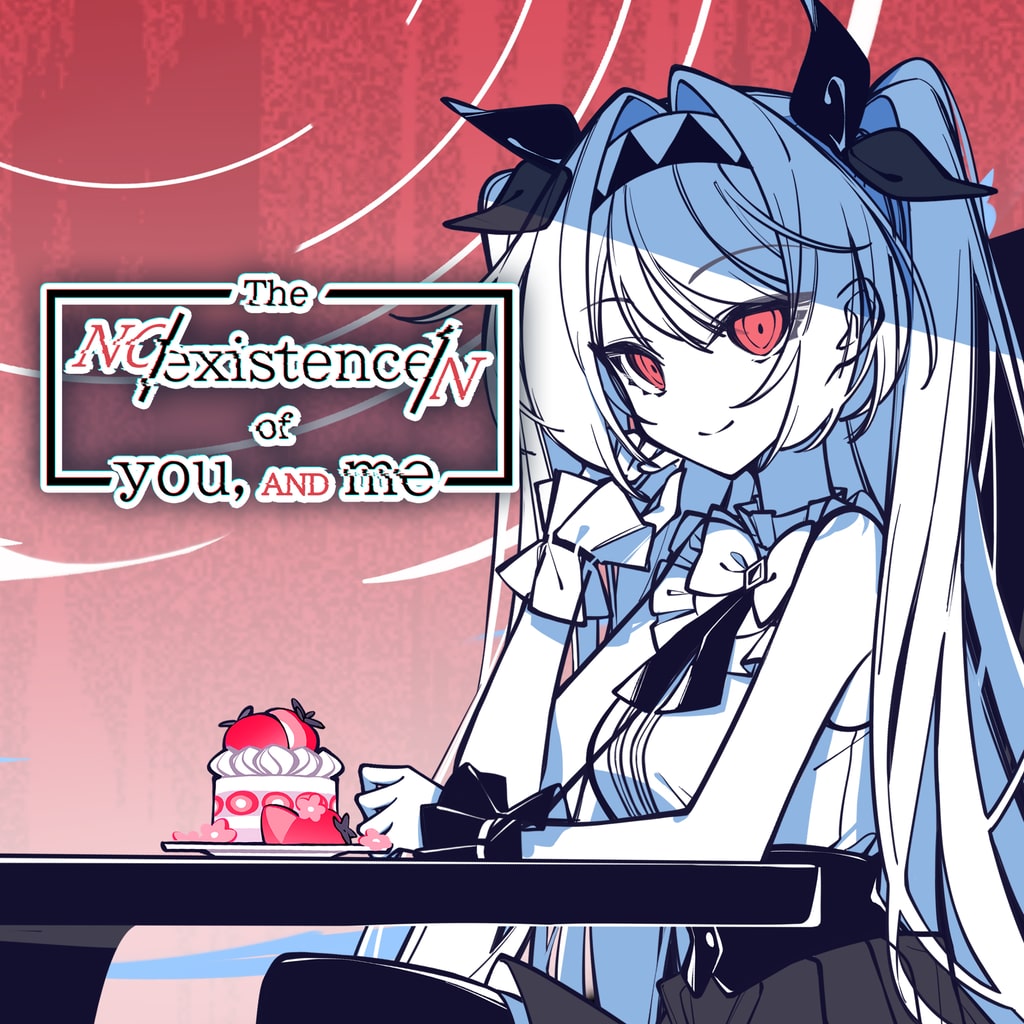
Say hello to the girl. That is all you have to do. It sounds simple enough, doesn’t it? You wake in a strange room, discover a mysterious girl sitting in front of you, and are presented with what appears to be the easiest objective imaginable. Say hello. Of course, this is a psychological horror visual novel, so there is absolutely no chance that something this straightforward will remain so for very long.
The NOexistenceN of you AND me is the sort of game that is best experienced with as little prior knowledge as possible. Developed by 0x0Real Studio and published by Nino Games, this compact visual novel takes the familiar idea of making dialogue choices and starts poking holes in the very concept of what a game is supposed to be. It asks questions about existence, identity, memory and perception, but rather than presenting those ideas as a dry philosophical lecture, it wraps them in a bizarre collection of stories, characters, choices and increasingly unsettling situations.
Most importantly, it understands that the player is part of the equation. You are not simply controlling a character called Yuman or some other fictional protagonist. The game repeatedly blurs the line between you and the person sitting in that strange room, and that distinction becomes increasingly difficult to ignore as the story progresses.
Just Say Hello
The mysterious girl is Lilith, though calling her a conventional character would probably miss the point. She appears in the protagonist’s room without warning, smiles at you, and then makes you question almost everything you thought you understood about the situation.
Lilith is wonderfully difficult to pin down. She does not simply exist to provide exposition or guide you towards the next objective. Instead, she seems aware of the relationship between herself, the protagonist, the player, and the game, and the game has plenty of fun with that idea. Her personality can shift between playful, curious, unsettling, and surprisingly sincere, sometimes within the same conversation.
That makes the central relationship rather fascinating. You are not simply trying to romance the mysterious girl, although the game certainly has some moments that head in that direction. You are trying to understand her, and perhaps more importantly, why she is there at all.
A Visual Novel That Knows It Is A Game
The most interesting thing about The NOexistenceN of you AND me is how it plays with the visual novel format. The game is perfectly happy to let you believe you understand how it works before suddenly changing the rules.
Menus, saves, chapters and choices are not necessarily as trustworthy as they appear. The game plays with the interface itself, so something as ordinary as moving through a menu can suddenly become part of the narrative. It is an approach familiar to anyone who has played games such as Doki Doki Literature Club, but The NOexistenceN of you AND me has enough of its own personality to avoid feeling like a simple imitation.
There are moments when you realise the game has been paying attention to things you thought existed outside the story. A restart might not feel like a restart. A choice might have consequences beyond the conversation in which you made it. Even the act of progressing through chapters becomes something you start to question.
That is where the horror comes from. There are no hordes of monsters jumping out of cupboards. Instead, the unsettling feeling comes from gradually realising that the rules you rely on may not actually be rules at all.
Hundreds Of Choices And A World That Keeps Changing
The game throws an enormous number of choices at you, though not every decision carries the same weight. Some are silly, some are strange, and others appear completely ridiculous until you realise they may have a purpose.
One minute you might find yourself making strawberry cake and deciding who gets to eat it. The next, you could be ruling a kingdom and listening to the advice of suspicious ministers. Elsewhere, you might be stopping a conspiracy involving a time machine, travelling through a fantasy forest to defeat a Demon Lord, or going on a date with Lilith at the end of the world.
It sounds completely bonkers because it is. Yet there is a method to the madness. These little scenarios constantly play with the idea of identity and perspective, asking you to consider what makes one reality feel more legitimate than another. Is the strange fantasy world any less real because it is presented as a game? If a character remembers something that you do not, who is actually wrong? The game does not always give you an answer. Instead, it enjoys leaving you sitting there, thinking about the question long after the scene has finished.
Philosophy Without Taking Itself Too Seriously
There is a danger in a game built around existential philosophy. It could easily become unbearably self-important, filling every conversation with grand statements about the meaning of life while forgetting that players need to enjoy themselves.
Thankfully, The NOexistenceN of you AND me has a sense of humour. The sillier scenarios are important because they stop the philosophical material from becoming too heavy. The game can be discussing existence one moment and then throw something completely absurd at you the next. That contrast gives the experience its personality and makes the stranger ideas easier to digest.
Lilith is particularly effective in this respect. Her conversations can become philosophical, but she never feels like a walking textbook. There is enough playfulness in her dialogue to make you want to keep talking to her, even when you have absolutely no idea where the conversation is going.
Lilith Is The Heart Of It
For all the game’s clever tricks, none of them would matter quite as much if Lilith were not an interesting character. Thankfully, she is. Her red eyes and distinctive appearance make her instantly memorable, while the expressive, anime-inspired artwork shifts her presentation to match the scene’s tone. She can look cute one moment and deeply unsettling the next, often without requiring a dramatic change in the environment.
The full voice performance also helps considerably. Lilith needs to carry much of the game’s dialogue, and having a real performance behind those conversations gives her words more weight. When the game becomes emotional or uncomfortable, the voice acting helps sell the moment rather than leaving it entirely to the player’s imagination.
There is also an intriguing mystery surrounding her that keeps you moving forward. You want answers, but the more the game tells you, the more questions seem to appear.
Cute, Strange And Occasionally Creepy
Visually, The NOexistenceN of you AND me strikes an unusual balance between sweetness and unease. The character artwork is attractive and colourful, particularly when set against the darker themes running beneath the story.
Lilith’s design is particularly effective because her appearance initially suggests something quite different from the psychological horror lurking beneath the surface. The game understands that something need not look terrifying to make you uncomfortable. Sometimes a cheerful smile in the wrong context can be far more disturbing than a monster covered in blood.
The environments are generally more restrained, which works in the game’s favour. The focus remains on the characters and the interface, allowing shifts in presentation to have a greater impact when the game decides to unsettle you.
The sound design follows a similar approach. Gentle music and atmospheric effects create an almost dreamlike quality during quieter scenes, while interface sounds and changes in the soundtrack can make later moments feel considerably more uncomfortable.
Breaking The Fourth Wall
There is something particularly satisfying about a game that knows exactly where the fourth wall is and then spends its entire running time looking for increasingly creative ways to kick holes through it.
The NOexistenceN of you AND me does not simply have a character occasionally say, “Hey, you’re playing a game.” That would be far too easy. Instead, it uses the mechanics themselves to make you question the boundary between player and protagonist.
The save system and chapter progression become part of the experience. Restarts can take on a different meaning. Choices can feel as though they are being remembered somewhere outside the immediate story. The game wants you to become suspicious of its own structure, and once that suspicion takes hold, even something as harmless as selecting a menu option can feel slightly dangerous.
That is clever design because it turns familiarity against you. The more visual novels you have played, the more confident you are about what to expect. This game enjoys proving you wrong.
Short, But Deliberately So
One of the biggest criticisms that could be levelled at the game is its length. It is a compact experience, and players expecting a sprawling visual novel with dozens of hours of content are likely to be disappointed.
Personally, I think the shorter format works reasonably well. The ideas come thick and fast, and the game rarely becomes bogged down in unnecessary filler. There are moments when the philosophical discussions could perhaps have benefited from more breathing room, but stretching the experience considerably longer could just as easily have weakened its impact.
The branching structure also gives you a reason to revisit it. Discovering another ending or seeing what happens when you make a different choice can reveal another little piece of the larger puzzle. You may finish the game, sit back and think you understand what happened, only to find yourself wondering what would have happened if you had chosen differently.
So, What Does It All Mean?
That is the question. The non-existence of you and me keeps coming back to you.
It is about existence, but also about how we decide what it means. It is about the relationship between a player and a character, but also about whether that relationship can work both ways. It is about memory, perception and identity, but it is also about something much simpler: the strange feeling of meeting someone and wondering why they have entered your life.
The game does not always explain its ideas in the clearest possible way, and some players will probably find parts of its philosophy rushed or deliberately vague. That is a legitimate weakness, particularly when the game introduces a big idea and then moves on to something completely different before giving it enough time to settle.
Even so, I would rather play something that occasionally leaves me scratching my head than something that explains every single thing to death. There is value in a game that trusts its audience to make connections for themselves.
Final Verdict
The NOexistenceN of you AND me is a strange little game, and I mean that as a compliment. It takes the humble visual novel and turns it into a playground for ideas about existence, identity, reality and the relationship between the player and the characters on screen.
Its greatest achievement is how it makes the mechanics part of the story. Choices, saves, restarts and menus all become potential pieces of the puzzle, while Lilith provides the emotional and philosophical centre of an experience that constantly keeps you guessing. The combination of cute character art, unsettling moments, full voice acting and an appropriately atmospheric soundtrack creates a surprisingly memorable package.
It is not perfect. Some of the philosophical conversations feel as though they could have used more room to breathe, and the short runtime means certain ideas are introduced and explored before they have fully settled. There is also a deliberate sense of confusion running through the experience that will either intrigue you or leave you wondering what on earth you have just played.
For me, that uncertainty is part of its charm. The NOexistenceN of you AND me is not really interested in giving you a comfortable journey from beginning to end. It wants you to question what you see, what you remember, and, eventually, the role you are playing in the first place. And it all begins with the simplest instruction imaginable. Say hello to the girl.