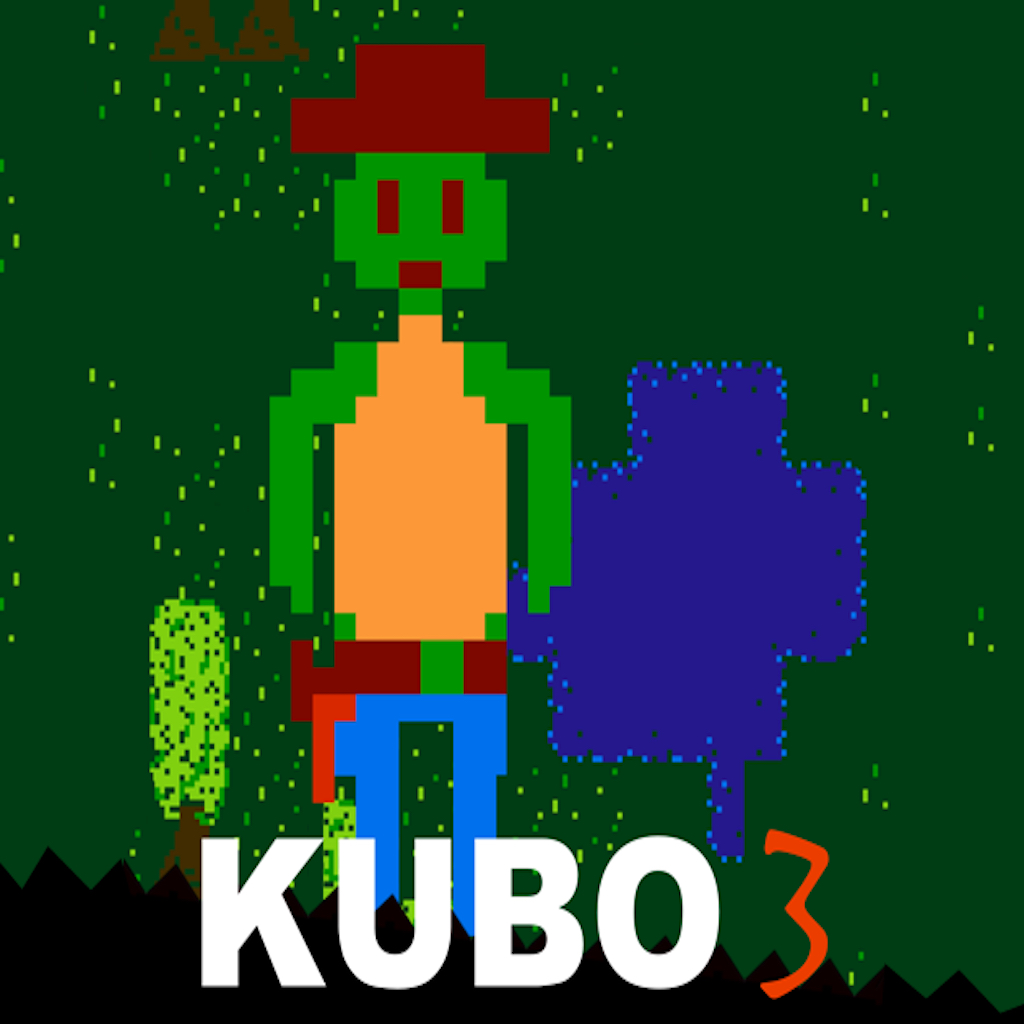
There is something wonderfully sincere about a game that looks as though it has escaped from a dusty NES cartridge and somehow wandered onto modern hardware. KUBO 3 is exactly that sort of game. Originally created as an authentic NES and Famicom homebrew project by developer Seiji of SJ Games alongside his father, this colourful little adventure feels less like an attempt to recreate the past and more like a genuine love letter to the 8-bit era.
At the centre of it all is Kubo, a heroic cowboy turtle with a remarkably unfortunate problem. The villainous Moglar has kidnapped the inhabitants of Kubo’s world and imprisoned them, leaving our unlikely hero to travel across the four corners of the world in search of sacred crystals. His journey takes him through the underworld, graveyards, underwater environments and the skies themselves, with plenty of monsters and bosses standing between him and Moglar’s castle.
What immediately makes KUBO 3 appealing is its lack of pretension. It does not try to disguise its humble origins with flashy effects or unnecessarily complicated mechanics. Instead, it embraces the limitations and personality of classic 8-bit adventure games, delivering a compact experience built around exploration, platforming, combat and the simple pleasure of discovering what lies around the next corner.
A Classic Adventure With a Modern Audience in Mind
The basic structure will feel instantly familiar to anyone who grew up with the NES. Kubo begins his adventure with limited health and a relatively straightforward set of abilities, but exploring the world and defeating bosses gradually makes him stronger. Sacred crystals provide a tangible sense of progress, increasing his survivability and allowing players to tackle increasingly dangerous areas with a little more confidence.
The overworld is where KUBO 3 differs from a purely linear platformer. Rather than simply marching from one level to the next, players are encouraged to explore the map and discover where they need to go. Entrances, secrets and important items are scattered throughout the environment, creating a pleasant sense of adventure reminiscent of the early days of console gaming.
There is a refreshing simplicity to this approach. Modern games often feel the need to fill every corner of the screen with icons, objectives, markers and notifications telling you precisely where to go. KUBO 3 is happier to let you wander around and figure things out. Sometimes you will know exactly what you are looking for, while at other times you will simply stumble across something interesting and wonder whether it might be useful later.
That sense of discovery is one of the game’s biggest charms. The world is not enormous, but it makes enough of what it has to encourage curiosity. You are never far from another little surprise, an enemy encounter, or an entrance leading into a completely different style of stage.
Four Worlds, Four Flavours of Trouble
The variety of environments is another strong point. The underworld offers a suitably dangerous introduction to some of the game’s nastier hazards, while the graveyard gives Kubo an appropriately spooky setting filled with undead enemies. The underwater sections change the pace by introducing swimming, while the sky stages provide a completely different visual backdrop and their own platforming challenges.
This variety helps prevent the adventure from becoming visually monotonous. The limited 8-bit palette is used effectively, with each area receiving its own identity rather than simply recycling the same backgrounds with a few altered colours. There is a playful quality to the presentation that suits Kubo perfectly, particularly when some of the stranger enemies begin to appear.
And there are plenty of them. KUBO 3 clearly enjoys throwing silly creatures into Kubo’s path, with everything from flying carrots to zombies getting in the way of our determined turtle. The enemies are not necessarily sophisticated, but they are memorable, and that is arguably more important in a game of this scale.
Boss encounters provide the major punctuation points. Reaching the end of a stage and coming face to face with a larger, more dangerous opponent gives each area a satisfying sense of conclusion. Learning attack patterns, finding openings, and eventually bringing a boss down is exactly the sort of uncomplicated satisfaction that retro action games were built around.
The Joy of Not Overcomplicating Things
Playing KUBO 3 reminded me that a game does not always need dozens of abilities, skill trees or elaborate progression systems to keep you interested. Its mechanics are deliberately straightforward, yet they work well together. You move, jump, attack, explore and collect items, with the difficulty gradually encouraging you to become more familiar with the game’s hazards and enemy patterns.
There is also an old-school rhythm to the experience. Modern games are often designed around constant progression, allowing players to save whenever they want and recover from mistakes almost instantly. KUBO 3 instead leans into its homebrew heritage, offering a more compact arcade-style experience that rewards patience and memorisation.
That can occasionally work against it. Players accustomed to modern conveniences may find the absence of a traditional save system frustrating, particularly when a mistake sends them further back than expected. Yet it is difficult to separate this from the game’s overall identity. KUBO 3 is trying to capture the feeling of playing an old NES adventure, warts and all.
The important thing is that the challenge generally feels understandable. When something goes wrong, there is usually a lesson to take from it. You learn an enemy’s movement, remember the position of a hazard or work out a safer route through an awkward section. It is a slower, more deliberate approach to difficulty than simply throwing increasingly powerful enemies at the player.
Pixel Art With Plenty of Personality
Visually, KUBO 3 is never going to compete with modern blockbuster releases, and thankfully it has no interest in doing so. The pixel art embraces the limitations of the NES aesthetic, with simple yet expressive sprites and colourful environments that have an unmistakable retro personality. Kubo himself is a particularly likeable little character, and his cowboy turtle design manages to be both ridiculous and strangely adorable.
There is also a genuine warmth to the presentation. The game never feels embarrassed about looking old-fashioned. Instead, it proudly celebrates the aesthetic that inspired it, complete with chunky sprites, simple animations and environments that rely on clever use of colour rather than technical spectacle.
The soundtrack follows the same philosophy. Chiptune music accompanies the adventure with suitably energetic melodies, giving each environment its own retro atmosphere. The music does not try to overwhelm the player, but it does an excellent job of reinforcing the feeling of sitting in front of an old television with a controller in your hands.
It is the sort of presentation that will probably mean more to players with an affection for classic console gaming. There is something comforting about hearing a simple electronic tune while wandering through a pixelated world, particularly when the game itself understands that restraint can be part of the appeal.
A Homebrew Adventure Made With Heart
Perhaps the most interesting thing about KUBO 3 is the story behind the game. Knowing it originated as a homebrew project by a young developer and his father gives the adventure an extra sense of character. It feels like the kind of project made because somebody genuinely wanted to create an NES game, rather than because a market report suggested retro nostalgia was currently fashionable.
That enthusiasm comes through in the finished product. KUBO 3 has rough edges, certainly, but those imperfections are part of what makes it appealing. It feels handmade, personal and proudly independent.
The inclusion of the original KUBO and KUBO 2 is also a welcome addition. Rather than simply getting one small retro adventure, players can experience the wider history of the series and see how the games developed. For anyone interested in NES homebrew, that makes the package considerably more intriguing than it might initially appear.
There is something satisfying about watching an idea grow. KUBO 3 feels like the culmination of a series made with genuine affection for the hardware and games that inspired it. That enthusiasm is infectious, even when the underlying mechanics remain deliberately simple.
Final Verdict
KUBO 3 is a charming reminder that you do not need cutting-edge technology or a gigantic budget to make an enjoyable adventure. Its authentic NES presentation, colourful environments and straightforward platforming capture the spirit of an era when games were often much smaller in scope but enormous in personality. The combination of an overworld, varied environments, collectible upgrades and entertaining boss encounters gives the adventure enough variety to keep the journey moving.
It is not without limitations. The compact nature of the experience and its old-school approach to saving and difficulty will not appeal to everyone, particularly players who expect modern conveniences and extensive progression. Some of the platforming and combat mechanics can also feel rather basic by today’s standards. But judging KUBO 3 purely through a modern AAA lens would miss the point.
This is a lovingly crafted piece of NES homebrew that wears its influences proudly. There is a real sense of personality running through the adventure, from the bizarre concept of a cowboy turtle hero to the colourful enemies and cheerful chiptune soundtrack. The fact that it also includes KUBO and KUBO 2 makes the package an even more appealing proposition for retro enthusiasts.
Most importantly, KUBO 3 has heart. Beneath the pixels, simple mechanics and old-school difficulty is a game that feels as though it was made because its creators genuinely love this style of gaming. Sometimes that enthusiasm counts for more than technical wizardry, and Kubo’s latest adventure proves that a tiny turtle can still carry a surprisingly big adventure on his shell.