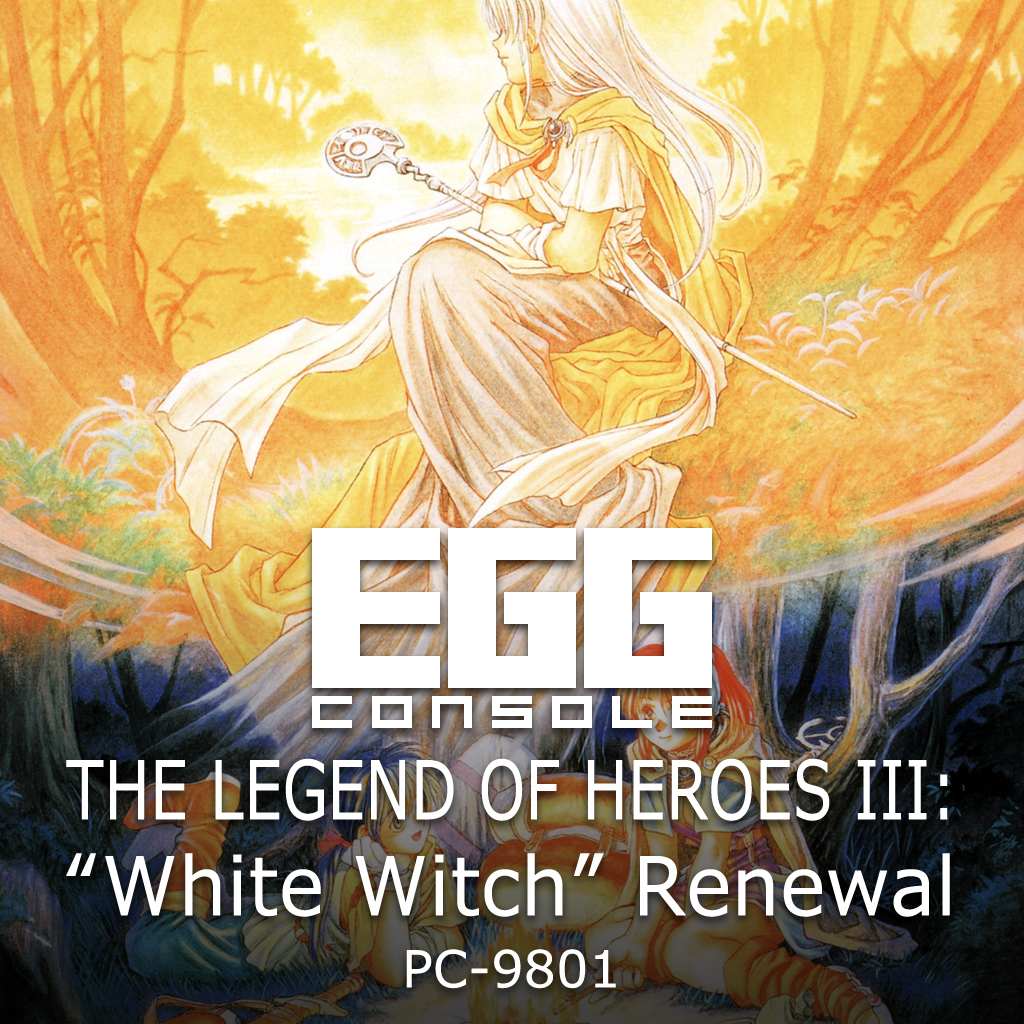
There is something wonderfully nostalgic about discovering an old RPG that feels as though it belongs to a different era of gaming. Before open worlds became enormous checklists and before role-playing games routinely stretched beyond a hundred hours, developers had to rely on characters, dialogue, imagination and the simple promise that the next town might contain something worth discovering. EGGCONSOLE THE LEGEND OF HEROES III: “White Witch” Renewal PC-9801 is very much a product of that philosophy, bringing Nihon Falcom’s 1994 classic back in its authentic PC-9801 form.
This is not a remake attempting to disguise its age. It is a preservation piece, complete with the visual language, systems and presentation of an early-90s Japanese computer RPG. That may sound daunting to modern players accustomed to slick interfaces and immediate tutorials, but there is a surprising warmth to White Witch. Beneath the dated presentation lies an ambitious adventure with a huge story, memorable characters and a world that clearly mattered to the people who created it.
A Pilgrimage That Becomes Something Much Bigger
The adventure begins with Jurio, a somewhat timid young man, and Chris, his more confident companion. The pair set out on a traditional pilgrimage linked to their village’s coming-of-age ceremony, giving the opening a wonderfully grounded quality. This is not a story that immediately throws its heroes into a colossal battle for the fate of the universe. Instead, it begins with two young people leaving home and gradually discovering that the world beyond their village is far more complicated than they imagined.
Naturally, things do not remain quite so innocent. Their journey eventually becomes entangled with the mysterious White Witch, and what initially appears to be a relatively straightforward pilgrimage develops into an enormous adventure spanning nine chapters. The sheer scale of the narrative is one of the game’s most impressive characteristics, particularly when you consider the hardware it originally targeted.
The prologue and first chapter alone reportedly contain more content than the entirety of the previous game, which gives you some idea of the ambition involved. This is a game that wants to tell a proper story rather than simply provide an excuse for another series of battles. Towns have their own personalities, characters have their own concerns, and the wider world gradually becomes more important as Jurio and Chris continue their journey.
Falcom’s Storytelling DNA
One of the most interesting things about White Witch today is seeing the foundations of ideas that would later become synonymous with Falcom. The company would go on to create the hugely successful Trails series, and there are hints here of that same fascination with world-building, regional stories and characters who feel like more than disposable quest-givers.
Talking to people in towns is therefore an important part of the experience. The world does not simply exist between dungeon entrances. Villagers provide information, background stories and little glimpses into the lives of ordinary people, giving the adventure a sense of place. Even when a conversation does not immediately lead to an important quest, it can still make a town feel like somewhere rather than simply another stop on a map.
That slower approach to storytelling will not suit everyone. Modern RPGs are generally much more explicit about what the player should do next, whereas White Witch expects a little more patience and curiosity. Yet there is a charm in having to engage with the world rather than simply following an objective marker from one location to another.
A Different Kind of Battle
Combat is perhaps the biggest adjustment for modern RPG players. Rather than relying on a conventional turn-based system where you issue every command each round, White Witch uses an auto-battle approach that lets players configure behaviour and then watch their characters carry out those instructions.
It is an unusual system, but it fits the game’s design surprisingly well. Rather than turning every encounter into a repetitive exercise of selecting attack, magic and item commands, the emphasis is on preparing your party effectively. Adjusting combat settings becomes an important part of the process, particularly as the party grows and encounters become more demanding.
The early game can be particularly unforgiving because your party is relatively small. That can make some battles feel tougher than expected, especially if you approach them with modern expectations about how RPG combat should work. Taking the time to adjust your battle commands can make a significant difference, and there is something satisfying about finding a configuration that lets your party handle encounters more efficiently.
It is not a system that will instantly win over everyone. Players who enjoy controlling every action may find the automation restrictive, while those who appreciate strategic preparation may find it refreshingly different. The important thing is that it feels like a deliberate part of the game’s identity rather than an unfinished substitute for traditional combat.
The Gagharv Trilogy Begins
For Falcom enthusiasts, White Witch holds particular historical significance as the opening chapter of the Gagharv Trilogy. Its story exists within a shared universe alongside The Legend of Heroes IV: A Tear of Vermillion and The Legend of Heroes V: Song of the Ocean, placing the game within a larger narrative framework.
That makes the EGGCONSOLE release especially interesting for anyone interested in the series’ history. This is not simply another obscure retro RPG dragged out of an archive. It is an important part of the evolution of one of Falcom’s most enduring role-playing properties.
There is also something fascinating about experiencing the game in its original PC 9801 form. The platform was very different from the consoles and PCs many modern players grew up with, and that difference is evident throughout the presentation. Rather than attempting to modernise the experience beyond recognition, the EGGCONSOLE release allows the original character of the game to remain intact.
A Beautifully Dated Presentation
There is no escaping the fact that White Witch looks old. Its pixel art unmistakably belongs to the 1990s, and the PC 9801’s limited colour palette gives everything a distinctly retro appearance. Characters are small, environments are comparatively simple, and animations lack the sophistication even modest modern RPGs can offer.
Yet there is a particular beauty in these limitations. The developers had to convey character, place and atmosphere with relatively little, and the resulting artwork has a personality that can sometimes be missing from technically superior games. Portraits and sprites work together effectively, while the overworld has enough detail to make exploration worthwhile.
The sound is arguably even more evocative. Falcom’s musical heritage has always been one of its great strengths, and the FM synthesis soundtrack has that unmistakable vintage computer sound. It may not have the sweeping orchestration of a modern RPG, but there is an infectious quality to those old electronic tones that immediately transports you back to another era of gaming.
Living With The Past
The real question about a release like this is whether modern players should approach it expecting a conventional contemporary RPG. The answer is probably no. White Witch asks for patience, particularly if you are unfamiliar with older Japanese computer role-playing games.
There are systems that take time to understand, and moments when the pacing can feel slower than today’s audience might expect. The combat system requires adjustment, the visuals are unmistakably dated, and the game does not always hold your hand. Those are genuine barriers, and pretending otherwise would do the experience a disservice.
But those same characteristics are also what make it fascinating. This is a game from a period when developers were experimenting with how much story could be packed into a computer RPG, how characters could be made memorable through dialogue, and how combat could be streamlined without simply becoming mindless.
A Valuable Piece of RPG History
The EGGCONSOLE presentation does much to make this historical experience more approachable. Modern conveniences such as save states and speed adjustments are particularly welcome, as they allow players to enjoy the original game without necessarily enduring every inconvenience associated with 1990s computer gaming.
That balance is important. Preservation need not mean making players suffer through every technical limitation of the past. The ability to save conveniently or speed through slower sections does not fundamentally alter what makes White Witch special. Instead, it provides a bridge between the original experience and modern expectations.
For newcomers, that bridge could make the difference between appreciating the game and abandoning it. For long-time Falcom fans, meanwhile, there is enormous appeal in being able to experience this chapter of the series’ history in such an authentic form.
Verdict
EGGCONSOLE THE LEGEND OF HEROES III: “White Witch” Renewal PC-9801 is a fascinating reminder of the ambition of 1990s Japanese computer RPGs. Its presentation is undeniably dated, its combat system requires patience, and its storytelling moves at a very different pace from contemporary role-playing games. Yet beneath those ageing foundations lies an enormous adventure filled with memorable characters, detailed world-building and the unmistakable storytelling instincts that would help define Falcom’s later work.
Jurio and Chris’ pilgrimage is far more than a simple coming-of-age journey, gradually expanding into a sweeping tale that gives the game an impressive sense of scale. The nine-chapter structure, shared Gagharv universe and emphasis on character interactions make it an important piece of The Legend of Heroes history, while the authentic PC-9801 presentation gives the release a fascinating sense of place.
This is not a retro RPG that has been dragged into the present and polished until all of its personality disappears. It is an old game allowed to remain proudly old, with just enough modern convenience to make the journey more approachable. For players willing to meet it on its own terms, there is plenty of charm waiting to be uncovered.