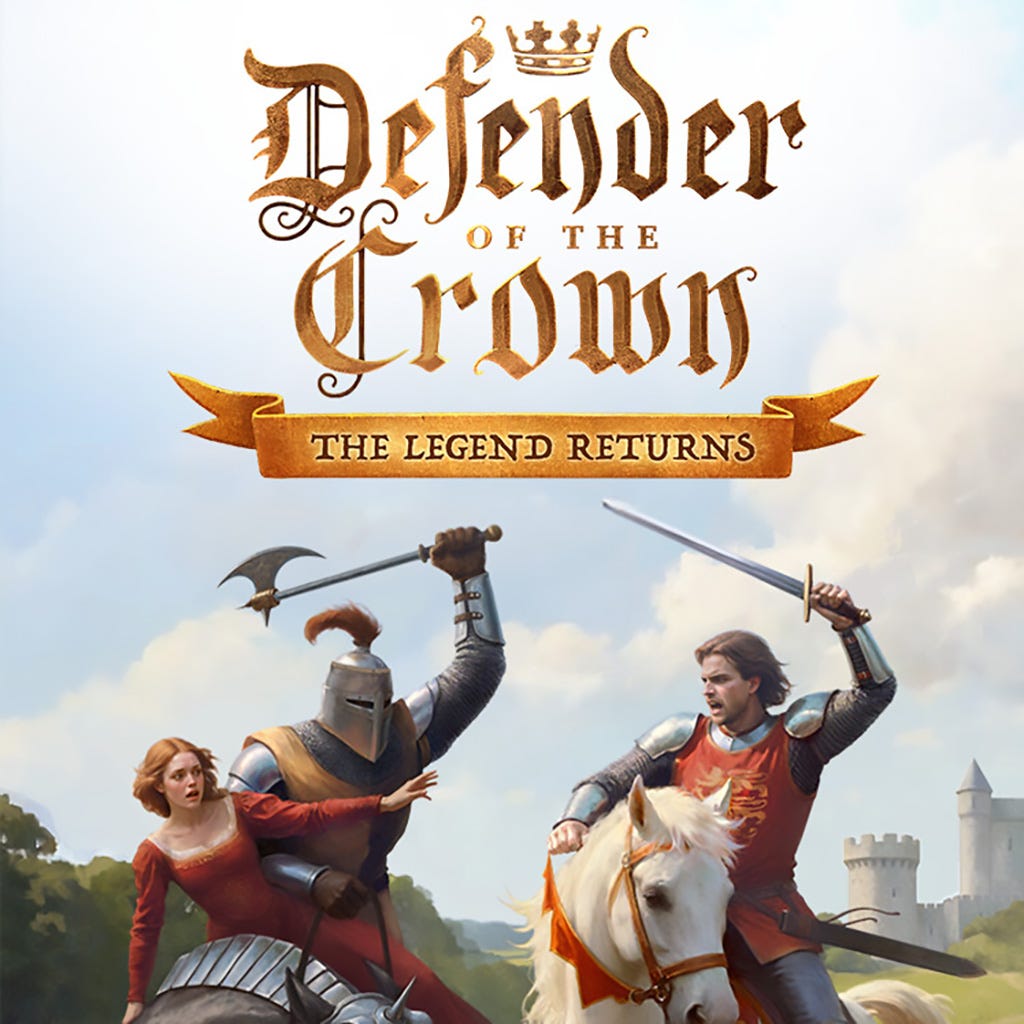
Some games simply refuse to disappear. They may have been surpassed by newer technology, outpaced by more complex mechanics, or left behind by shifting tastes, yet something about them remains lodged in memory. Defender of the Crown is one of those games. When Cinemaware released it for the Amiga in 1986, it felt genuinely different, blending strategy with spectacle in a way that made a computer game feel almost cinematic. Forty years later, Defender of the Crown: The Legend Returns arrives with the unenviable task of reviving that experience without sanding away the personality that made the original so memorable.
The good news is that this is not merely a fresh coat of paint. Developed by Black Tower Basement and published by Nordcurrent Labs, The Legend Returns recognises that there are several reasons people might want to return to Defender of the Crown. Some will want the original experience, warts and all, while others will expect something that feels comfortable on modern hardware. Then there are players discovering the series for the first time, who need more than nostalgia to keep them interested. By offering Retro, Classic and Kingdom modes, the game addresses all three audiences without pretending that the past and present need to be identical.
A Kingdom Worth Remembering
The premise remains wonderfully straightforward. England is fractured, rival factions are fighting for control, and you must carve out your own kingdom through conquest, diplomacy and sheer force of arms. Territories need to be captured, armies have to be raised, and castles must be defended or assaulted when the opportunity arises. There is an appealing simplicity to the strategic layer, particularly when compared with modern grand strategy games that can bury players beneath spreadsheets before they have even moved their first unit.
Yet that simplicity is part of Defender of the Crown’s charm. The game was never really about presenting a historically exhaustive simulation of medieval England. Instead, it was about making the player feel like a medieval ruler. One minute you are deciding where to expand your influence, the next you are preparing for a castle siege or entering a jousting tournament. It is a theatrical approach to strategy, and The Legend Returns preserves that sense of occasion surprisingly well.
Retro Mode
For long-time fans, Retro Mode is arguably the most important part of the package. This is where The Legend Returns acknowledges that sometimes the best way to celebrate an old game is simply to let it be itself. The original Amiga presentation remains wonderfully distinctive, with its chunky visuals, period audio and unmistakable sense of 1980s computer-game ambition.
What makes the preservation particularly valuable is knowing the original is not hidden behind the modern presentation. You can experience the game in something much closer to its original form while benefiting from sensible modern conveniences. Controller support and quick saving make returning to a game designed for a very different era considerably less cumbersome, without fundamentally changing what made it tick.
There is an almost nostalgic warmth to Retro Mode that cannot be manufactured by simply applying a filter to a modern game. The limitations become part of the experience. The visuals leave plenty to the imagination, while the soundtrack and presentation have that wonderfully earnest quality that defined so many ambitious Amiga games. For anyone who remembers when Defender of the Crown felt like a glimpse into the future, this mode is likely to be the closest thing to stepping through a time machine.
Classic Mode
Classic Mode is where The Legend Returns starts to make its own case. Rather than simply reproducing the original, this version takes the familiar foundations and rebuilds them for modern displays and expectations. The visuals are considerably cleaner, menus are easier to navigate, and the overall experience feels less like a museum piece and more like a game that belongs on today’s hardware.
The important thing is that the modernisation does not completely overwhelm the underlying character. Defender of the Crown still feels like Defender of the Crown. Territories remain important, armies still need to be managed, and the game’s various activities continue to break up the strategic campaign. The improved presentation simply makes it easier to appreciate the ideas beneath the ageing technology.
The pacing also benefits from refinement. The original was a product of its time, and some of its systems can feel rather primitive when approached without the rose-tinted glasses of nostalgia. Classic Mode smooths some of those rough edges without turning the game into something unrecognisable. It is probably the mode that best demonstrates why the original formula still has value beyond historical curiosity.
Kingdom Mode Changes the Rules
Kingdom Mode is the boldest addition and, in many respects, the most interesting. Rather than simply extending the original campaign, it introduces a more modern roguelite structure built around procedural maps, dice mechanics, cards and unlockable abilities. This changes the rhythm considerably, encouraging experimentation rather than simply attempting to recreate a familiar route to victory.
There is a satisfying unpredictability to the system. Your army composition influences the dice available to you, while cards can help manipulate the outcome of battles or give you opportunities to recover from a poor roll. Suddenly, victory is not always about having the biggest army. Sometimes it is about knowing when to take a risk, when to conserve resources and when to use a particular ability to turn an uncertain situation in your favour.
The roguelite structure also gives the game something the original inevitably struggled with: longevity. Once you understood the systems of the 1986 release, subsequent campaigns could become increasingly familiar. Kingdom Mode introduces enough variables to keep you wondering what the next run will bring. Procedural encounters and unlockable abilities provide a reason to keep experimenting, even after you have conquered England several times.
That said, Kingdom Mode will not necessarily appeal to everyone. Players coming specifically for the traditional territory-based strategy of Defender of the Crown may initially find the randomness distracting. Dice and cards introduce a layer of chance that was not the central appeal of the original. For me, the important distinction is that this mode does not replace the classic experience. It sits alongside it, allowing The Legend Returns to explore what Defender of the Crown might look like if it were designed for today’s appetite for replayable runs.
The Games Within the Game
One of the most enjoyable aspects of Defender of the Crown has always been its willingness to break up the strategy with different activities, and The Legend Returns recognises that this variety remains essential. Castle sieges are still dramatic affairs, while jousting offers a welcome change of pace from moving armies around the map. Raiding enemy territory and pursuing other opportunities add further texture to the campaign.
These elements might seem almost quaint compared with the enormous systems found in modern strategy games, but that is exactly why they work. Defender of the Crown has never tried to simulate every detail of medieval warfare. Instead, it picks moments that feel exciting and lets the player participate in them. There is something wonderfully direct about launching a siege or preparing for a joust rather than simply watching numbers change on a spreadsheet.
The Legend Returns benefits enormously from retaining that structure. It gives the campaign personality and prevents the strategic layer from becoming an endless sequence of menus and map movements. Even when individual activities are relatively simple, they contribute to the larger fantasy of being a ruler fighting to establish a kingdom.
A Beautiful Piece of History
Visually, the contrast between the three modes is one of the game’s strongest ideas. Retro Mode shows how far technology has come, while Classic Mode demonstrates how effectively the same basic concepts can be presented today. Neither approach invalidates the other.
There is also a broader lesson here about remasters. The Legend Returns does not seem embarrassed by its origins. It embraces the fact that Defender of the Crown was an unusual game for its era, one that sought to make players feel as much as to think strategically. That ambition remains visible beneath every updated texture, interface improvement and modern control option.
The soundtrack and atmosphere remain central to that identity. Medieval strategy games can easily become dry affairs, but Defender of the Crown has always possessed a sense of drama. The Legend Returns carries that forward rather than turning the experience into a sterile strategy exercise.
Does the Legend Still Stand?
After four decades, Defender of the Crown inevitably shows its age in places. Some systems are surprisingly basic by modern standards, and anyone expecting the complexity of a contemporary grand strategy title may find the campaign lightweight. Kingdom Mode adds depth and replayability, but its reliance on procedural systems and randomness may not satisfy players seeking a pure strategic experience.
However, those limitations are part of the game’s appeal. The Legend Returns works best when approached on its own terms. It is not trying to compete with the biggest strategy games on the market. It celebrates a very specific kind of game design, one where strategy, arcade action and cinematic presentation can comfortably sit alongside each other.
Most importantly, it feels like a celebration rather than a cynical resurrection. There is genuine affection for the original here, and that affection is evident in the decision to preserve it alongside the modern interpretation. Giving players three distinct ways to experience the concept is a smart approach because it recognises that nostalgia alone is not enough, but neither is modernisation for its own sake.
The Final Verdict
Defender of the Crown: The Legend Returns is a thoughtful revival of a fascinating piece of gaming history. Retro Mode lets veterans revisit the original, Classic Mode offers a more accessible, polished interpretation, while Kingdom Mode gives the formula an entirely new lease of life with procedural maps, dice and roguelite progression.
It is not perfect, and some underlying mechanics inevitably feel simpler than in a modern strategy game. Yet that simplicity is part of what makes the experience so approachable. There is a directness to conquering territory, raising an army and riding into battle that remains appealing, particularly when the game surrounds those mechanics with enough personality to make the kingdom feel like somewhere rather than simply another collection of statistics.
Four decades on, Defender of the Crown still has something to say. More importantly, The Legend Returns gives it a platform from which a new audience can actually hear it.