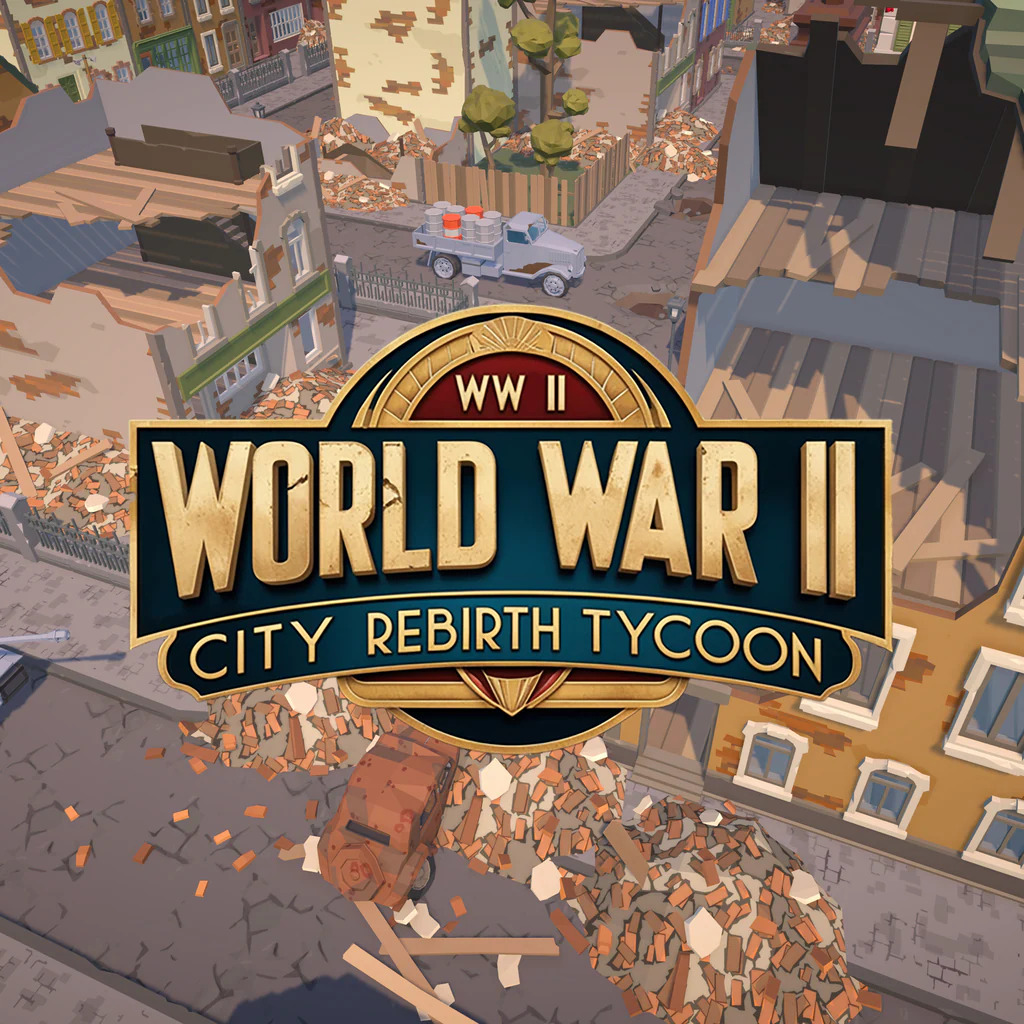
City builders often invite us to play architect, economist, and benevolent overlord all at once, but World War II City Rebirth Tycoon asks something slightly different: to play historian. MagicPro’s strategy-simulation hybrid drops players into a scarred post-1945 European landscape and tasks them with knitting a broken city back together—one low-poly brick at a time. It’s a thoughtful premise with flashes of genuine depth, though the execution sometimes struggles to rise above its modest foundations.
Picking Through the Rubble
The game opens with a panorama of devastation: crumbling factories, half-standing apartments, roads that lead nowhere. As newly appointed mayor, you inherit not just ruins but a population wrestling with unemployment, shortages, and the lingering trauma of war. Rather than the usual “blank canvas” approach of the genre, you’re handed a wounded organism that needs triage before it can dream of prosperity.
Early hours are spent clearing debris, restoring basic utilities, and erecting emergency housing. The familiar zoning trinity—residential, commercial, industrial—returns, yet feels grounded by context. Building a factory isn’t just about profit margins; it represents jobs for demobilized soldiers and stability for families living on ration cards.
MagicPro deserves credit for weaving historical flavor into mechanical systems. Random events reference black-market scandals, refugee influxes, or ration protests. These aren’t window dressing; they meaningfully affect morale and budgets, forcing difficult choices that echo real post-war dilemmas.
Strategy in Small Pieces
Visually, the game adopts a clean low-poly aesthetic. Buildings resemble carefully crafted miniatures, and the restrained art direction avoids the grim photorealism that could have made the subject matter oppressive. Instead, there’s a model-railway charm to watching trams rattle past pastel tenements while a gentle period-inspired soundtrack hums along.
Mechanically, City Rebirth Tycoon sits somewhere between accessible casual builder and hardcore management sim. Resource allocation is the central tension. Steel, timber, and coal arrive in limited shipments; spend too freely and reconstruction grinds to a halt. Do you prioritize a hospital to curb disease, or a power plant to stimulate industry? Such trade-offs form the game’s most engaging moments.
Population management adds another layer. Citizens have needs—employment, housing quality, leisure—and neglect breeds unrest. A happiness meter looms like a moral compass, reminding you that spreadsheets represent people. At its best, the game captures that delicate post-war balancing act between compassion and cold arithmetic.
Historical Headwinds
Where the experience shines brightest is in its scenario design. Campaign chapters introduce specific challenges: rebuilding after a catastrophic flood, negotiating with occupying authorities, or coping with sudden waves of displaced citizens. These episodes lend narrative momentum absent from many sandbox peers.
However, the portrayal remains broad rather than nuanced. Political upheavals are reduced to simple modifiers, and the cultural complexity of post-war Europe rarely surfaces. You won’t grapple with ideological divides, black-market economies, or the ethical shadows of collaboration—topics that could have added bite to the simulation.
Still, the tone stays respectful, avoiding gamified trivialization of tragedy. The focus remains on recovery and resilience rather than warfare itself, a perspective that feels refreshing.
Foundations That Need Reinforcement
For all its thoughtful ideas, the nuts and bolts occasionally creak. The user interface is functional but clunky, hiding vital information behind nested menus. Tooltips can be vague, leaving newcomers guessing why a district stagnates. Tutorialization is minimal; expect trial and error before systems click.
AI behavior also wobbles. Traffic logic produces inexplicable jams, and service vehicles sometimes ignore obvious routes. Economic balance swings between generous surpluses and punishing deficits with little warning. Veterans of the genre may weather these quirks, but casual mayors could feel unfairly scolded.
Content variety is another weak point. Building types are limited, and visual upgrades are mostly cosmetic recolors. After several hours, cities begin to resemble one another, lacking the personality seen in genre leaders. A deeper tech tree or architectural diversity would have helped convey decades of transformation rather than a few static years.
The Human Scale
Yet amid the rough edges, moments of quiet satisfaction emerge. Watching a bombed boulevard evolve into a lively shopping street genuinely feels earned. A notification announcing the birth rate finally outpacing mortality carries unexpected emotional weight. The game understands that rebuilding isn’t just about concrete but confidence.
Multiplayer and mod support are absent, narrowing longevity, but the core campaign offers a solid 12–15 hours. Sandbox mode allows experimentation with fewer historical constraints, though it also exposes systemic limitations more starkly.
Who Should Rebuild?
World War II City Rebirth Tycoon will appeal most to players who enjoy contemplative management rather than explosive expansion. It lacks the mechanical depth of Cities: Skylines or the narrative punch of Frostpunk, but occupies a gentler middle ground where empathy matters as much as efficiency.
MagicPro’s project feels like a promising blueprint rather than a finished monument—full of heart, occasionally fragile, yet built on meaningful intentions. With patches and expanded content, it could mature into something special.
Verdict
A respectful and occasionally moving city builder that treats reconstruction as a human story, World War II City Rebirth Tycoon offers engaging strategy wrapped in modest presentation. Its systems don’t always support its ambitions, but the act of turning ruins into neighborhoods remains quietly compelling.