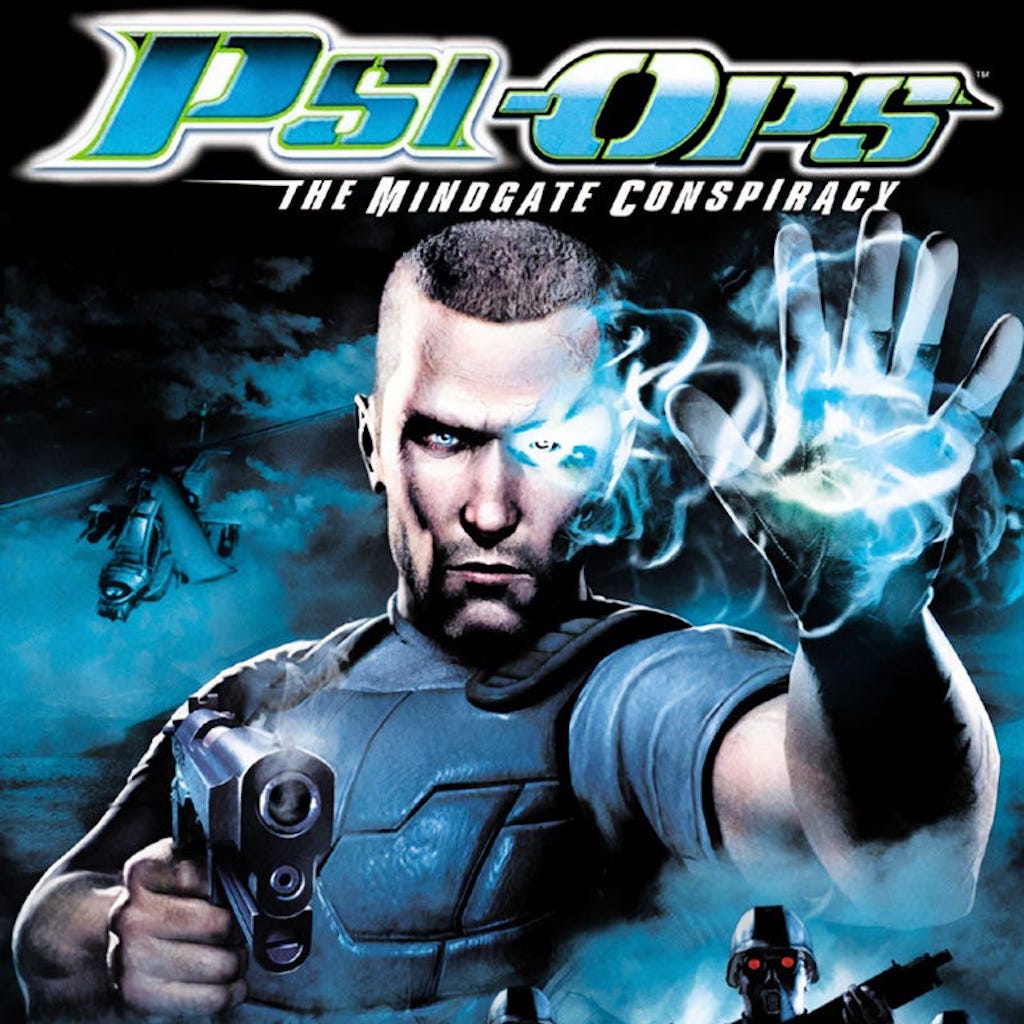
Some games become classics because they sell millions of copies. Others earn that status quietly, gathering a devoted following over the years as players realise they experienced something genuinely special. Psi-Ops: The Mindgate Conspiracy belongs firmly in the second category. Released by Midway in 2004, it arrived at a time when military shooters and action games were flooding the market, yet it somehow carved out its own identity with a simple question: what if your greatest weapon wasn’t your gun, but your mind?
Looking back more than two decades later, it’s remarkable how many ideas Psi-Ops explored long before they became mainstream. Games such as Control and Star Wars Jedi: Fallen Order have since refined telekinetic combat, yet Nick Scryer’s psychic arsenal still feels refreshingly inventive. While its story occasionally slips into familiar conspiracy-thriller territory and its visuals inevitably show their age, the sheer joy of experimenting with supernatural abilities remains as entertaining today as it was when the game first appeared.
Psi-Ops may wear the clothes of a conventional third-person shooter, but beneath the surface beats the heart of an imaginative sandbox that encouraged players to be creative long before that became a genre expectation.
Building A Super Soldier
You step into the boots of Nick Scryer, a government operative whose memory has been deliberately erased before he is sent deep into the mysterious Mindgate Project. As Nick slowly uncovers fragments of his past, he also begins to rediscover extraordinary psychic abilities buried within his mind. The setup is hardly revolutionary, borrowing heavily from conspiracy films and espionage thrillers of the early 2000s, but it provides an effective way to drip-feed new powers throughout the campaign.
The supporting cast leans into exaggerated comic-book territory. General Grienko, the rogue organisation known as The Movement, and the collection of powerful psychic operatives known simply as The Six all possess memorable personalities, even if they sometimes border on Saturday-afternoon cartoon villains. That larger-than-life presentation actually works in the game’s favour, giving the adventure a pulpy charm that prevents it from taking itself too seriously.
The biggest disappointment comes right at the end. After investing hours in uncovering the mysteries surrounding Mindgate, the story concludes with an infamous cliffhanger, clearly designed to launch a sequel. Unfortunately, Midway’s financial struggles meant that the continuation never arrived, leaving one of gaming’s more frustrating unresolved endings.
Power Is More Fun Than Firepower
The true star of Psi-Ops has always been its gameplay. While Nick carries a respectable selection of conventional weapons, guns quickly become secondary once psychic abilities unlock. Each new power dramatically changes how encounters unfold, encouraging experimentation rather than repetitive shooting.
Telekinesis is the headline attraction, and even today it remains immensely satisfying. Powered by the Havok physics engine, players can lift almost anything within reach, including explosive barrels, crates, furniture, and, perhaps most amusingly, enemy soldiers. Picking up an unfortunate guard, spinning him helplessly through the air before launching him into his equally unfortunate colleagues never loses its appeal. The physics may appear dated by modern standards, but they remain surprisingly convincing thanks to the game’s commitment to making every object feel part of the battlefield.
Mind Control adds another entertaining layer of chaos. Rather than eliminating enemies directly, Nick can briefly possess them, forcing them to attack their own allies before returning to reality. Watching confused soldiers suddenly turn on one another creates memorable encounters that rarely play out the same way twice.
Pyrokinesis offers pure spectacle. Setting enemies ablaze, igniting explosive hazards, or turning entire rooms into fiery death traps delivers exactly the sort of over-the-top action the game thrives on. Meanwhile, Remote Viewing allows players to scout dangerous areas before entering, adding an unexpected tactical element that rewards careful planning alongside reckless destruction.
Each ability feels useful, and more importantly, they combine beautifully. It isn’t simply about choosing one power over another. The real magic lies in layering them creatively, producing encounters that feel uniquely your own.
Every Room Is A Playground
What separates Psi-Ops from many action games of its era is the freedom it affords players. Levels are often designed as interactive spaces rather than linear shooting galleries. Environmental hazards, explosive objects, movable machinery, and multiple routes through combat arenas all encourage improvisation.
One player might quietly mind-control a guard to clear a path. Another might hurl heavy crates like wrecking balls before finishing off survivors with an assault rifle. Someone else may simply decide that launching every enemy off a nearby platform is the most efficient solution. None of these approaches feel wrong because the game actively celebrates player creativity.
Puzzle design follows a similar philosophy. Psychic abilities are regularly used outside combat, prompting players to manipulate machinery, move obstacles, or access otherwise unreachable areas. These moments prevent the campaign from becoming a relentless procession of firefights, giving each new environment a welcome sense of variety.
The pacing remains one of the game’s greatest strengths. New abilities arrive steadily enough that the experience rarely feels repetitive, constantly introducing fresh opportunities to rethink familiar situations.
A Product Of Its Time
Returning to Psi-Ops today also highlights some unavoidable signs of its age. Character models are angular, facial animation is limited, and environmental textures often appear flat by modern standards. Military bases, laboratories, and industrial compounds dominate much of the adventure, resulting in environments that occasionally blend together visually.
Voice acting varies in quality, although Nick himself remains a likeable protagonist thanks to his understated performance. The soundtrack delivers suitably dramatic orchestral themes without becoming particularly memorable, allowing the explosive gameplay to take centre stage.
Controls have aged better than expected, although certain camera angles can become awkward during more frantic psychic encounters. Modern players accustomed to smoother third-person camera systems may need a short adjustment period before everything feels natural.
Despite these shortcomings, the game’s presentation retains a distinctive identity. The visual effects accompanying psychic powers still create an impressive sense of impact, while the Havok physics continue to provide countless unscripted moments that keep combat entertaining long after prettier games have faded from memory.
The Legacy It Deserved
Perhaps the greatest tragedy surrounding Psi-Ops is that it never became the franchise it clearly aspired to be. Released during an exceptionally competitive period and overshadowed by larger blockbuster titles, it struggled commercially despite receiving positive critical attention.
In hindsight, its influence feels far greater than its sales figures suggest. Many of the mechanics players celebrate in modern action games can trace their DNA to ideas Psi-Ops embraced years earlier. The emphasis on environmental interaction, creative combat, and physics-driven problem-solving now feels remarkably forward-thinking.
It also serves as a reminder of an era when publishers were more willing to experiment with ambitious mid-budget projects. Psi-Ops may lack the enormous production values of today’s biggest releases, but it compensates with confidence, originality, and a willingness to trust players to have fun on their own terms.
Final Verdict
Psi-Ops: The Mindgate Conspiracy remains one of gaming’s greatest overlooked action-adventures. Its conspiracy-driven narrative may not break new ground, and its infamous cliffhanger still stings years later, but neither issue can overshadow how enjoyable its psychic combat remains.
Telekinesis, mind control, pyrokinesis, and the rest of Nick Scryer’s supernatural toolkit turn every encounter into an opportunity for experimentation rather than routine gunplay. The impressive Havok physics system continues to enable emergent gameplay that feels surprisingly fresh, even decades after release.
While modern audiences may notice ageing visuals and occasional mechanical rough edges, the core experience still has an infectious sense of fun that many contemporary action games struggle to match. Psi-Ops was ahead of its time, and that forward-thinking design ensures it remains well worth revisiting.