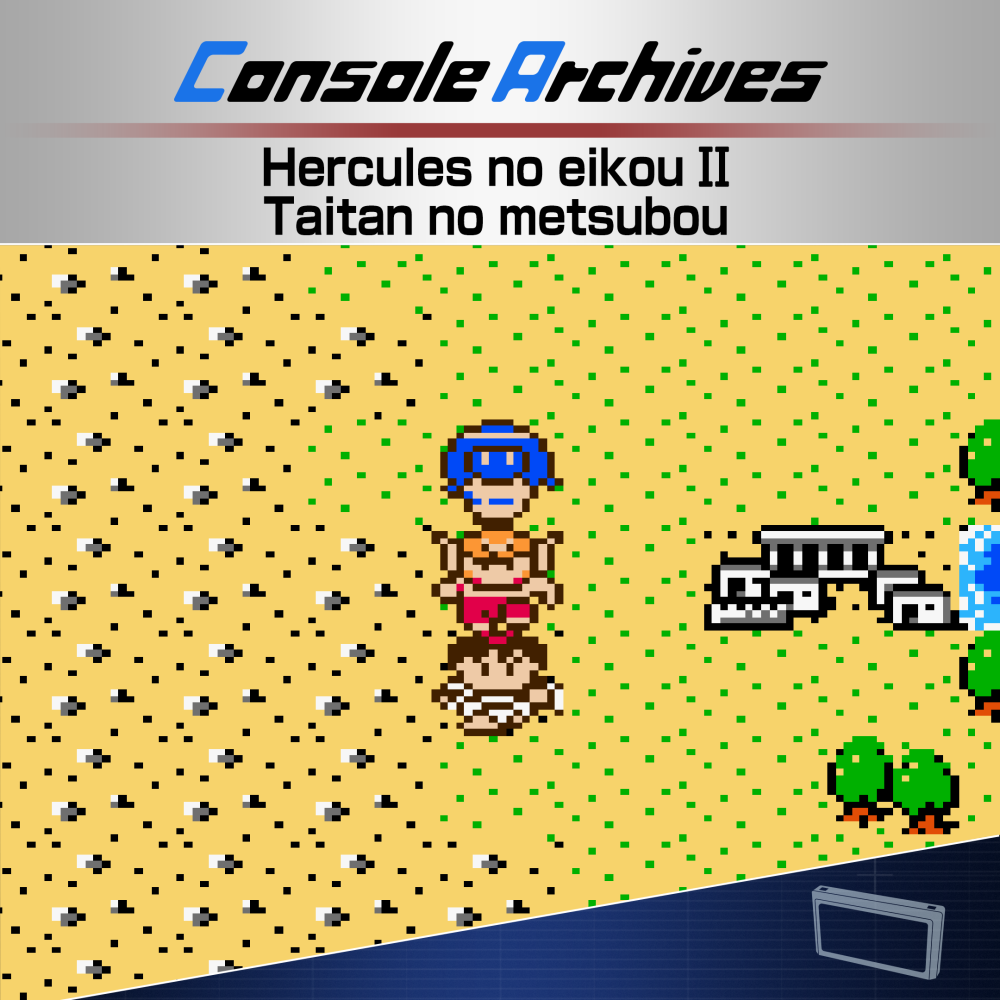
Retro role-playing games have enjoyed something of a renaissance in recent years. Modern developers continue to draw on their simple mechanics, charming visuals and adventurous spirit, while publishers have become increasingly interested in preserving gaming history for new audiences. Yet despite this growing appreciation for the genre, countless Japanese exclusives have remained locked away for decades, known only through magazine scans, fan translations and whispered recommendations among dedicated enthusiasts. Console Archives: Hercules no Eikou II: Taitan no Metsubou finally gives one of those hidden classics another chance to shine.
Originally released by Data East in 1989 for the Famicom, Hercules no Eikou II arrives on modern platforms through HAMSTER Corporation’s Console Archives initiative. Rather than rebuilding or remastering the game, this release focuses on preservation. The original experience remains largely untouched, complete with its authentic visuals, music and gameplay systems, while modern conveniences such as save states, display options and controller customisation make revisiting this slice of gaming history considerably more approachable.
That authenticity is both the game’s greatest strength and its greatest obstacle. Hercules no Eikou II remains every bit as ambitious a role-playing adventure as it was nearly four decades ago, but it also carries many of the design philosophies that defined the era. Players willing to embrace those old-fashioned mechanics will discover an adventure full of charm, imagination and surprising personality, even if it occasionally asks for a little more patience than modern audiences may be accustomed to.
A Different Kind of Fantasy
One of the first things that sets Hercules no Eikou II apart is its setting. While many role-playing games of the late eighties drew heavily on medieval fantasy traditions inspired by European folklore, Data East looked to ancient Greek mythology instead. The result feels refreshing, even today.
Rather than dragons, castles and knights dominating every corner of the world, players travel through landscapes inspired by classical myths, encountering legendary creatures and familiar figures from Greek mythology. There is something wonderfully distinctive about battling monsters rooted in ancient mythology rather than yet another collection of generic fantasy beasts.
The story itself follows a classic heroic structure. Dark forces seek to awaken the Titans and plunge the world into chaos, leaving an unlikely hero to gather companions and restore peace. It may not reinvent storytelling, but it delivers its adventure with sincerity and confidence, creating a world that feels surprisingly rich despite the obvious technical limitations of the hardware.
For players discovering this game for the first time, its mythological setting offers a welcome change of pace that helps distinguish it from many of its contemporaries.
A Traditional Journey Through an Eight Bit World
The gameplay will immediately feel familiar to anyone who has spent time with early Japanese role-playing games. Exploration unfolds across an expansive overworld, where towns, caves and ancient ruins gradually reveal themselves as your party grows stronger.
Combat adopts the classic first-person perspective popularised in that era. Encounters are entirely turn-based, requiring players to balance physical attacks, healing magic and limited resources while slowly building enough strength to overcome increasingly dangerous enemies.
These systems have an undeniable simplicity, yet they remain surprisingly engaging. Battles move at a brisk pace, and progression follows a satisfying rhythm of exploration, discovery and gradual character improvement. Every new town offers opportunities to buy stronger equipment, uncover useful information or recruit valuable companions.
The pacing encourages curiosity. Rather than filling the world with objective markers and highlighted destinations, the game expects players to speak with villagers, investigate their surroundings and piece together clues by observing. While this approach can occasionally feel cryptic, it also creates a genuine sense of adventure that many modern role-playing games struggle to replicate.
Companions Worth Remembering
Perhaps the game’s most memorable feature is its wonderfully unusual party. Rather than relying on familiar fantasy archetypes, Hercules no Eikou II assembles a cast that reflects its mythological inspiration.
Throughout the journey, you recruit companions ranging from centaurs to living bronze statues, alongside several other unexpected allies. Each character brings unique abilities and combat roles, encouraging players to think carefully about party composition rather than relying solely on boosting statistics.
These companions also help reinforce the game’s identity. Rather than feeling like another imitation of Dragon Quest, Hercules no Eikou II establishes its own personality through the creatures and legends that populate its world. Even today, those choices give the adventure a distinctive flavour that lingers long after the credits roll.
While character development remains relatively limited by modern standards, the sheer originality of the cast lends plenty of charm throughout the adventure.
Preservation Done with Care
HAMSTER deserves considerable praise for the quality of this re-release. The company has built an excellent reputation through its Arcade Archives line, and that same attention to detail is evident here.
Players can save and reload progress at any time, making difficult dungeon sections and unexpected defeats far less punishing than in 1989. Customisable display filters allow players to recreate the look of an old CRT television or enjoy razor-sharp pixel presentation on modern displays.
Button remapping offers welcome flexibility, while performance remains rock-solid throughout. The original soundtrack has also been beautifully preserved, with cheerful eight-bit melodies sounding crisp and vibrant on modern hardware.
The inclusion of translated manuals and menus is another thoughtful touch. Although the game itself still uses the original Japanese ROM, the supplementary material makes the mechanics considerably easier for international players to understand. It is preservation rather than reinvention, which feels entirely appropriate for a project dedicated to celebrating gaming history.
A Product of Its Time
As much as Hercules no Eikou II deserves recognition, it also demands honesty about its limitations. This is unmistakably a role-playing game from the late eighties, complete with all the frustrations that accompanied the genre at the time.
Random encounters occur frequently, sometimes interrupting exploration every few steps. Progress often depends on spending significant time defeating enemies simply to gain enough experience for the next major challenge. Players raised on modern quality-of-life improvements may find the pacing difficult to adjust to.
The lack of translated in-game text will also prove challenging for some audiences. Although the accompanying documentation explains many mechanics, navigating story scenes and conversations still requires either familiarity with Japanese or a willingness to rely on outside resources.
None of these issues diminish the historical importance of the release, but they are important considerations for newcomers expecting a more accessible modern remake.
More Than Nostalgia
What makes Hercules no Eikou II fascinating is not merely its age. Many retro games exist purely as nostalgic curiosities, remembered more for their age than for their quality. This adventure feels different because its creativity still shines through.
Its setting remains distinctive. Its world invites exploration. Its unusual companions continue to surprise, and its willingness to embrace mythology gives it a personality many modern fantasy games still lack.
Playing it today also offers an appreciation of how far role-playing games have evolved. Systems that now feel commonplace were once ambitious innovations, and many mechanics introduced during this era laid the groundwork for generations of adventures that followed. Rather than being a museum piece gathering dust, Hercules no Eikou II still manages to entertain players willing to meet it on its own terms.
Final Verdict
Console Archives: Hercules no Eikou II: Taitan no Metsubou is exactly the kind of release that preservation initiatives should celebrate. It rescues an overlooked chapter of role-playing history without compromising its original identity, allowing a new audience to experience a fascinating adventure that had previously remained out of reach for most Western players.
Its age inevitably brings frustrations. High encounter rates, occasional grinding, cryptic progression and untranslated game text create barriers that many modern releases have long since abandoned. Yet those willing to look beyond those limitations will find an imaginative journey built on a uniquely distinctive mythological foundation.
HAMSTER has once again shown that preserving gaming history matters as much as creating it. Hercules no Eikou II may not enjoy the worldwide recognition of Dragon Quest or Final Fantasy, but it deserves its place alongside the forgotten pioneers who helped shape the role-playing genre.
For retro enthusiasts and historians alike, this is more than just another re-release. It is an opportunity to experience a long-lost adventure that still possesses the heart, ambition and imagination that made the golden age of Japanese role-playing games so special.