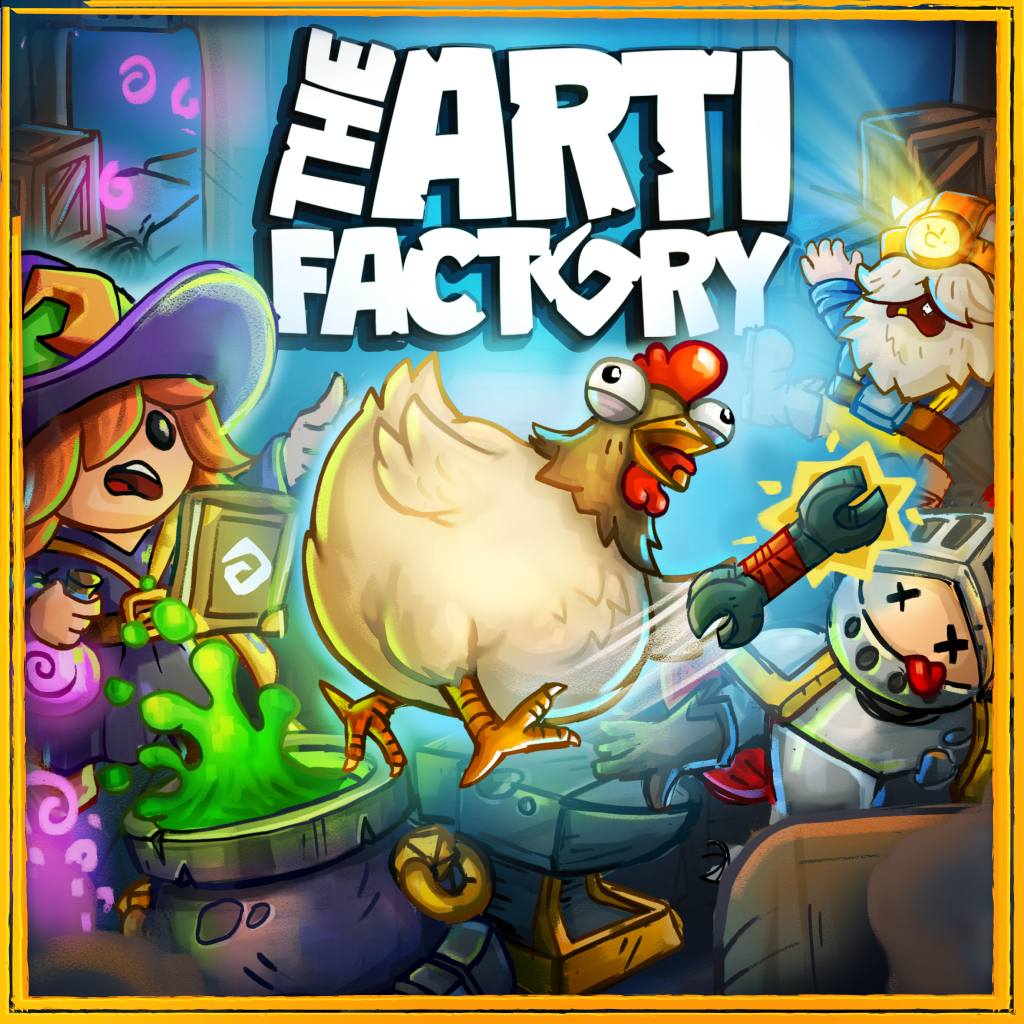
Factory games have traditionally been about efficiency. They ask players to optimise every conveyor belt, calculate production ratios, and slowly build sprawling industrial empires capable of processing unimaginable quantities of resources. While that formula has produced some outstanding experiences over the years, it can also feel intimidating for newcomers. The Artifactory takes a very different approach. Rather than drowning players in spreadsheets and logistics charts, it strips the concept down to its most accessible elements and rebuilds it as a lively cooperative party game.
Developed with local multiplayer firmly in mind, The Artifactory combines factory management, crafting, puzzle-solving, and frantic teamwork into a colourful package that feels equally comfortable at a family game night or an evening with friends. It is not trying to compete with the complexity of automation giants. Instead, it focuses on communication, creativity, and the simple joy of working together under pressure. The result is one of the most charming cooperative experiences to arrive this year.
Building a Better Production Line
The premise is wonderfully straightforward. You and your fellow workers are tasked with keeping a magical factory running efficiently. Orders arrive, materials need collecting, recipes must be completed, and delivery trucks refuse to wait for excuses. Every second counts as players rush around gathering ingredients, passing items between stations, and ensuring finished products reach their destination before time runs out.
At first glance, the objectives seem simple enough. Gather resources, craft the required items, and load them onto outgoing trucks. The beauty of The Artifactory lies in how quickly these simple tasks evolve into organised madness. As new mechanics are introduced, production lines grow increasingly complex. Suddenly players are juggling multiple ingredient chains while avoiding obstacles, navigating moving platforms, and coordinating deliveries in limited space and time.
The game understands that chaos is often the source of the best multiplayer memories. Few things are funnier than watching a perfectly functioning production line collapse because someone accidentally picked up the wrong ingredient or blocked a critical conveyor route. The Artifactory embraces these moments rather than punishing them too harshly.
Teamwork Above All Else
Communication sits at the heart of every successful shift. While solo play is supported and remains enjoyable, the game truly comes alive when several people share responsibility for keeping the factory moving. One player might focus on collecting resources while another handles assembly. A third may be responsible for transportation, while someone else manages deliveries.
The challenge lies in the fact that every role is interconnected. If one person falls behind, the entire operation begins to suffer. Conveyor belts become clogged, ingredients pile up in the wrong places, and valuable seconds disappear as everyone scrambles to restore order.
What makes this particularly satisfying is how naturally teams develop strategies. Early levels often feel chaotic as players stumble through objectives. By the time you reach later stages, groups start assigning responsibilities and establishing workflows almost instinctively. There is genuine satisfaction in watching a previously disorganised team evolve into a highly efficient production machine.
The game constantly encourages cooperation without making failure feel discouraging. Mistakes are part of the experience, and many of the funniest moments emerge from spectacular logistical disasters.
Discovery Through Experimentation
One of The Artifactory’s strongest ideas is its recipe discovery system. Rather than presenting every crafting option at once, players are encouraged to experiment with different material combinations. New discoveries gradually unlock additional production possibilities and create opportunities for more efficient workflows.
This system adds a welcome layer of curiosity to the experience. Each newly discovered recipe feels like a small reward, encouraging players to continue exploring the game’s mechanics. It also prevents the gameplay from becoming too repetitive, as there is always the possibility of uncovering a more effective solution.
As a result, the sense of progression feels organic. Instead of simply moving from one level to the next, players gradually develop a deeper understanding of how the factory operates. New recipes become tools that can completely change how you approach future challenges.
There is something immensely satisfying about discovering a shortcut that dramatically improves productivity. The game consistently rewards creativity rather than forcing players into rigid solutions.
Clever Level Design
The Artifactory introduces new mechanics at a steady, thoughtful pace. Each stage is designed to teach a specific lesson before combining it with earlier challenges. Moving platforms, awkward conveyor arrangements, environmental hazards, and increasingly complex production requirements keep the gameplay fresh throughout.
Importantly, these additions rarely feel overwhelming. The difficulty curve is well judged, allowing players to learn naturally through experimentation. Even when levels become demanding, they remain approachable thanks to the game’s clear visual design and intuitive controls.
The environments themselves are wonderfully imaginative. Factories are filled with colourful machinery, moving mechanisms, and inventive layouts that constantly reshape how players interact with the space. No two stages feel identical, which helps maintain momentum across the campaign.
The variety also gives multiplayer sessions a strong sense of unpredictability. Just when you think your team has mastered the factory floor, the game introduces another wrinkle that forces everyone to rethink their strategy.
Bright, Charming and Accessible
Visually, The Artifactory embraces a cheerful, inviting aesthetic. The colourful environments are packed with personality without feeling cluttered. Important information remains easy to read, even when multiple players are running around the screen at once.
Character animations are expressive and playful, adding humour to the inevitable workplace disasters. Watching workers scramble to recover dropped materials or collide while rushing between stations adds charm to the experience.
The sound design deserves praise as well. Machines hum, conveyor belts rattle, and crafting stations buzz with satisfying feedback. The soundtrack maintains a light, upbeat energy that perfectly complements the game’s cooperative spirit. It keeps tension high enough to feel exciting without becoming stressful.
Accessibility is another area where the game performs well. The controls are straightforward, making it easy for newcomers to jump in. At the same time, the deeper layers of optimisation provide enough complexity to keep experienced players engaged.
A Few Missing Pieces
Despite its many strengths, The Artifactory is not without shortcomings. The biggest limitation is the lack of online multiplayer. In an era when many friends are separated by distance, confining the cooperative experience to local play inevitably limits the game’s audience.
While solo play works reasonably well, it cannot fully replicate the energy of a room full of players shouting instructions and celebrating successful deliveries. The game is clearly designed around human cooperation, and that is where it shines brightest.
Some players may also wish for a little more long-term content. The progression system is enjoyable, but experienced groups may want additional stages or challenge variants once they have mastered the existing content. The core mechanics are strong enough to support even more ambitious future expansions. Fortunately, these issues never overshadow what the game achieves. They simply leave you wishing there were more of it.
Final Verdict
The Artifactory succeeds because it understands exactly what kind of experience it wants to be. It does not chase overwhelming complexity or attempt to become the next hardcore factory simulator. Instead, it focuses on accessibility, cooperation, creativity, and fun.
Its recipe discovery system keeps players curious, its level design continually introduces fresh ideas, and its cooperative gameplay creates countless memorable moments. Whether you are coordinating with experienced gamers or introducing family members to multiplayer gaming, the factory floor consistently delivers laughter and excitement.
There are areas where the experience could be expanded, particularly regarding online play and long-term content, but the foundation is remarkably strong. The Artifactory is a joyful reminder that sometimes the best multiplayer games are not about competition at all. They are about working together, overcoming chaos, and celebrating success as a team.